How AI Is Rewriting the Future of Humanities Education


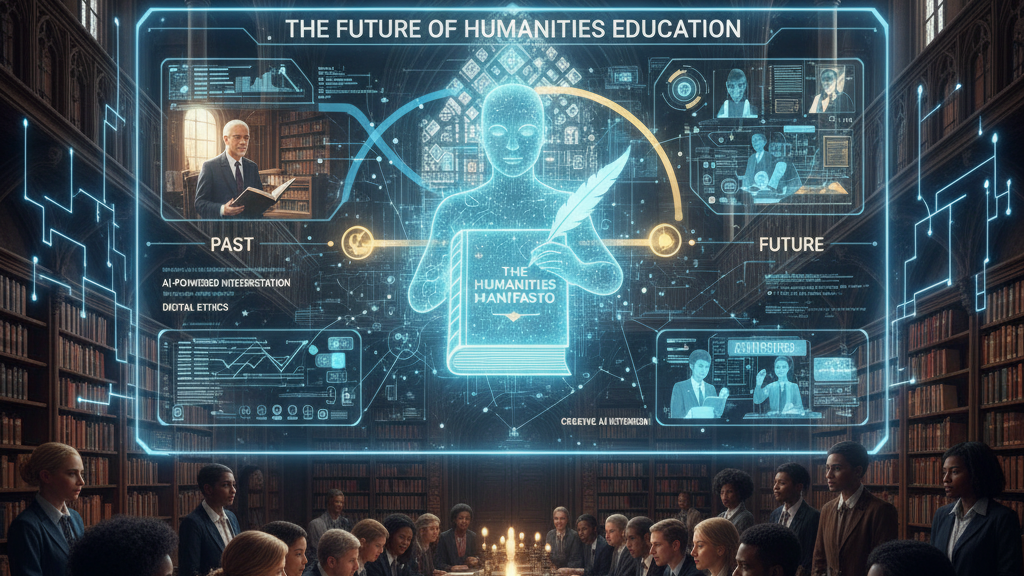
In a grand, ornate university library, a group of diverse students and professors are seated around a long, candlelit wooden table, engaged in a discussion. Above them, a large holographic display titled "THE FUTURE OF HUMANITIES EDUCATION" shows a central figure holding "THE HUMANITIES MANIFESTO" with a quill, flanked by "PAST" and "FUTURE" panels detailing AI-powered interpretation, digital ethics, and evolving roles of AI in humanities. Image (and typos) generated by Nano Banana.
Artificial intelligence is not merely influencing but actively “rewriting” the trajectory of humanities education, prompting a re-evaluation of its foundational principles and methodologies. This image captures a moment of deep academic reflection, visualizing how AI is introducing new tools for interpretation, posing ethical challenges, and ultimately shaping a dynamic new future for the study of human culture and thought. Image (and typos) generated by Nano Banana.

Source

Forbes

Summary

Mary Hemphill argues that while AI is rapidly changing technical and STEM fields, its impact on the humanities may be even more profound. She sees AI not just as a tool but a collaborator—helping students explore new interpretations, generate creative prompts, and push boundaries in writing, philosophy, or cultural critique. But this is double-edged: overreliance risks hollowing out the labour of thinking deeply, undermining the craft faculty value. Hemphill suggests humanities courses must adapt via “AI-native” pedagogy: teaching prompt literacy, interrogative reading, and critical layering. The goal: use AI to elevate human thinking, not replace it.

Key Points

  • Humanities may shift from sourcing facts to exploring deeper interpretation, guided by AI-assisted exploration.
  • Students should be taught prompt literacy—how to interrogate AI outputs, not accept them.
  • “AI-native” pedagogy: adaptation of assignments to expect AI use, layered with critical human engagement.
  • Overreliance on AI can weaken students’ capacity for independent thinking and textual craftsmanship.
  • Humanities faculty must lead design of AI integration that preserves the values of the discipline.

Keywords

URL

https://www.forbes.com/sites/maryhemphill/2025/10/01/how-ai-is-rewriting-the-future-of-humanities-education/

Summary generated by ChatGPT 5


You Can Detect AI Writing With These Tips


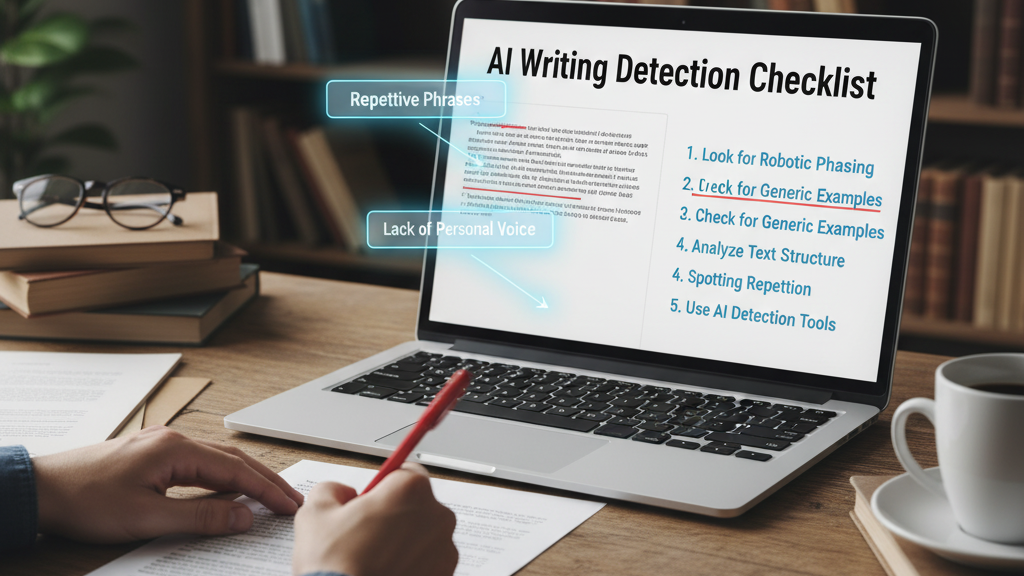
A person's hands are shown at a wooden desk, writing on a paper with a red pen. In front of them, a laptop displays an "AI Writing Detection Checklist" with tips like "Look for Robotic Phrasing," "Check for Generic Examples," and "Analyze Text Structure." Highlighted on the screen are examples of "Repetitive Phrases" and "Lack of Personal Voice," indicating common AI writing tells. A stack of books and a coffee cup are also on the desk. Image (and typos) generated by Nano Banana.
With the proliferation of AI-generated content, discerning human writing from machine-generated text has become an essential skill. This image presents practical tips and a checklist to help identify AI writing, focusing on common tells such as repetitive phrases, generic examples, and a lack of personal voice, empowering readers and educators to critically evaluate written material. Image (and typos) generated by Nano Banana.

Source

CNET

Summary

CNET offers a practical guide for spotting AI-generated writing. It highlights typical cues: prompts embedded openly in the text, overly generic or ambiguous language, unnatural transitions, repetition, and lack of depth or specificity. The article suggests that when a piece echoes the original assignment prompt too directly, that’s a red flag. While no single cue is definitive, combining several tells (tone flatness, formulaic structure, prompt residue) increases confidence that AI was involved. The aim isn’t accusation but raising readers’ critical sensitivity toward AI authorship.

Key Points

  • AI text often includes remnants of the assignment prompt verbatim.
  • It tends to use generic, vague, or ambivalent phrasing more often than human writers.
  • Repetitive patterns, smooth transitions, and “flat” tone are common signals.
  • Contextual depth, original insight, nuance, and emotional detail are often muted.
  • Use a cluster of clues rather than relying on one signal to infer AI writing.

Keywords

URL

https://www.cnet.com/tech/services-and-software/use-these-simple-tips-to-detect-ai-writing/

Summary generated by ChatGPT 5