AI: Are we empowering students – or outsourcing the skills we aim to cultivate?


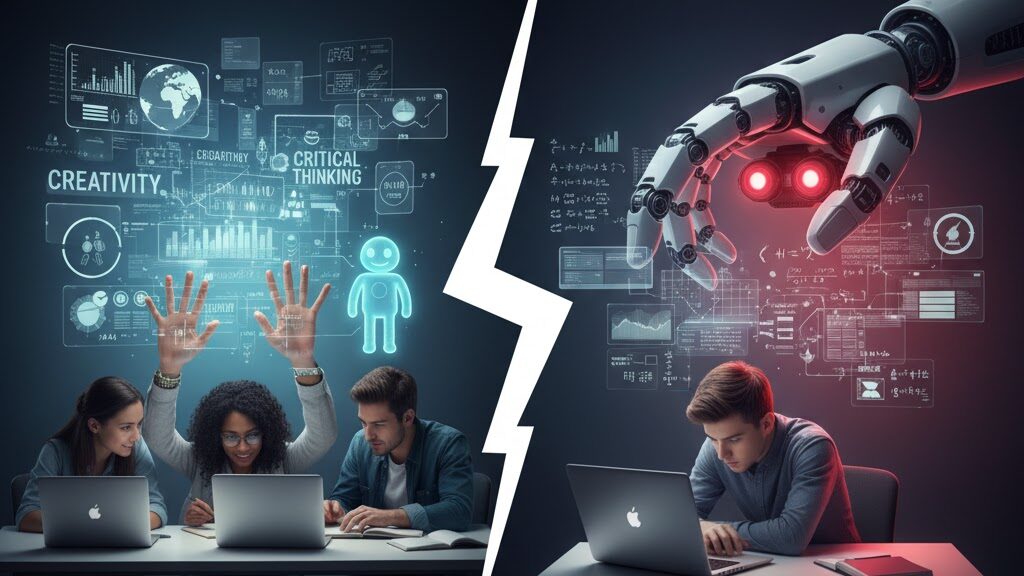
A stark split image contrasting two outcomes of AI in education, divided by a jagged white lightning bolt. The left side shows a diverse group of three enthusiastic students working collaboratively on laptops, with one student raising their hands in excitement. Above them, a vibrant, glowing display of keywords like "CRITICAL THINKING," "CREATIVITY," and "COLLABORATION" emanates, surrounded by data and positive learning metrics. The right side shows a lone, somewhat disengaged male student working on a laptop, with a large, menacing robotic hand hovering above him. The robot hand has glowing red lights and is connected to a screen filled with complex, auto-generated data, symbolizing the automation of tasks and potential loss of human skills. Image (and typos) generated by Nano Banana.
The rise of AI in education presents a crucial dichotomy: are we using it to truly empower students and cultivate essential skills, or are we inadvertently outsourcing those very abilities to algorithms? This image visually explores the two potential paths for AI’s integration into learning, urging a thoughtful approach to its implementation. Image (and typos) generated by Nano Banana.

Source

The Irish Times

Summary

Jean Noonan reflects on the dual role of artificial intelligence in higher education—its capacity to empower learning and its risk of eroding fundamental human skills. As AI becomes embedded in teaching, research, and assessment, universities must balance innovation with integrity. AI literacy, she argues, extends beyond technical skills to include ethics, empathy, and critical reasoning. While AI enhances accessibility and personalised learning, over-reliance may weaken originality and authorship. Noonan calls for assessment redesigns that integrate AI responsibly, enabling students to learn with AI rather than be replaced by it. Collaboration between academia, industry, and policymakers is essential to ensure education cultivates judgment, creativity, and moral awareness. Echoing Orwell’s warning in 1984, she concludes that AI should enhance, not diminish, the intellectual and linguistic richness that defines human learning.

Key Points

  • AI literacy must combine technical understanding with ethics, empathy, and reflection.
  • Universities are rapidly adopting AI but risk outsourcing creativity and independent thought.
  • Over-reliance on AI tools can blur authorship and weaken critical engagement.
  • Assessment design should promote ethical AI use and active, independent learning.
  • Collaboration between universities and industry can align innovation with responsible practice.
  • Education must ensure AI empowers rather than replaces essential human skills.

Keywords

URL

https://www.irishtimes.com/ireland/education/2025/10/29/ai-are-we-empowering-students-or-outsourcing-the-skills-we-aim-to-cultivate/

Summary generated by ChatGPT 5


AI and the future of education. Disruptions, dilemmas and directions


Source

UNESCO

Summary

This UNESCO report provides policy guidance on integrating artificial intelligence (AI) into education systems worldwide. It stresses both the opportunities—such as personalised learning, enhanced efficiency, and expanded access—and the risks, including bias, privacy concerns, and the erosion of teacher and learner agency. The document frames AI as a powerful tool that can help address inequalities and support sustainable development, but only if implemented responsibly and inclusively.

Central to the report is the principle that AI in education must remain human-centred, promoting equity, transparency, and accountability. It highlights the importance of teacher empowerment, digital literacy, and robust governance frameworks. The guidance calls for capacity building at all levels, from policy to classroom practice, and for international cooperation to ensure that AI use aligns with ethical standards and local contexts. Ultimately, the report argues that AI should augment—not replace—human intelligence in education.

Key Points

  • AI offers opportunities for personalised learning and system efficiency.
  • Risks include bias, inequity, and privacy breaches if left unchecked.
  • AI in education must be guided by human-centred, ethical frameworks.
  • Teachers remain central; AI should support rather than replace them.
  • Digital literacy for learners and educators is essential.
  • Governance frameworks must ensure transparency and accountability.
  • Capacity building and training are critical for sustainable adoption.
  • AI should contribute to equity and inclusion, not exacerbate divides.
  • International collaboration is vital for responsible AI use in education.
  • AI’s role is to augment human intelligence, not supplant it.

Conclusion

UNESCO concludes that AI has the potential to transform education systems for the better, but only if adoption is deliberate, ethical, and values-driven. Policymakers must prioritise equity, inclusivity, and transparency while ensuring that human agency and the role of teachers remain central to education in the age of AI.

Keywords

URL

https://www.unesco.org/en/articles/ai-and-future-education-disruptions-dilemmas-and-directions

Summary generated by ChatGPT 5