Most Teachers Rethinking How They Set Assignments Due to AI


A diverse group of eight teachers or educators are gathered around a conference table in a modern library or academic setting, engaged in a discussion. Two male teachers stand and point at a large, glowing holographic display above the table, which is split into two sections: "TRADITIONAL ASSIGNMENT DESIGN" and "AI-INTEGRATED PROJECTS." Each section contains pie charts, diagrams, and keywords like "CRITICAL THINKING," "HUMAN-AI COLLABORATION," and "ETHICS," illustrating a shift in pedagogical approaches. A large red bracket and arrow point from the traditional to the AI-integrated section, symbolizing the transition. Other teachers at the table are working on laptops with glowing interfaces. Image (and typos) generated by Nano Banana.
A significant majority of teachers—8 out of 10—are actively re-evaluating their assignment design strategies in response to the rise of AI. This shift reflects a crucial effort to adapt educational methods, ensuring assignments remain relevant, promote critical thinking, and address the capabilities and challenges presented by artificial intelligence. Image (and typos) generated by Nano Banana.

Source

Tes

Summary

A British Council survey of 1,000 UK secondary teachers reveals that 79 per cent have changed how they design assignments because of artificial intelligence. The rapid integration of AI tools into student learning is reshaping assessment practices and communication skills in classrooms. While 59 per cent of teachers are creating assignments that incorporate AI responsibly, 38 per cent are designing tasks to prevent its use entirely. Teachers report declines in writing quality, originality, and vocabulary, as well as shorter attention spans among students. Education leaders, including Amy Lightfoot of the British Council and Sarah Hannafin of the NAHT, call for guidance, training, and proportional expectations to help schools manage AI’s growing influence while maintaining academic integrity and creativity.

Key Points

  • 79 per cent of teachers have altered assignment design due to AI.
  • 59 per cent integrate AI intentionally, while 38 per cent design tasks to exclude it.
  • Teachers report reduced writing quality, narrower vocabulary, and shorter attention spans.
  • 60 per cent worry AI is changing how students communicate and express ideas.
  • Education unions call for clearer national guidance and funded teacher training on AI use.
  • Experts highlight the need to balance innovation with safeguarding originality and ethics.

Keywords

URL

https://www.tes.com/magazine/news/secondary/teachers-rethinking-assignments-artificial-intelligence

Summary generated by ChatGPT 5


My Students Use AI. So What?


A confident female teacher stands at the center of a modern classroom, holding up a tablet that displays a world map, symbolizing global connection. She looks directly at the viewer with a slight smile. Around her, a diverse group of college-aged students are seated at collaborative tables, actively working on laptops that show glowing digital interfaces. Above the entire scene, a large, vibrant word cloud hovers, with prominent words like "CREATIVITY," "INNOVATION," "COLLABORATION," "CRITICAL THINKING," and "PROBLEM-SOLVING," all associated with AI and learning. The words are illuminated with a soft, energetic glow. Image (and typos) generated by Nano Banana.
In a world where AI is ubiquitous, some educators are embracing its presence in the classroom. This image captures the perspective of a teacher who views AI not as a threat, but as an integral tool that can foster creativity, innovation, and critical thinking, challenging traditional views on technology in education. Image (and typos) generated by Nano Banana.

Source

The Atlantic

Summary

John McWhorter, a linguist and professor at Columbia University, argues that fears about artificial intelligence destroying academic integrity are exaggerated. He contends that educators should adapt rather than resist, acknowledging that AI has become part of how students read, write, and think. While traditional essay writing once served as a key training ground for argumentation, AI now performs that function efficiently, prompting teachers to develop more relevant forms of assessment. McWhorter urges educators to replace formulaic essays with classroom discussions, personal reflections, and creative applications that AI cannot replicate. Grammar and stylistic rules, he suggests, should no longer dominate education; instead, AI can handle mechanical precision, freeing students to focus on reasoning and ideas. For McWhorter, the goal is not to preserve outdated academic rituals but to help students learn to think more deeply in a changed world.

Key Points

  • The author challenges alarmist narratives about AI eroding higher education.
  • AI has replaced traditional essay writing as a mechanical exercise but not genuine thought.
  • Teachers should create assessments that require personal insight and classroom engagement.
  • Grammar and stylistic conventions are becoming obsolete as AI handles technical writing.
  • AI allows students to focus on creativity, reasoning, and synthesis rather than busywork.
  • The shift mirrors earlier transitions in media—from print to digital—without diminishing intellect.

Keywords

URL

https://www.theatlantic.com/ideas/archive/2025/10/ai-college-crisis-overblown/684642/

Summary generated by ChatGPT 5


The Lecturers Learning to Spot AI Misconduct


Four serious and focused lecturers/academics (two men, two women) are gathered around a table in a dimly lit, high-tech setting. They are looking at a large, glowing blue holographic screen that displays complex text, code, and highlights, with the prominent title "AI MISCONDUCT DETECTION." The screen shows an example of potentially AI-generated text with highlighted sections. Two individuals are actively pointing at the screen, while others are taking notes on laptops and paper. Surrounding the main screen are smaller holographic icons representing documents and a magnifying glass, symbolizing investigation and analysis. Image (and typos) generated by Nano Banana.
As AI tools become more sophisticated, the challenge of maintaining academic integrity intensifies. This image depicts lecturers undergoing specialised training to hone their skills in identifying AI-generated misconduct, ensuring fairness and originality in student work. Image (and typos) generated by Nano Banana.

Source

BBC News

Summary

Academics at De Montfort University (DMU) in Leicester are receiving specialist training to identify when students misuse artificial intelligence in coursework. The initiative, led by Dr Abiodun Egbetokun and supported by the university’s new AI policy, seeks to balance ethical AI use with maintaining academic integrity. Lecturers are being taught to spot linguistic “markers” of AI generation, such as repetitive phrasing or Americanised language, though experts acknowledge that detection is becoming increasingly difficult. DMU encourages students to use AI tools to support critical thinking and research, but presenting AI-generated work as one’s own constitutes misconduct. Staff also highlight the flaws of AI detection software, which has produced false positives, prompting calls for education over punishment. Students, meanwhile, recognise both the value and ethical boundaries of AI in their studies and future professions.

Key Points

  • DMU lecturers are being trained to recognise signs of AI misuse in student work.
  • The university’s policy allows ethical AI use for learning support but bans misrepresentation.
  • Detection focuses on linguistic patterns rather than unreliable software tools.
  • Staff warn that false accusations can harm students as much as confirmed misconduct.
  • Educators stress fostering AI literacy and integrity rather than “catching out” students.
  • Students value AI for translation, study support, and clinical applications but accept clear ethical limits.

Keywords

URL

https://www.bbc.com/news/articles/c2kn3gn8vl9o

Summary generated by ChatGPT 5


Greece Launches “AI in Schools” Program to Bring ChatGPT Edu into Classrooms


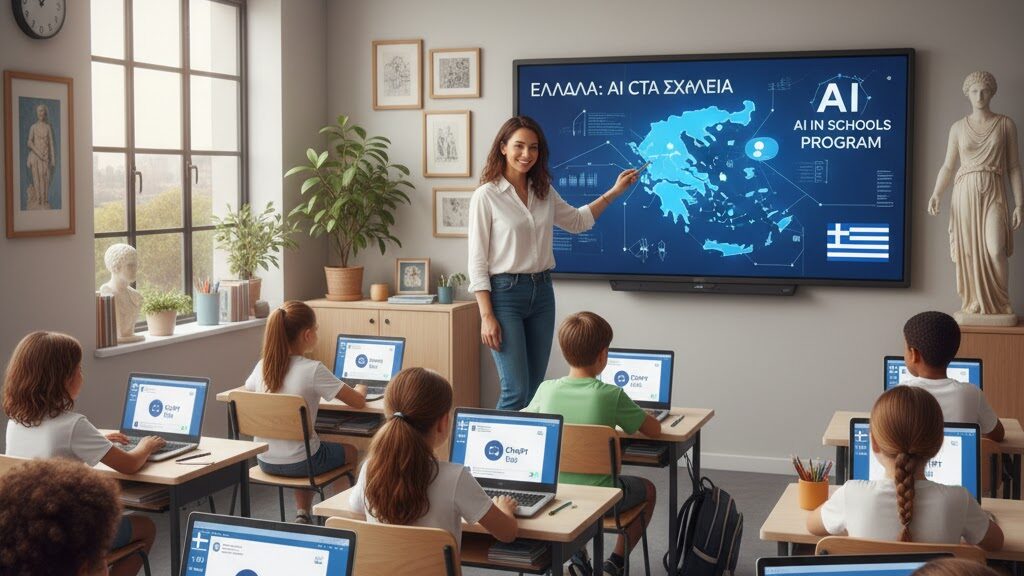
A bright and modern elementary school classroom where a female teacher stands in front of a large digital screen, pointing at a map of Greece with an "AI IN SCHOOLS PROGRAM" logo. The screen also displays the Greek flag and "ΕΛΛΑΔΑ: AI ΣΤΑ ΣΧΟΛΕΙΑ" (Greece: AI in Schools). Rows of young students are seated at individual desks, each actively engaged with a laptop displaying the "ChatGPT Edu" interface. The classroom has large windows, plants, and classical artwork, blending traditional and modern educational elements. Image (and typos) generated by Nano Banana.
Greece is making a significant leap into the future of education by launching its “AI in Schools” program, introducing ChatGPT Edu into classrooms nationwide. This initiative aims to equip students with cutting-edge AI tools, fostering innovation and preparing them for a technology-driven world. Image (and typos) generated by Nano Banana.

Source

Greek Reporter

Summary

Greece has announced a nationwide initiative, AI in Schools, making it one of the first European countries to formally integrate generative AI into public education. Beginning with a pilot in December 2025, the programme will introduce ChatGPT Edu—OpenAI’s education-focused platform—into 20 high schools. Led by The Tipping Point in Education and funded by the Onassis Foundation, the initiative aims to enhance AI literacy among teachers and students while maintaining ethical standards and data privacy. The rollout includes four phases: teacher training, pilot implementation, student participation, and full integration by 2027. The Ministry of Education has established strict GDPR-compliant data protocols, ensuring that AI supports creativity, collaboration, and critical thinking without replacing teachers’ central role in learning.

Key Points

  • Greece will pilot ChatGPT Edu in 20 high schools from December 2025.
  • The project is run by The Tipping Point in Education and funded by the Onassis Foundation.
  • A four-phase rollout prioritises teacher training, student engagement, and responsible AI use.
  • ChatGPT Edu offers secure, ad-free, GDPR-compliant tools for schools.
  • The initiative promotes AI literacy, ethical awareness, and digital innovation.
  • Teachers remain central to guiding creative and critical classroom use of AI.

Keywords

URL

https://greekreporter.com/2025/10/18/greece-ai-schools-program-chatgpt-edu-classrooms/

Summary generated by ChatGPT 5


From Textbook to a Second Teacher: How AI Has Changed Study


A split image illustrating the evolution of studying. The left side shows a young male student in a warmly lit, traditional setting, deeply engrossed in reading a physical textbook under a desk lamp, with other books around him. The right side shows the same student, but in a modern, blue-lit setting, smiling as he interacts with a laptop. A glowing, holographic AI tutor in the shape of a friendly, simplistic figure hovers above his laptop, surrounded by intricate data visualizations and educational content, symbolizing AI as a "second teacher." Image (and typos) generated by Nano Banana.
The landscape of learning is transforming dramatically. This image contrasts the traditional method of studying with textbooks against the modern approach, where AI has emerged as a dynamic “second teacher,” offering personalised guidance and insights that are fundamentally changing how students learn. Image (and typos) generated by Nano Banana.

Source

The Post (New Zealand)

Summary

Hanna McCallum reports on how artificial intelligence is reshaping study habits, teaching methods, and classroom culture in New Zealand schools. Students at Wellington East Girls’ College describe AI as a “second teacher” that provides on-demand academic support, while educators work to build digital literacy and responsible-use frameworks. Some students view AI as empowering—enhancing access to personalised study tools and creative learning—while others fear it undermines independent thinking and deep learning. Teachers and experts note growing divides between schools that embrace AI and those that resist it, with potential long-term effects on cognitive development. As one lecturer observes, AI can either accelerate learning or encourage intellectual shortcuts depending on how students use it.

Key Points

  • Students describe AI as a “second teacher” offering instant academic assistance.
  • Wellington East Girls’ College is developing an AI strategy focusing on staff training and digital literacy.
  • Some students report overreliance on AI, while others feel left behind without it.
  • Educators warn that unmanaged AI use may reduce critical thinking and motivation.
  • University experts note widening gaps between AI-literate students and those from AI-restricted schools.

Keywords

URL

https://www.thepost.co.nz/nz-news/360856298/textbook-second-teacher-how-ai-has-changed-study

Summary generated by ChatGPT 5