How AI Adoption May Erode Key Skills US Students Need in an Automated World


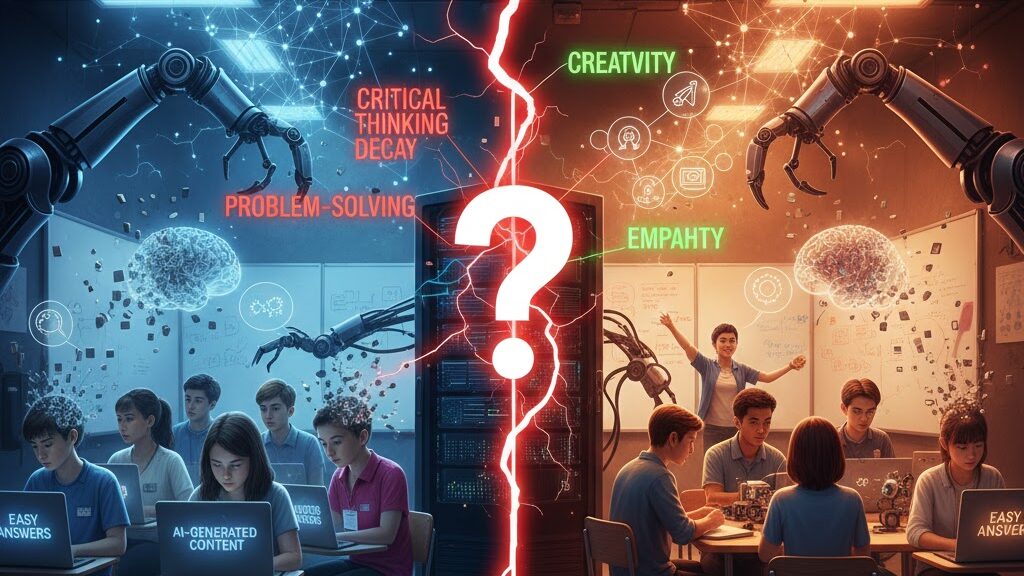
A highly conceptual visual of a digital circuit board with key areas representing skills like "Critical Thinking," "Problem Solving," and "Originality" fading and becoming obscured by an overwhelming cloud of generic, high-speed AI data. Image (and typos) generated by Nano Banana.
The automation paradox: Experts warn that while AI drives efficiency, its widespread adoption in education may inadvertently erode the crucial cognitive and creative skills US students need to thrive in a future dominated by technology. Image (and typos) generated by Nano Banana.

Source

Times of India (Education International Desk)

Summary

This article explores concerns that widespread adoption of AI tools in education may undermine essential skills that students require for long-term success in an increasingly automated world. Educators and analysts interviewed argue that easy access to generative AI for writing, problem solving and research may weaken students’ capacity for critical thinking, creativity and independent judgement. They note that while AI can accelerate tasks, it may also reduce opportunities for deep learning and cognitive struggle, both of which are crucial for intellectual development. The article raises concerns that students who rely heavily on AI may experience diminished confidence in producing original work and solving complex problems without technological support. Experts recommend curriculum renewal that blends responsible AI literacy with explicit instruction in foundational skills, ensuring that students can use AI effectively without sacrificing their broader intellectual growth. The discussion reflects a recurring theme in the global AI-in-education debate: the need to preserve human expertise and cognitive resilience in an era of pervasive automation. The article calls for educators, policymakers and institutions to strike a balance between embracing AI and safeguarding human capabilities.

Key Points

  • Widespread AI use may weaken foundational cognitive skills
  • Risks include reduced independent thinking and reduced confidence
  • Educators call for curriculum redesign with balanced AI integration
  • Highlights need for responsible AI literacy
  • Addresses long-term workforce preparation concerns

Keywords

URL

https://timesofindia.indiatimes.com/education/news/how-ai-adoption-may-erode-key-skills-us-students-need-in-an-automated-world/articleshow/125672541.cms

Summary generated by ChatGPT 5.1


‘It’s going to be a life skill’: educators discuss the impact of AI on university education


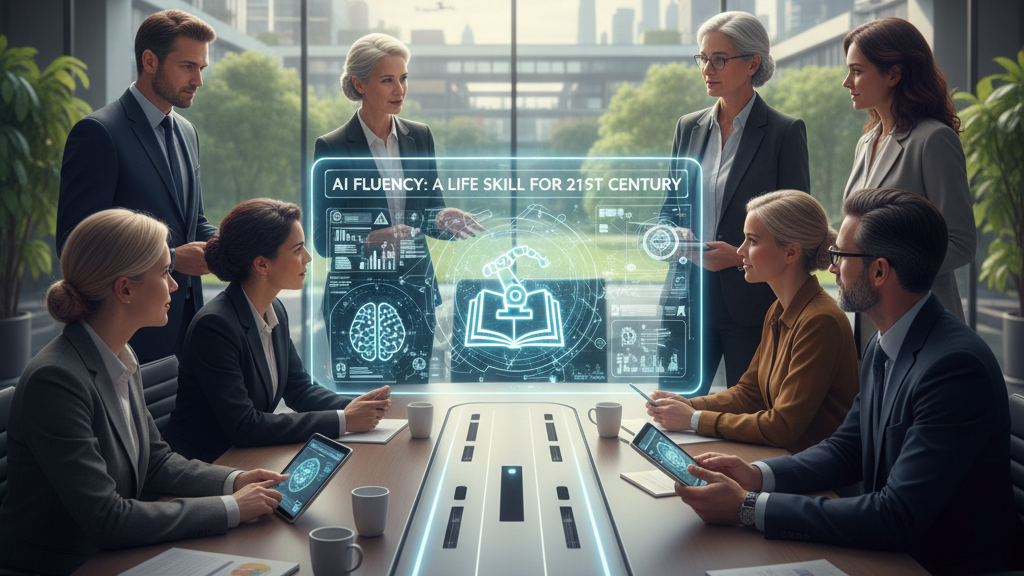
In a modern, sunlit conference room with a city view, a diverse group of seven educators in business attire are gathered around a sleek table. They are looking at a central holographic display that reads 'AI FLUENCY: A LIFE SKILL FOR 21ST CENTURY' and shows icons related to AI and learning. The scene depicts a discussion among professionals about the transformative impact of AI on university education. Generated by Nano Banana.
As AI reshapes industries and daily life, educators are converging to discuss its profound impact on university education, recognising AI fluency not merely as a technical skill but as an essential ‘life skill’ for the 21st century. This image captures a pivotal conversation among academic leaders focused on integrating AI into curricula to prepare students for the future. Image generated by Nano Banana.

Source

The Guardian

Summary

Educators argue that generative AI is swiftly moving from a novelty to a necessary skill, and universities must catch up. Students are often more advanced in AI usage than academic institutions, which are playing catch‑up with policy, curriculum adaptation, and support services. The piece emphasises that being able to use AI tools (and understand their limits) should be as fundamental as reading and writing. Universities are urged to incorporate AI literacy broadly—across disciplines—ensure equitable access, and ensure that teaching still reinforces enduring human skills like critical thinking, creativity, and communication.

Key Points

  • AI proficiency is becoming a life skill; many students already use AI tools, often more adeptly than institutions can respond.
  • Important for students to evaluate what AI can and can’t do, not just how to use it.
  • Universities should show leadership: clear AI strategy, support across all courses.
  • Equity matters: ensuring all students have access and skills to use AI.
  • Human skills (creativity, communication, thinking) retain their value even as AI tools become common.

Keywords

URL

https://www.theguardian.com/education/2025/sep/13/its-going-to-be-a-life-skill-educators-discuss-the-impact-of-ai-on-university-education

Summary generated by ChatGPT 5


Unis respond to new challenge of AI revolution


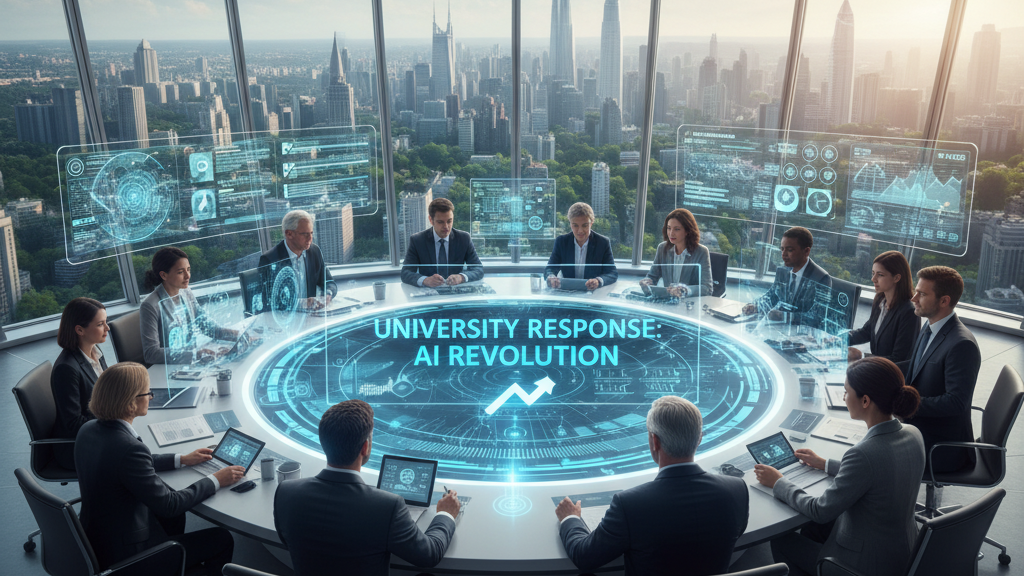
A diverse group of university leaders in business attire is seated around a futuristic, circular conference table in a high-rise office with a panoramic city view. The table features a glowing blue holographic display in the center that reads 'UNIVERSITY RESPONSE: AI REVOLUTION' with an upward-trending arrow. Surrounding screens show various data and analytics, symbolizing strategic planning in response to technological shifts. Generated by Nano Banana.
As the AI revolution sweeps across all sectors, universities worldwide are strategically convening to forge their responses to this unprecedented challenge. This image captures academic leadership engaged in critical discussions and planning, focusing on how to adapt curricula, research, and institutional operations to embrace the new era of artificial intelligence. Image generated by Nano Banana.

Source

The Australian Financial Review

Summary

Australian universities are increasingly under pressure to adapt, as students expect to graduate not just with subject knowledge but with fluency in AI and the ability to work alongside it. Institutions are responding by integrating AI-capabilities into curricula, industry partnerships, and upskilling programmes. The change is driven as much by employer demands as student expectations. There are challenges—ethical issues, resource constraints, staff training, and policy development—but the sentiment is that universities can’t treat AI as an optional extra. To remain relevant, institutions must develop AI as part of professional preparation, incorporating both technical tools and human skills (judgement, adaptability).

Key Points

  • Students expect universities to prepare them for AI-enabled work; they see AI literacy as part of career readiness.
  • Universities are adding AI elements to teaching, curriculum, and partnerships with industry to meet those expectations.
  • Significant challenges: ensuring ethical use, upskilling staff, securing resources for tools, and creating relevant policy frameworks.
  • It’s not just about automating tasks; universities see need to emphasise human skills that AI can’t replicate (creativity, critical thinking, etc.).
  • Institutions are also feeling urgency: lagging behind risks graduates being underprepared for a changing job market.

Keywords

URL

https://www.afr.com/technology/unis-respond-to-new-challenge-of-ai-revolution-20250905-p5msot

Summary generated by ChatGPT 5