UWA and Oxford Partner for Generative AI in Higher Education


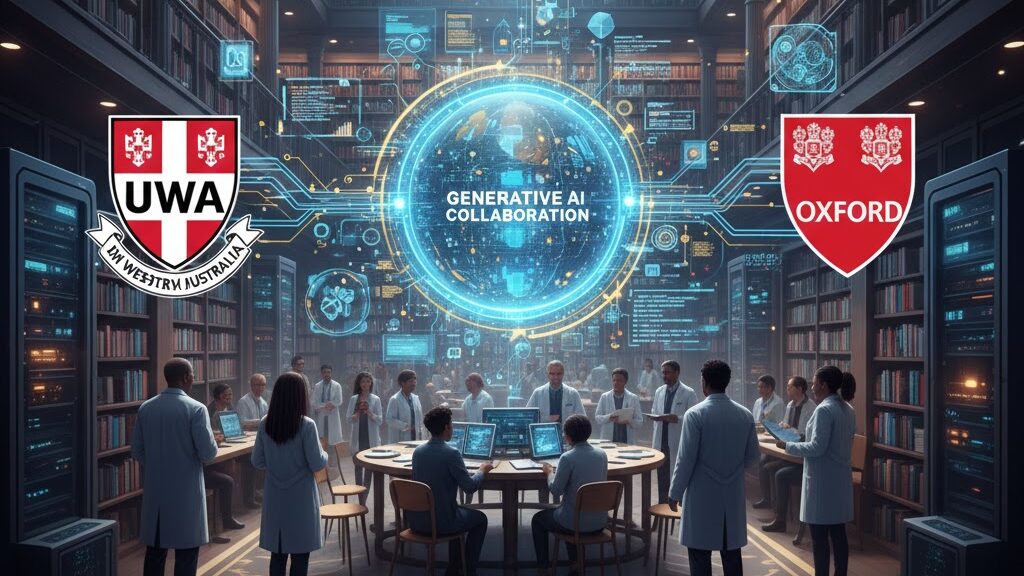
A digital illustration merging the architectural styles of the University of Western Australia (UWA) and the University of Oxford. A traditional university shield or crest is split in two, with one half featuring a classic coat of arms and the other half displaying generative AI code and glowing digital patterns, symbolizing their partnership in advanced education. Image (and typos) generated by Nano Banana.
Global collaboration in the age of AI: UWA and Oxford University join forces to pioneer the integration and study of generative artificial intelligence within the landscape of higher education. Image (and typos) generated by Nano Banana.

Source

University of Western Australia

Summary

The University of Western Australia and the University of Oxford announced a formal partnership that positions generative AI as a strategic driver in the future of higher education. The collaboration focuses on advancing responsible AI research, developing governance models and integrating generative AI into teaching and learning in ways that uphold academic integrity and inclusivity. Both institutions highlight that the rapid acceleration of AI requires coordinated international responses that balance innovation with ethical safeguards. The partnership will explore curriculum transformation, staff development and AI-informed pedagogical frameworks intended to support both student learning and broader institutional capability building. By aligning two globally significant universities, the initiative signals a trend toward cross-border cooperation designed to shape sector-wide AI standards. It also indicates growing recognition that AI adoption in higher education must be underpinned by shared values, transparent methodologies and research-based evidence. This collaboration aims to become a blueprint for how universities can jointly shape the future of AI-enabled education while ensuring that human expertise remains central.

Key Points

  • Major partnership between UWA and Oxford to advance responsible AI
  • Focus on governance, research and curriculum innovation
  • Reflects global shift toward collaboration on AI strategy
  • Emphasises ethical frameworks for AI adoption in higher education
  • Positions AI as core to long-term institutional development

Keywords

URL

https://www.uwa.edu.au/news/article/2025/november/uwa-and-oxford-partner-for-generative-ai-in-higher-ed

Summary generated by ChatGPT 5.1


2025 Horizon Action Plan: Building Skills and Literacy for Teaching with GenAI


Source

Jenay Robert, EDUCAUSE (2025)

Summary

This collection of essays explores how artificial intelligence—particularly generative AI (GenAI)—is reshaping the university sector across teaching, research, and administration. Contributors, including Dame Wendy Hall, Vinton Cerf, Rose Luckin, and others, argue that AI represents a profound structural shift rather than a passing technological wave. The report emphasises that universities must respond strategically, ethically, and holistically: developing AI literacy among staff and students, redesigning assessment, and embedding responsible innovation into governance and institutional strategy.

AI is portrayed as both a disruptive and creative force. It automates administrative processes, accelerates research, and transforms strategy-making, while simultaneously challenging ideas of authorship, assessment, and academic integrity. Luckin and others call for universities to foster uniquely human capacities—critical thinking, creativity, emotional intelligence, and metacognition—so that AI augments rather than replaces human intellect. Across the essays, there is strong consensus that AI literacy, ethical governance, and institutional agility are vital if universities are to remain credible and relevant in the AI era.

Key Points

  • GenAI is reshaping all aspects of higher education teaching and learning.
  • AI literacy must be built into curricula, staff training, and institutional culture.
  • Faculty should use GenAI to enhance creativity and connection, not replace teaching.
  • Clear, flexible policies are needed for responsible and ethical AI use.
  • Institutions must prioritise equity, inclusion, and closing digital divides.
  • Ongoing professional development in AI is essential for staff and administrators.
  • Collaboration across institutions and with industry accelerates responsible adoption.
  • Assessment and pedagogy must evolve to reflect AI’s role in learning.
  • GenAI governance should balance innovation with accountability and transparency.
  • Shared toolkits and global practice networks can scale learning and implementation.

Conclusion

The Action Plan positions GenAI as both a challenge and a catalyst for renewal in higher education. Institutions that foster literacy, ethics, and innovation will not only adapt but thrive. Teaching with AI is framed as a collective, values-led enterprise—one that keeps human connection, creativity, and critical thinking at the centre of the learning experience.

Keywords

URL

https://library.educause.edu/resources/2025/9/2025-educause-horizon-action-plan-building-skills-and-literacy-for-teaching-with-genai

Summary generated by ChatGPT 5


AI Is Making the College Experience Lonelier


A male college student sits alone at a wooden desk in a grand, dimly lit library, intensely focused on his laptop which projects a glowing blue holographic interface. Rain streaks down the large gothic window in the background, enhancing the sense of isolation. Other students are sparsely visible in the distance, similarly isolated at their desks. The scene evokes a feeling of loneliness and individual digital engagement in an academic setting. Generated by Nano Banana.
As AI tools become increasingly integrated into academic life, some fear that the college experience is becoming more solitary. This image captures a student immersed in a digital world within a traditional library, symbolising a potential shift towards individual interaction with technology, rather than communal learning, and raising questions about the social impact of AI on university life. Image generated by Nano Banana.

Source

The Chronicle of Higher Education

Summary

Amid growing integration of AI into student learning (e.g. ChatGPT “study mode”), there’s a quieter but profound concern: the erosion of collaborative study among students. Instead of learning together, many may retreat into solo AI-mediated calls for efficiency and convenience. The authors argue that the informal, messy, social study moments — debating, explaining, failing together — are vital to the educational experience. AI may offer convenience, but it cannot replicate human uncertainty, peer correction, or the bonding formed through struggle and exploration.

Key Points

  • AI “study mode” may tempt students to bypass peer collaboration, weakening communal learning.
  • The social, frustrating, back-and-forth parts of learning are essential for deep understanding — AI cannot fully emulate them.
  • Faculty worry that students working alone miss opportunities to test, explain, and refine ideas together.
  • The shift risks hollowing out parts of education that are about connection, not just content transmission.
  • Authors advocate for pedagogy that re-centres collaboration, discourse, and community as buffers against “silent learning.”

Keywords

URL

https://www.chronicle.com/article/ai-is-making-the-college-experience-lonelier

Summary generated by ChatGPT 5