Not Even Generative AI’s Developers Fully Understand How Their Models Work


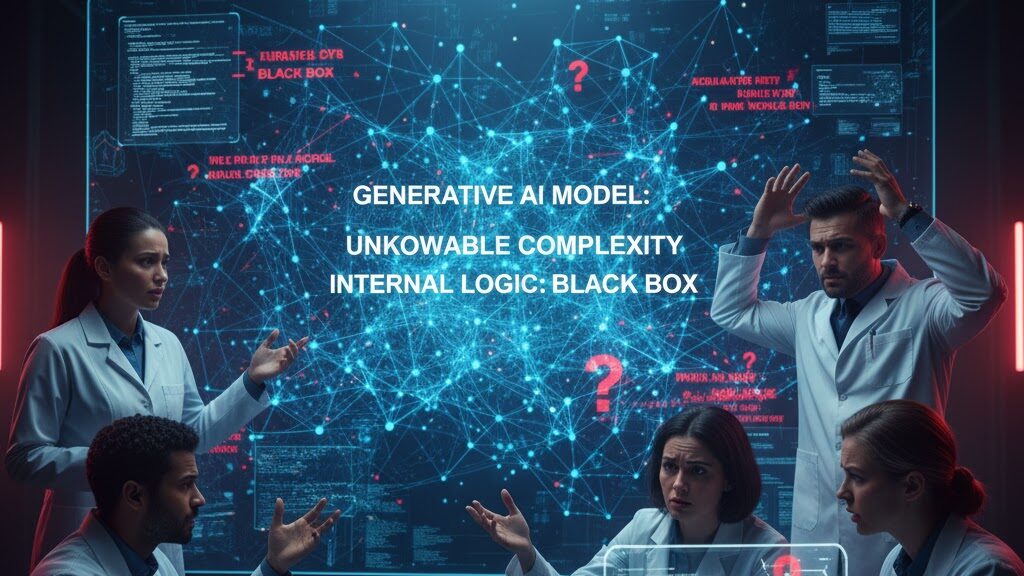
In a futuristic lab or control room, a diverse group of frustrated scientists and developers in lab coats are gathered around a table with laptops, gesturing in confusion. Behind them, a large holographic screen prominently displays "GENERATIVE AI MODEL: UNKNOWABLE COMPLEXITY, INTERNAL LOGIC: BLACK BOX" overlaid on a glowing neural network. Numerous red question marks and "ACCESS DENIED" messages highlight their inability to fully comprehend the AI's workings. Image (and typos) generated by Nano Banana.
Groundbreaking research has unveiled a startling truth: even the developers of generative AI models do not fully comprehend the intricate inner workings of their own creations. This image vividly portrays a team of scientists grappling with the “black box” phenomenon of advanced AI, highlighting the profound challenge of understanding systems whose complexity surpasses human intuition and complete analysis. Image (and typos) generated by Nano Banana.

Source

The Irish Times

Summary

John Thornhill examines the paradox at the heart of the artificial intelligence boom: even the developers of generative AI systems cannot fully explain how their models function. Despite hundreds of billions being invested in the race toward artificial general intelligence (AGI), experts remain divided on what AGI means or whether it is achievable. While industry leaders such as OpenAI and Google DeepMind pursue it with near-religious zeal, critics warn of existential risks and call for restraint. At a Royal Society conference, scholars argued for redirecting research toward tangible, transparent goals and prioritising safety over hype in AI’s relentless expansion.

Key Points

  • Massive investment continues despite no shared understanding of AGI’s meaning or feasibility.
  • Industry figures frame AGI as imminent, while most academics consider it unlikely.
  • Experts highlight safety, transparency, and regulation as neglected priorities.
  • Alan Kay and Shannon Vallor urge shifting focus from “intelligence” to demonstrable utility.
  • Thornhill concludes that humanity’s true “superhuman intelligence” remains science itself.

Keywords

URL

https://www.irishtimes.com/business/2025/10/10/not-even-generative-ais-developers-fully-understand-how-their-models-work/

Summary generated by ChatGPT 5


AI and the future of education. Disruptions, dilemmas and directions


Source

UNESCO

Summary

This UNESCO report provides policy guidance on integrating artificial intelligence (AI) into education systems worldwide. It stresses both the opportunities—such as personalised learning, enhanced efficiency, and expanded access—and the risks, including bias, privacy concerns, and the erosion of teacher and learner agency. The document frames AI as a powerful tool that can help address inequalities and support sustainable development, but only if implemented responsibly and inclusively.

Central to the report is the principle that AI in education must remain human-centred, promoting equity, transparency, and accountability. It highlights the importance of teacher empowerment, digital literacy, and robust governance frameworks. The guidance calls for capacity building at all levels, from policy to classroom practice, and for international cooperation to ensure that AI use aligns with ethical standards and local contexts. Ultimately, the report argues that AI should augment—not replace—human intelligence in education.

Key Points

  • AI offers opportunities for personalised learning and system efficiency.
  • Risks include bias, inequity, and privacy breaches if left unchecked.
  • AI in education must be guided by human-centred, ethical frameworks.
  • Teachers remain central; AI should support rather than replace them.
  • Digital literacy for learners and educators is essential.
  • Governance frameworks must ensure transparency and accountability.
  • Capacity building and training are critical for sustainable adoption.
  • AI should contribute to equity and inclusion, not exacerbate divides.
  • International collaboration is vital for responsible AI use in education.
  • AI’s role is to augment human intelligence, not supplant it.

Conclusion

UNESCO concludes that AI has the potential to transform education systems for the better, but only if adoption is deliberate, ethical, and values-driven. Policymakers must prioritise equity, inclusivity, and transparency while ensuring that human agency and the role of teachers remain central to education in the age of AI.

Keywords

URL

https://www.unesco.org/en/articles/ai-and-future-education-disruptions-dilemmas-and-directions

Summary generated by ChatGPT 5