How to use ChatGPT at university without cheating: ‘Now it’s more like a study partner’


Three university students (two male, one female) are seated at a table with laptops and books, smiling and engaged in discussion. Behind them, a large transparent screen displays a glowing blue humanoid AI figure pointing to various academic data and charts. The setting is a modern library, conveying a collaborative study environment where AI acts as a helpful, non-cheating resource. Generated by Nano Banana.
Moving beyond fears of academic dishonesty, many students are now leveraging ChatGPT as an ethical ‘study partner’ to enhance their learning experience at university. This image illustrates a collaborative approach where AI supports understanding and exploration, rather than providing shortcuts, thereby fostering a new era of academic assistance. Image generated by Nano Banana.

Source

The Guardian

Summary

Many students now treat ChatGPT less like a cheating shortcut and more like a study partner: for grammar checks, revision, practice questions, and organising notes. Usage jumped from 66% to 92% in a year. Universities are clarifying rules: AI can support study but not generate assignment content. Educators stress AI literacy, awareness of risks (hallucinations, fake references), and critical thinking to ensure AI complements rather than replaces learning.

Key Points

  • Student AI use rose from ~66% to ~92% in a year; viewed more as a partner than a cheat tool.
  • Valid uses: organising notes, summarising, and generating practice questions.
  • Risks: overreliance, hallucinations, using AI to write assignments still banned.
  • Some universities track AI usage or require logs; policies clearer.
  • Message: AI should be supplemental, not a substitute; build literacy and critical skills.

Keywords

URL

https://www.theguardian.com/education/2025/sep/14/how-to-use-chatgpt-at-university-without-cheating-now-its-more-like-a-study-partner

Summary generated by ChatGPT 5


‘It’s going to be a life skill’: educators discuss the impact of AI on university education


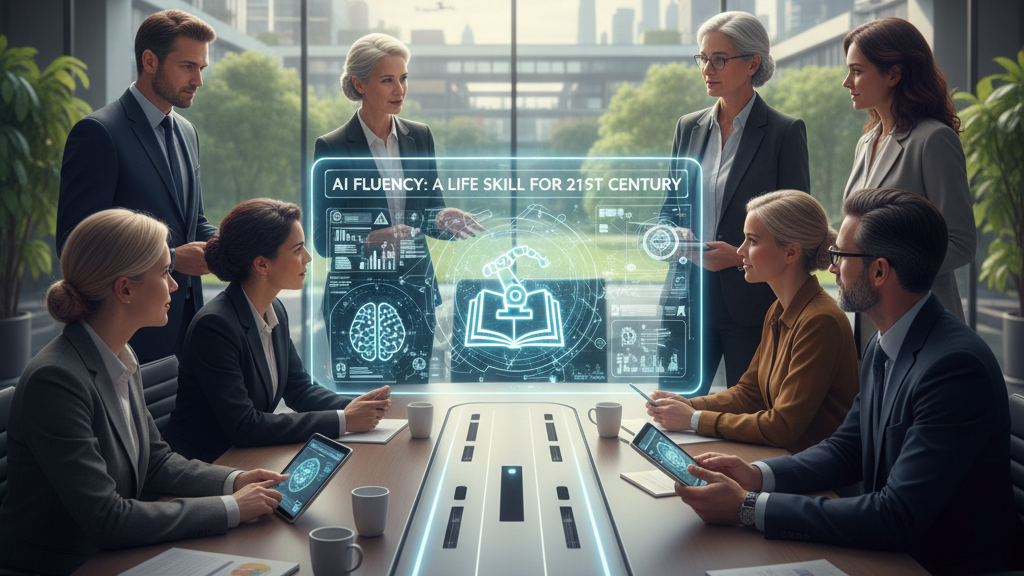
In a modern, sunlit conference room with a city view, a diverse group of seven educators in business attire are gathered around a sleek table. They are looking at a central holographic display that reads 'AI FLUENCY: A LIFE SKILL FOR 21ST CENTURY' and shows icons related to AI and learning. The scene depicts a discussion among professionals about the transformative impact of AI on university education. Generated by Nano Banana.
As AI reshapes industries and daily life, educators are converging to discuss its profound impact on university education, recognising AI fluency not merely as a technical skill but as an essential ‘life skill’ for the 21st century. This image captures a pivotal conversation among academic leaders focused on integrating AI into curricula to prepare students for the future. Image generated by Nano Banana.

Source

The Guardian

Summary

Educators argue that generative AI is swiftly moving from a novelty to a necessary skill, and universities must catch up. Students are often more advanced in AI usage than academic institutions, which are playing catch‑up with policy, curriculum adaptation, and support services. The piece emphasises that being able to use AI tools (and understand their limits) should be as fundamental as reading and writing. Universities are urged to incorporate AI literacy broadly—across disciplines—ensure equitable access, and ensure that teaching still reinforces enduring human skills like critical thinking, creativity, and communication.

Key Points

  • AI proficiency is becoming a life skill; many students already use AI tools, often more adeptly than institutions can respond.
  • Important for students to evaluate what AI can and can’t do, not just how to use it.
  • Universities should show leadership: clear AI strategy, support across all courses.
  • Equity matters: ensuring all students have access and skills to use AI.
  • Human skills (creativity, communication, thinking) retain their value even as AI tools become common.

Keywords

URL

https://www.theguardian.com/education/2025/sep/13/its-going-to-be-a-life-skill-educators-discuss-the-impact-of-ai-on-university-education

Summary generated by ChatGPT 5


Social media is teaching children how to use AI. How can teachers keep up?


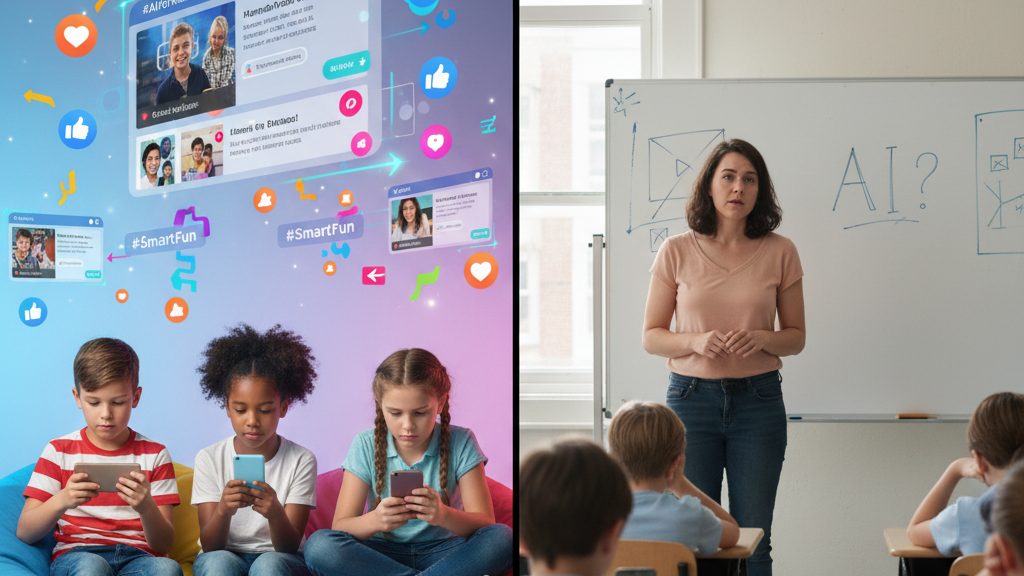
A split image contrasting two scenes. On the left, three young children are engrossed in tablets and smartphones, surrounded by vibrant social media interfaces featuring AI-related content and hashtags like "#AIforkids." On the right, a teacher stands in a traditional classroom looking somewhat perplexed at a whiteboard with "AI?" written on it, while students sit at desks, symbolizing the challenge for educators to keep pace with children's informal AI learning. Image (and typos) generated by Nano Banana.
While children are rapidly learning about AI through pervasive social media platforms, educators face the challenge of integrating this knowledge into formal learning environments. This image highlights the growing disconnect between how children are acquiring AI literacy informally and the efforts teachers must make to bridge this gap and keep classroom instruction relevant and engaging. Image (and typos) generated by Nano Banana.

Source

The Conversation

Summary

Students are learning to use AI mainly through TikTok, Discord, and peer networks, while teachers rely on informal exchanges and LinkedIn. This creates quick but uneven knowledge transfer that often skips deeper issues such as bias, equity, and ethics. A Canadian pilot project showed that structured teacher education transforms enthusiasm into critical AI literacy, giving educators both vocabulary and judgment to integrate AI responsibly. The article stresses that without institutional clarity and professional development, AI adoption risks reinforcing inequity and mistrust.

Key Points

  • Informal learning (TikTok, Discord, staff rooms) drives AI uptake but lacks critical depth.
  • Teacher candidates benefit from structured AI education, gaining language and tools to discuss ethics and bias.
  • Institutional AI policies are fragmented, leaving instructors without support and creating confusion.
  • Equity and bias are central concerns; multilingual learners may be disadvantaged by uncritical AI use.
  • Embedding AI literacy in teacher education and learning communities is critical to move from casual adoption to critical engagement.

Keywords

URL

https://theconversation.com/social-media-is-teaching-children-how-to-use-ai-how-can-teachers-keep-up-264727

Summary generated by ChatGPT 5


QQI Generative Artificial Intelligence Survey Report 2025


Source

Quality and Qualifications Ireland (QQI), August 2025

Summary

This national survey captures the views of 1,229 staff and 1,005 learners across Ireland’s further, higher, and English language education sectors on their knowledge, use, and perceptions of generative AI (GenAI). The report reveals growing engagement with GenAI but also wide disparities in understanding, policy, and preparedness. Most respondents recognise AI’s transformative impact but remain uncertain about its role in assessment, academic integrity, and employability.

While over 80% of staff and learners believe GenAI will significantly change education and work over the next five years, few feel equipped to respond. Only 20% of staff and 14% of learners report access to GenAI training. Policies are inconsistent or absent, with most institutions leaving decisions on use to individual educators. Both staff and learners support transparent, declared use of GenAI but express concerns about bias, overreliance, loss of essential skills, and declining trust in qualifications. Respondents call for coherent national and institutional policies, professional development, and curriculum reform that balances innovation with integrity.

Key Points

  • 82% of respondents expect GenAI to transform learning and work within five years.
  • 63% of staff and 36% of learners believe GenAI literacy should be explicitly taught.
  • Fewer than one in five institutions currently provide structured GenAI training.
  • Policies on GenAI use are inconsistent, unclear, or absent in most institutions.
  • Over half of respondents fear skill erosion and reduced academic trust from AI use.
  • 70% of staff say assessment rules for GenAI lack clarity or consistency.
  • 83% of learners believe GenAI will change how they are assessed.
  • Staff and learners call for transparent declaration of GenAI use in assignments.
  • 61% of staff feel learners are unprepared to use GenAI responsibly in the workplace.
  • Respondents emphasise ethical governance, inclusion, and sustainable AI adoption.

Conclusion

The survey highlights a critical moment for Irish education: generative AI is already influencing learning and work, yet systems for policy, training, and ethics are lagging behind. To maintain public trust and educational relevance, QQI recommends a coordinated national response centred on transparency, AI literacy, and values-led governance that equips both learners and educators for an AI-driven future.

Keywords

URL

https://www.qqi.ie/sites/default/files/2025-08/generative-artificial-intelligence-survey-report-2025.pdf

Summary generated by ChatGPT 5


Will AI Make You Stupid?


A digital representation of a human brain with glowing teal data streams and circuit-like patterns flowing out from its right side, against a dark, technical background with a subtle digital frame. Image (and typos) generated by Nano Banana.
Exploring the cognitive impact of artificial intelligence: Will reliance on AI enhance our intellect or diminish our critical thinking abilities? Image (and typos) generated by Nano Banana.

Source

The Economist

Summary

A Massachusetts Institute of Technology study has found that students using ChatGPT during essay-writing tasks showed reduced brain activity in areas linked to creativity and attention. Similar research from Microsoft and the SBS Swiss Business School supports the claim that frequent AI use may diminish critical thinking, fostering “cognitive miserliness,” or the tendency to offload mental effort. While experts caution that the evidence is not yet conclusive, they warn that excessive reliance on AI could erode problem-solving and creative skills over time. Historical parallels—such as Socrates’ scepticism about writing—suggest technological tools often reshape, but do not destroy, cognitive abilities. The article concludes that using AI thoughtfully—prompting step by step and reflecting critically—can help preserve intellectual engagement even as automation advances.

Key Points

  • MIT researchers observed reduced creative and attentional brain activity in AI-assisted students.
  • Frequent AI users performed worse on critical-thinking tests in a Swiss study.
  • Over-reliance on AI can create “cognitive offloading” and feedback loops of dependence.
  • Experts urge reflective, guided use—AI as assistant, not replacement.
  • Strategies such as incremental prompting and “cognitive forcing” can sustain mental effort.
  • Evidence remains mixed: AI may change, but not necessarily weaken, human intelligence.

Keywords

URL

https://www.economist.com/science-and-technology/2025/07/16/will-ai-make-you-stupid

Summary generated by ChatGPT 5