How AI Is Changing—Not ‘Killing’—College


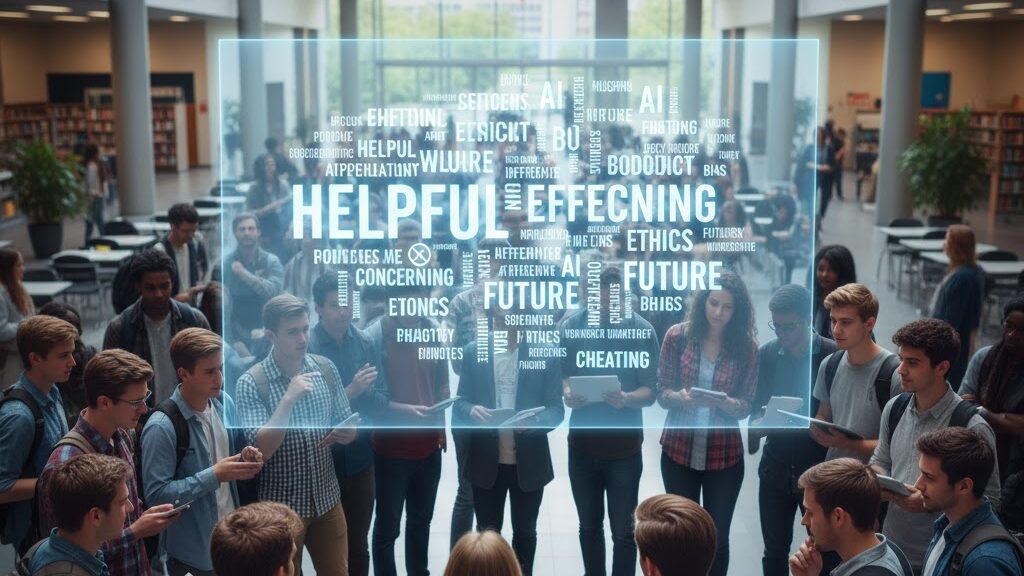
A diverse group of college students is gathered in a modern university library or common area, with some holding tablets or looking at laptops. Above them, a large, glowing word cloud hovers, filled with terms related to artificial intelligence and its impact. Prominent words include "HELPFUL," "FUTURE," "ETHICS," "CHEATING," "BIAS," and "CONCERNING," reflecting a range of student opinions. The overall impression is one of active discussion and varied perspectives on AI. Image (and typos) generated by Nano Banana.
What do the next generation of leaders and innovators think about artificial intelligence? This visual captures the dynamic and often contrasting views of college students on AI’s role in their education, future careers, and daily lives. Image (and typos) generated by Nano Banana.

Source

Inside Higher Ed

Summary

A new Student Voice survey by Inside Higher Ed and Generation Lab captures how U.S. college students are adapting to generative AI in their studies and what they expect from institutions. Of the 1,047 students surveyed, 85 per cent had used AI tools in the past year—mainly for brainstorming, tutoring, and studying—while only a quarter admitted to using them for completing assignments. Most respondents called for universities to provide education on ethical AI use and clearer, standardised policies, rather than policing or banning the technology. Although students are divided about AI’s impact on critical thinking, most agree it can enhance learning if used responsibly. The majority do not view AI as diminishing the value of college; some even see it as increasing it.

Key Points

  • 85 per cent of students have used AI tools for coursework, mainly for brainstorming and study support.
  • 97 per cent want universities to respond to AI’s impact on academic integrity through education, not restriction.
  • Over half say AI has mixed effects on critical thinking; 27 per cent find it enhances learning.
  • Students want institutions to offer professional and ethical AI training, not leave it to individual faculty.
  • Only 18 per cent believe AI reduces the value of college; 23 per cent say it increases it.

Keywords

URL

https://www.insidehighered.com/news/students/academics/2025/08/29/survey-college-students-views-ai

Summary generated by ChatGPT 5

QQI Generative Artificial Intelligence Survey Report 2025


Source

Quality and Qualifications Ireland (QQI), August 2025

Summary

This national survey captures the views of 1,229 staff and 1,005 learners across Ireland’s further, higher, and English language education sectors on their knowledge, use, and perceptions of generative AI (GenAI). The report reveals growing engagement with GenAI but also wide disparities in understanding, policy, and preparedness. Most respondents recognise AI’s transformative impact but remain uncertain about its role in assessment, academic integrity, and employability.

While over 80% of staff and learners believe GenAI will significantly change education and work over the next five years, few feel equipped to respond. Only 20% of staff and 14% of learners report access to GenAI training. Policies are inconsistent or absent, with most institutions leaving decisions on use to individual educators. Both staff and learners support transparent, declared use of GenAI but express concerns about bias, overreliance, loss of essential skills, and declining trust in qualifications. Respondents call for coherent national and institutional policies, professional development, and curriculum reform that balances innovation with integrity.

Key Points

  • 82% of respondents expect GenAI to transform learning and work within five years.
  • 63% of staff and 36% of learners believe GenAI literacy should be explicitly taught.
  • Fewer than one in five institutions currently provide structured GenAI training.
  • Policies on GenAI use are inconsistent, unclear, or absent in most institutions.
  • Over half of respondents fear skill erosion and reduced academic trust from AI use.
  • 70% of staff say assessment rules for GenAI lack clarity or consistency.
  • 83% of learners believe GenAI will change how they are assessed.
  • Staff and learners call for transparent declaration of GenAI use in assignments.
  • 61% of staff feel learners are unprepared to use GenAI responsibly in the workplace.
  • Respondents emphasise ethical governance, inclusion, and sustainable AI adoption.

Conclusion

The survey highlights a critical moment for Irish education: generative AI is already influencing learning and work, yet systems for policy, training, and ethics are lagging behind. To maintain public trust and educational relevance, QQI recommends a coordinated national response centred on transparency, AI literacy, and values-led governance that equips both learners and educators for an AI-driven future.

Keywords

URL

https://www.qqi.ie/sites/default/files/2025-08/generative-artificial-intelligence-survey-report-2025.pdf

Summary generated by ChatGPT 5


Understanding the Impacts of Generative AI Use on Children


Source

Alan Turing Institute

Summary

This report, prepared by the Alan Turing Institute with support from the LEGO Group, explores the impacts of generative AI on children aged 8–12 in the UK, alongside the views of their parents, carers, and teachers. Two large surveys were conducted: one with 780 children and their parents/carers, and another with 1,001 teachers across primary and secondary schools. The study examined how children encounter and use generative AI, how parents and teachers perceive its risks and benefits, and what this means for children’s wellbeing, learning, and creativity.

Findings show that while household use of generative AI is widespread (55%), access and awareness are uneven, being higher among wealthier families and private schools, and lower in state schools and disadvantaged groups. About 22% of children reported using generative AI, most commonly ChatGPT, for activities ranging from creating pictures to homework help. Children with additional learning needs were more likely to use AI for communication and companionship. Both children and parents who used AI themselves tended to view it positively, though parents voiced concerns about inaccuracy, inappropriate content, and reduced critical thinking. Teachers were frequent adopters—two-thirds used generative AI for lesson planning and research—and generally optimistic about its benefits for their work. However, many were uneasy about student use, particularly around academic integrity and diminished originality in schoolwork.

Key Points

  • 55% of UK households surveyed report generative AI use, with access shaped by income, region, and school type.
  • 22% of children (aged 8–12) have used generative AI; usage rises with age and is far higher in private schools.
  • ChatGPT is the most popular tool (58%), followed by Gemini and Snapchat’s “My AI.”
  • Children mainly use AI for creativity, learning, entertainment, and homework; those with additional needs use it more for communication and support.
  • 68% of child users find AI exciting; their enthusiasm strongly correlates with parents’ positive attitudes.
  • Parents are broadly optimistic (76%) but remain concerned about exposure to inappropriate or inaccurate information.
  • Teachers’ adoption is high (66%), especially for lesson planning and resource design, but often relies on personal licences.
  • Most teachers (85%) report increased productivity and confidence, though trust in AI outputs is more cautious.
  • Teachers are worried about students over-relying on AI: 57% report awareness of pupils submitting AI-generated work as their own.
  • Optimism is higher for AI as a support tool for special educational needs than for general student creativity or engagement.

Conclusion

Generative AI is already part of children’s digital lives, but access, understanding, and experiences vary widely. It sparks excitement and creativity yet raises concerns about equity, critical thinking, and integrity in education. While teachers see strong benefits for their own work, they remain divided on its value for students. The findings underline the need for clear policies, responsible design, and adult guidance to ensure AI enhances rather than undermines children’s learning and wellbeing.

Keywords

URL

https://www.turing.ac.uk/sites/default/files/2025-06/understanding_the_impacts_of_generative_ai_use_on_children_-_wp1_report.pdf

Summary generated by ChatGPT 5


2025 Horizon Report: Teaching and Learning Edition


Source

EDUCAUSE

Summary

The 2025 Horizon Report highlights generative AI (GenAI) as one of the most disruptive forces shaping higher education teaching and learning. It frames GenAI not merely as a technological trend but as a catalyst for rethinking pedagogy, assessment, ethics, and institutional strategy. GenAI tools are now widely available, reshaping how students learn, produce work, and engage with knowledge. The report emphasises both opportunities—personalisation, creativity, and efficiency—and risks, including misinformation, bias, overreliance, and threats to academic integrity.

Institutions are urged to move beyond reactive bans or detection measures and instead adopt values-led, strategic approaches to GenAI integration. This involves embedding AI literacy across curricula, supporting staff development, and redesigning assessments to focus on authentic, process-based demonstrations of learning. Ethical considerations are central: ensuring equity of access, safeguarding privacy, addressing sustainability, and clarifying boundaries of responsible use. GenAI is framed as a general-purpose technology—akin to the internet or electricity—that will transform higher education in profound and ongoing ways.

Key Points

  • GenAI is a general-purpose technology reshaping teaching and learning.
  • Opportunities include personalised learning, enhanced creativity, and staff efficiency.
  • Risks involve misinformation, bias, overreliance, and compromised academic integrity.
  • Detection tools are unreliable; focus should shift to assessment redesign.
  • AI literacy is essential for both staff and students across disciplines.
  • Equity and access must be prioritised to avoid deepening divides.
  • Ethical frameworks should guide responsible, transparent use of GenAI.
  • Sustainability concerns highlight the energy and resource costs of AI.
  • Institutional strategy must integrate GenAI into digital transformation plans.
  • Faculty development and sector-wide collaboration are critical for adaptation.

Conclusion

The report concludes that generative AI is no passing trend but a structural shift in higher education. Its potential to augment teaching and learning is significant, but only if institutions adopt proactive, ethical, and pedagogically grounded approaches. Success lies not in resisting GenAI, but in reimagining educational practices so that students and staff can use it critically, creatively, and responsibly.

Keywords

URL

https://library.educause.edu/resources/2025/5/2025-educause-horizon-report-teaching-and-learning-edition

Summary generated by ChatGPT 5


New Horizons for Higher Education: Teaching and Learning with Generative AI


Source

N-TUTORR National Digital Leadership Network (NDLN) – Professor Mairéad Pratschke

Summary

This report examines how generative AI (GAI) is transforming higher education, presenting both opportunities and risks. It highlights three main areas: the impact of GAI on current teaching, assessment, and learner-centred practice; the development of emerging AI pedagogy, international best practice, and early research findings; and the broader context of digital transformation, regulation, and future skills. The analysis stresses that while GAI can enhance accessibility, personalisation, and engagement, it also raises critical concerns around academic integrity, bias, equity, and sustainability.

The report positions GAI as a general-purpose technology akin to the internet or electricity, reshaping the nature of knowledge and collaboration in higher education. It calls for institutional leaders to align AI adoption with sectoral values such as inclusion, integrity, and social responsibility, while also addressing infrastructure gaps, staff training, and regulatory compliance. To be effective, GAI use must be pedagogically aligned, ethically grounded, and strategically supported. The future success of higher education depends on preparing students not just to use AI, but to work with it critically, creatively, and responsibly.

Key Points

  • GAI challenges academic integrity but also enables personalised learning at scale.
  • Pedagogical alignment is essential: AI must support, not replace, learning processes.
  • Early research warns of overreliance and “cognitive offloading” without human oversight.
  • AI can widen inequities unless digital equity and inclusion are prioritised.
  • Institutional strategy must balance efficiency with effectiveness in learning design.
  • National and EU regulation (e.g., AI Act) set high standards for responsible AI use.
  • Frontier AI models offer powerful capabilities but raise issues of bias and safety.
  • Educators increasingly take on roles as AI tool designers and facilitators.
  • Collaboration with industry is crucial for future career alignment and skills.
  • Sustained investment in infrastructure, training, and AI literacy is required.

Conclusion

Generative AI represents a transformative force in higher education. Its integration offers significant potential to augment human learning and expand access, but only if guided by values-led leadership, pedagogical rigour, and robust governance. Institutions must act strategically, embedding AI literacy and ethical practice to ensure that this “new horizon” supports both student success and the future sustainability of higher education.

Keywords

URL

https://www.ndln.ie/teaching-and-learning-with-generative-ai

Summary generated by ChatGPT 5