Latest Posts

Research, curriculum and grading: new data sheds light on how professors are using AI


In a bright, modern classroom, students are actively engaged at individual desks with laptops. At the front, two female professors and one male professor are presenting to the class, while a large interactive screen displays "INNOVATIVE AI CHATBOT USE CASES." The screen shows four panels detailing applications such as "Personalized Tutoring," "Collaborative Research," "Creative Writing & Feedback," and "Language Practice." Image (and typos) generated by Nano Banana.
University professors are increasingly discovering and implementing creative ways to leverage AI chatbots to enhance learning in the classroom. This image illustrates a dynamic educational environment where various innovative use cases for AI chatbots are being explored, from personalised tutoring to collaborative research, transforming traditional teaching and learning methodologies. Image (and typos) generated by Nano Banana.

Source

NPR

Summary

Professors across U.S. universities are increasingly using AI chatbots like Gemini and Claude for curriculum design, grading support, and administrative work. A Georgia State professor described using AI to brainstorm assignments and draft rubrics, while Anthropic’s analysis of 74,000 higher-ed conversations with Claude found 57% related to curriculum planning and 13% to research. Some professors even create interactive simulations. Others use AI to automate emails, budgets, and recommendations. But concerns remain: faculty warn that AI-grading risks hollowing out the student–teacher relationship, while scholars argue universities lack clear guidance, leaving professors to “fend for themselves.”

Key Points

  • National survey: ~40% of administrators and 30% of instructors now use AI weekly or daily, up from 2–4% in 2023.
  • 57% of higher-ed AI conversations focus on curriculum development; 13% on research.
  • Professors use AI to design interactive simulations, draft rubrics, manage budgets, and write recommendations.
  • 7% of analysed use involved grading, though faculty report AI is least effective here.
  • Concerns: risk of “AI-grading AI-written papers,” weakening educational purpose; calls for stronger guidance.

Keywords

URL

https://www.npr.org/2025/10/02/nx-s1-5550365/college-professors-ai-classroom

Summary generated by ChatGPT 5

AI as the Next Literacy


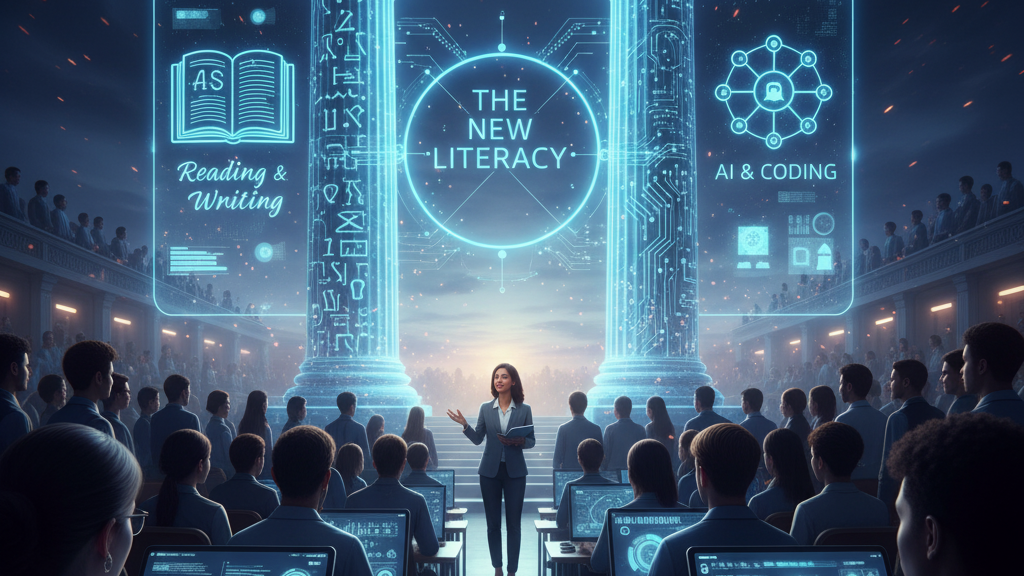
In a grand, columned lecture hall filled with students working on glowing laptops, a female professor stands at the front, gesturing towards a massive holographic screen. The screen is framed by two digital-circuitry columns and displays "THE NEW LITERACY" at its center. To the left, "Reading & Writing" is shown with traditional book icons, while to the right, "AI & CODING" is represented with connected nodes and circuits, symbolizing the evolution of foundational skills. Image (and typos) generated by Nano Banana.
Just as reading and writing have long been fundamental literacies, proficiency in Artificial Intelligence is rapidly emerging as the next essential skill. This image envisions a future where understanding AI, its principles, and its applications becomes a cornerstone of education, preparing individuals to navigate and thrive in an increasingly technologically advanced world. Image (and typos) generated by Nano Banana.

Source

Psychology Today

Summary

The article argues that as AI becomes pervasive, society is developing a new kind of literacy—not just how to read and write, but how to prompt, evaluate, and iterate with AI systems. AI extends our reach like a tool or “racket” in sport, but it can’t replace foundational skills like perception, language, and meaning making. The author warns that skipping fundamentals (critical thinking, writing, reasoning) risks hollowing out our capacities. In practice, education should blend traditional learning (drafting essays, debugging code) with AI-assisted revision and engagement, treating AI as augmentation, not replacement.

Key Points

  • AI literacy involves encoding intent → prompt design, interpreting output, iteration.
  • Just as literacy layered on speaking/listening, AI layers on existing cognitive skills.
  • Overreliance on AI without grounding in fundamentals weakens human capabilities.
  • Classrooms might require initial manual drafts or debugging before AI enhancement.
  • The challenge: integrate AI into scaffolding so it amplifies thinking rather than replacing it.

Keywords

URL

https://www.psychologytoday.com/us/blog/the-emergence-of-skill/202510/ai-as-the-next-literacy

Summary generated by ChatGPT 5


AI career mentors: Why students trust algorithms more than teachers


In a university library, a young female student is seated at a desk, looking confidently at the viewer with her laptop open. A holographic display in front of her shows a personalized "CAREERPATH AI - Your Personal Mentor" interface with a virtual assistant, data, and career graphs. Behind her, a male teacher or mentor looks on with a somewhat concerned expression, while other students are also engaging with similar AI interfaces. Image (and typos) generated by Nano Banana.
In an increasingly digital world, a striking trend is emerging: students are increasingly turning to AI career mentors, sometimes trusting algorithms more than traditional teachers for guidance. This image illustrates a student’s engagement with an AI-driven career planning tool, highlighting the shift in how young people seek and value mentorship in shaping their future paths. Image (and typos) generated by Nano Banana.

Source

eCampus News

Summary

Students are increasingly turning to AI-powered career mentoring tools rather than human advisers, attracted by their availability, consistency, and nonjudgmental tone. These tools guide students through résumé building, job matching, and interview preparation. While many students appreciate the low-stakes feedback and on-demand access, the article cautions that AI mentors lack context, empathy, adaptability, and the ability to intervene ethically. Human mentors remain essential for developing resilience, nuance, and professional values. The piece argues that AI mentoring should supplement—not replace—human guidance, and that institutions must consider trust, transparency, and balance in deploying algorithmic support systems.

Key Points

  • AI mentors are trusted by students for reliability, availability, and neutrality in feedback.
  • They are used to support résumé advice, career pathway suggestions, interview prep, etc.
  • However, AI lacks empathy, context awareness, and the moral judgement of human mentors.
  • Overreliance could erode the mentoring dimension of education—encouraging transactional rather than relational interaction.
  • Best practice: blend AI mentoring with human oversight and reflection, ensuring transparency and trust.

Keywords

URL

https://www.ecampusnews.com/ai-in-education/2025/10/01/ai-career-mentors-why-students-trust-algorithms-more-than-teachers/

Summary generated by ChatGPT 5


You Can Detect AI Writing With These Tips


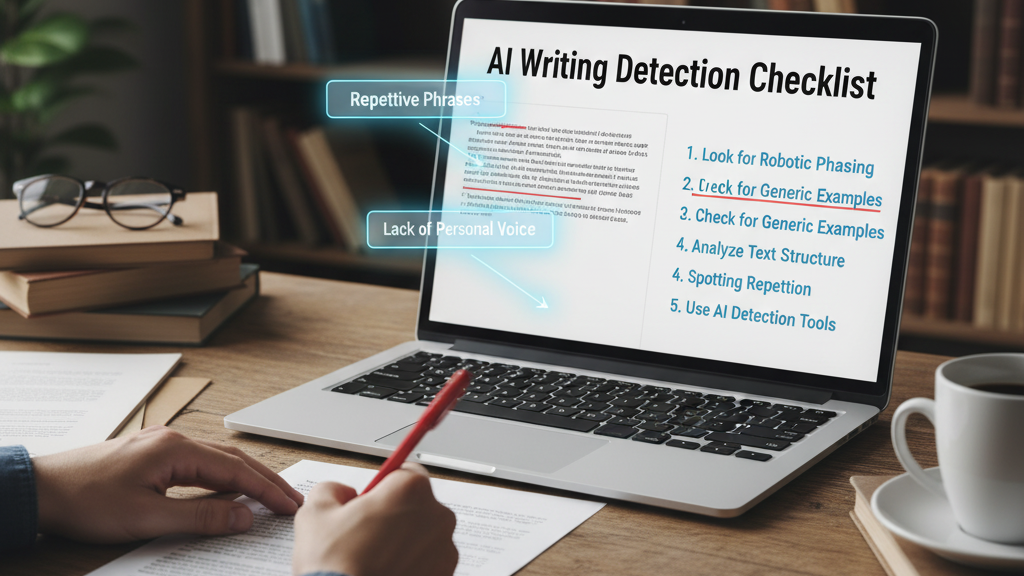
A person's hands are shown at a wooden desk, writing on a paper with a red pen. In front of them, a laptop displays an "AI Writing Detection Checklist" with tips like "Look for Robotic Phrasing," "Check for Generic Examples," and "Analyze Text Structure." Highlighted on the screen are examples of "Repetitive Phrases" and "Lack of Personal Voice," indicating common AI writing tells. A stack of books and a coffee cup are also on the desk. Image (and typos) generated by Nano Banana.
With the proliferation of AI-generated content, discerning human writing from machine-generated text has become an essential skill. This image presents practical tips and a checklist to help identify AI writing, focusing on common tells such as repetitive phrases, generic examples, and a lack of personal voice, empowering readers and educators to critically evaluate written material. Image (and typos) generated by Nano Banana.

Source

CNET

Summary

CNET offers a practical guide for spotting AI-generated writing. It highlights typical cues: prompts embedded openly in the text, overly generic or ambiguous language, unnatural transitions, repetition, and lack of depth or specificity. The article suggests that when a piece echoes the original assignment prompt too directly, that’s a red flag. While no single cue is definitive, combining several tells (tone flatness, formulaic structure, prompt residue) increases confidence that AI was involved. The aim isn’t accusation but raising readers’ critical sensitivity toward AI authorship.

Key Points

  • AI text often includes remnants of the assignment prompt verbatim.
  • It tends to use generic, vague, or ambivalent phrasing more often than human writers.
  • Repetitive patterns, smooth transitions, and “flat” tone are common signals.
  • Contextual depth, original insight, nuance, and emotional detail are often muted.
  • Use a cluster of clues rather than relying on one signal to infer AI writing.

Keywords

URL

https://www.cnet.com/tech/services-and-software/use-these-simple-tips-to-detect-ai-writing/

Summary generated by ChatGPT 5


How AI Is Rewriting the Future of Humanities Education


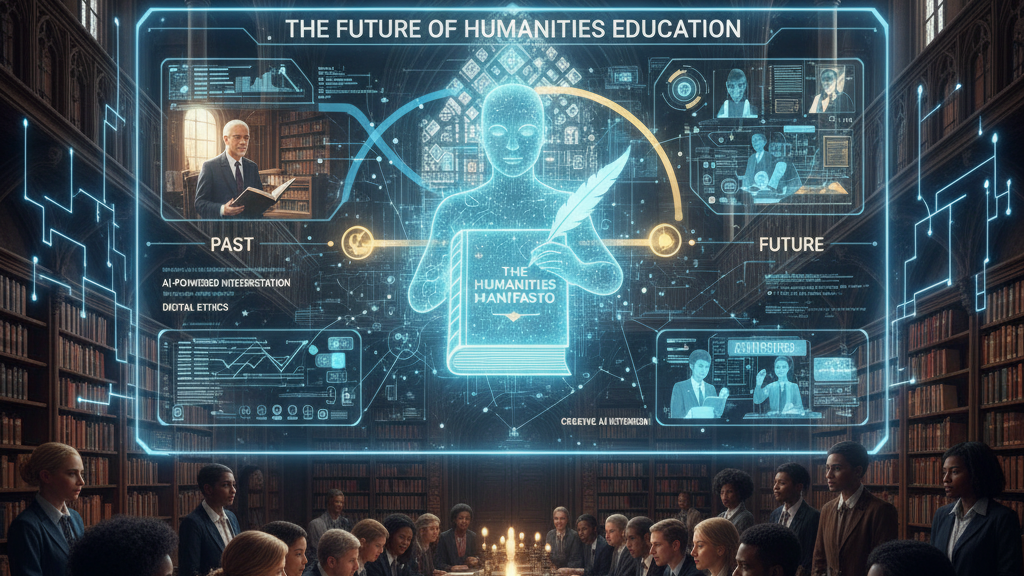
In a grand, ornate university library, a group of diverse students and professors are seated around a long, candlelit wooden table, engaged in a discussion. Above them, a large holographic display titled "THE FUTURE OF HUMANITIES EDUCATION" shows a central figure holding "THE HUMANITIES MANIFESTO" with a quill, flanked by "PAST" and "FUTURE" panels detailing AI-powered interpretation, digital ethics, and evolving roles of AI in humanities. Image (and typos) generated by Nano Banana.
Artificial intelligence is not merely influencing but actively “rewriting” the trajectory of humanities education, prompting a re-evaluation of its foundational principles and methodologies. This image captures a moment of deep academic reflection, visualizing how AI is introducing new tools for interpretation, posing ethical challenges, and ultimately shaping a dynamic new future for the study of human culture and thought. Image (and typos) generated by Nano Banana.

Source

Forbes

Summary

Mary Hemphill argues that while AI is rapidly changing technical and STEM fields, its impact on the humanities may be even more profound. She sees AI not just as a tool but a collaborator—helping students explore new interpretations, generate creative prompts, and push boundaries in writing, philosophy, or cultural critique. But this is double-edged: overreliance risks hollowing out the labour of thinking deeply, undermining the craft faculty value. Hemphill suggests humanities courses must adapt via “AI-native” pedagogy: teaching prompt literacy, interrogative reading, and critical layering. The goal: use AI to elevate human thinking, not replace it.

Key Points

  • Humanities may shift from sourcing facts to exploring deeper interpretation, guided by AI-assisted exploration.
  • Students should be taught prompt literacy—how to interrogate AI outputs, not accept them.
  • “AI-native” pedagogy: adaptation of assignments to expect AI use, layered with critical human engagement.
  • Overreliance on AI can weaken students’ capacity for independent thinking and textual craftsmanship.
  • Humanities faculty must lead design of AI integration that preserves the values of the discipline.

Keywords

URL

https://www.forbes.com/sites/maryhemphill/2025/10/01/how-ai-is-rewriting-the-future-of-humanities-education/

Summary generated by ChatGPT 5