Latest Posts

Harvard Business School Uses AI to Evaluate Students’ Work, Dean Says


In a sophisticated university lecture hall, reminiscent of Harvard, a female speaker stands at a podium, gesturing towards a large interactive screen. The screen prominently displays "AI EVALUATION SYSTEM" along with various complex charts, graphs, and data points, indicating detailed assessment metrics. An audience of students in business attire are seated at tiered desks, working on laptops. Image (and typos) generated by Nano Banana.
Harvard Business School is at the forefront of integrating artificial intelligence into academic assessments, with its Dean confirming the use of AI to evaluate students’ work. This image illustrates a high-tech academic environment where advanced AI evaluation systems are being employed, signifying a significant shift in how student performance is analyzed and graded in prestigious institutions. Image (and typos) generated by Nano Banana.

Source

The Harvard Crimson

Summary

Dean Srikant M. Datar revealed that Harvard Business School (HBS) is actively using AI tools to evaluate student assignments and provide rapid feedback, such as on spreadsheets. At Boston AI Week, he explained that HBS faculty are integrating AI into teaching and research, including through Foundry, a platform connecting entrepreneurs with HBS content. Administrators emphasised that AI supplements, not replaces, classroom learning—supporting tasks like condensing student feedback into actionable insights and offering 24/7 support. HBS leaders frame AI as part of an ongoing digital transformation, stressing the importance of adaptability and a “30 percent rule” for AI literacy.

Key Points

  • HBS uses AI to evaluate coursework and give students rapid feedback.
  • The Foundry platform leverages AI to connect entrepreneurs globally with HBS resources.
  • AI tools condense student feedback for faculty, improving teaching design.
  • Administrators stress AI complements, not replaces, the classroom experience.
  • HBS promotes the “30 percent rule”: basic literacy is enough to work with AI effectively.

Keywords

URL

https://www.thecrimson.com/article/2025/10/2/hbs-dean-ai-use/

Summary generated by ChatGPT 5

AI is smart, just don’t ask it to speak the Irish language


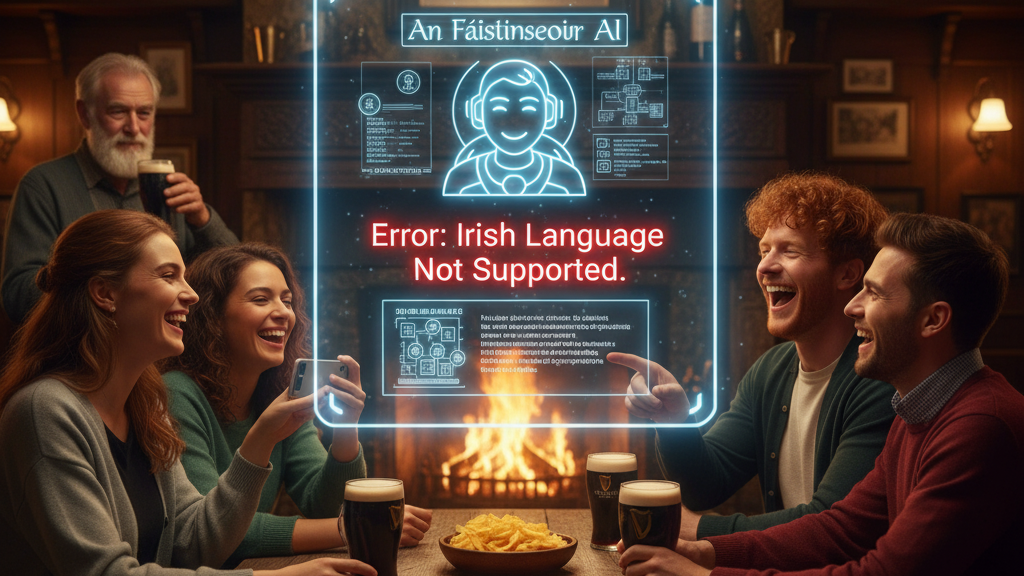
In a warm, traditional Irish pub setting, four friends are seated around a wooden table, laughing and enjoying pints of Guinness, with a fireplace in the background. Above their table, a holographic AI interface glows, displaying "An Fáistinseoir AI" (The Oracle AI) at the top, but prominently featuring a red error message: "Error: Irish Language Not Supported." An older gentleman is visible in the background. Image (and typos) generated by Nano Banana.
While AI demonstrates remarkable intelligence across many domains, its capabilities can be surprisingly limited when it comes to lesser-resourced languages. This image playfully highlights a common challenge: asking AI to engage with the Irish language often reveals its current shortcomings, underscoring the need for more inclusive linguistic development in AI. Image, cultural stereotypes, (and typos) generated by Nano Banana

Source

The Irish Times

Summary

The article highlights how advanced chatbots struggle badly with the Irish language (Gaeilge)—a stark reminder of persistent gaps in AI systems. While AI tools handle common European languages with ease, asking them to converse or translate into Irish produces jumbled pronunciation, random spelling, misinterpretation, or bizarre outputs. The author sees this as symptomatic: AI models often neglect smaller or less commercially profitable languages. For minority and indigenous languages, ensuring AI support is not optional but crucial for cultural preservation, representation, and equitable digital inclusion.

Key Points

  • Chatbots like ChatGPT and Google’s Gemini performed very poorly when asked to speak in Irish: pronunciation errors, mis-translations, confusion with Scots Gaelic.
  • The mismatch highlights that AI models are biased toward well-resourced languages and neglect minority ones.
  • AI’s “knowledge” is constrained by available training data—less data means poorer performance.
  • For languages like Irish, this has real stakes: cultural expression, educational access, digital equity.
  • Improving AI support for Irish (and other underrepresented languages) requires intentional investment and training on local, high-quality data.

Keywords

URL

https://www.irishtimes.com/business/2025/10/02/ai-is-smart-just-dont-ask-it-to-speak-the-irish-language/

Summary generated by ChatGPT 5


6 Smart Ways I Use AI for Learning (Without Becoming Lazy)


A multi-panel image illustrating smart ways to use AI for learning. The top panel shows a large screen displaying six distinct AI applications: "Personalized Tutor," "Concept Explainer," "Creative Brainstormer," "Language Partner," "Language Partner," and "Feedback Coach." The bottom two panels show individuals actively engaging with these AI tools on their laptops in study environments, utilizing holographic interfaces for tasks like personalized tutoring and receiving feedback, all without appearing lazy. Image (and typos) generated by Nano Banana.
This image showcases six intelligent and active ways individuals can leverage AI for enhanced learning without succumbing to intellectual laziness. From personalized tutoring and concept explanation to creative brainstorming and language practice, these methods highlight how AI can be a powerful tool to augment, rather than replace, human effort in the pursuit of knowledge and skill development. Image (and typos) generated by Nano Banana.

Source

PCMag UK

Summary

Brian Westover explains how AI can enhance learning when used as an active partner, not a shortcut. Drawing on studies from MIT and Microsoft, he warns that offloading critical thinking to AI weakens understanding. Instead, Westover outlines six practical ways to use AI as a learning aid—digitising handwritten notes, organising study materials, creating flashcards, simplifying complex topics, engaging in Socratic dialogue, and practising the Feynman technique. These methods turn AI into a reflection tool that reinforces comprehension, memory, and independent reasoning rather than replacing them.

Key Points

  • AI note-taking should complement—not replace—handwriting, which improves retention and understanding.
  • Use AI to digitise notes, compile key concepts, and create flashcards for spaced repetition learning.
  • Simplify complex topics via prompts such as “Explain like I’m 5” or “In simple English”.
  • Apply Socratic dialogue and Feynman techniques to build reasoning, self-explanation, and mastery.
  • Treat AI as a study partner to deepen thinking, not as a shortcut for completing tasks.

Keywords

URL

https://uk.pcmag.com/ai/160379/6-smart-ways-i-use-ai-for-learning-without-becoming-lazy

Summary generated by ChatGPT 5


Faculty innovate with, and avoid, AI in the classroom


A split image contrasting two distinct classroom approaches to AI. On the left, a bright, modern classroom shows faculty and students collaboratively engaging with holographic displays and laptops, demonstrating "Innovative Integration" and "Collaborative Research AI." On the right, a darker, traditional classroom features a blackboard with a large red 'X' over "AI" and "NO AI TOOLS" written below it, with faculty and students avoiding technology, symbolizing resistance to AI. Image (and typos) generated by Nano Banana.
The academic world is currently experiencing a bifurcated response to artificial intelligence: while some faculty are enthusiastically innovating with AI to transform learning, others are deliberately avoiding its integration, advocating for traditional methods. This image vividly illustrates these contrasting approaches within university classrooms, highlighting the ongoing debate and diverse strategies faculty are employing regarding AI. Image (and typos) generated by Nano Banana.

Source

Cornell Chronicle

Summary

Cornell faculty are experimenting with hybrid approaches to AI: some integrate generative AI into coursework, others push back by returning to in-person, pencil-and-paper assessments. In nutrition and disease classes, AI is used to simulate patient case studies, generating unpredictable errors that prompt students to think critically. In parallel, some professors now include short “job interview” chats or oral questions to verify understanding. A campus survey found 70% of students use GenAI weekly or more, but only 44% of faculty do. Cornell is responding via workshops, a GenAI education working group, and guidelines to preserve academic integrity while embracing AI’s pedagogical potentials.

Key Points

  • AI is used to generate case studies, simulate patients, debate AI arguments, and help faculty draft content.
  • Some faculty moved back to paper exams, in-class assessments, or short oral checks (“job interviews”) to guard learning.
  • A campus survey showed 70% of students use GenAI weekly, vs. 44% of faculty.
  • Cornell’s GenAI working group develops policies, workshops, and academic integrity guidelines around AI use.
  • The approach is not binary acceptance or rejection, but navigating where AI can support without eroding students’ reasoning and agency.

Keywords

URL

https://news.cornell.edu/stories/2025/10/faculty-innovate-and-avoid-ai-classroom

Summary generated by ChatGPT 5


How AI Is Rewriting the Future of Humanities Education


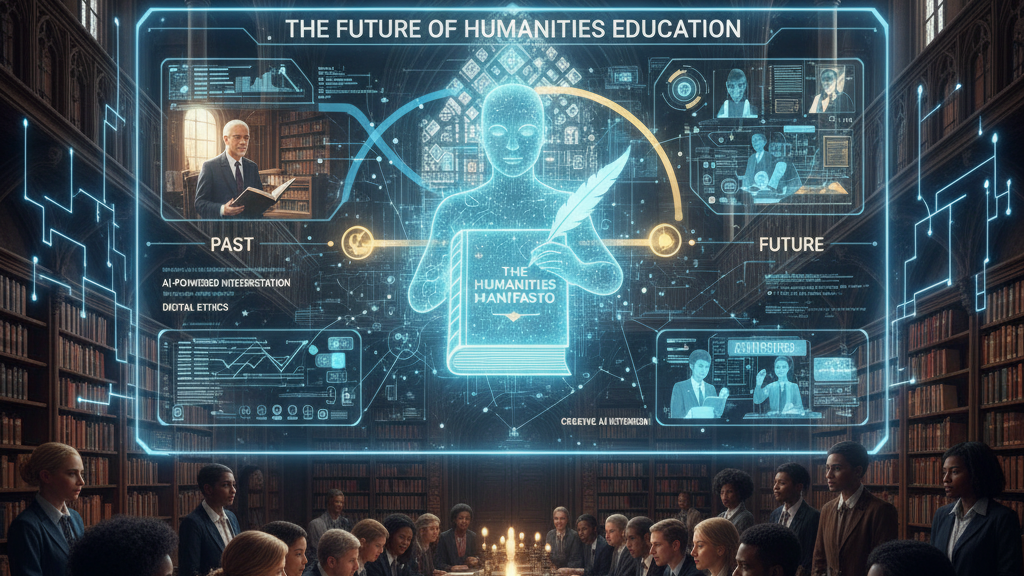
In a grand, ornate university library, a group of diverse students and professors are seated around a long, candlelit wooden table, engaged in a discussion. Above them, a large holographic display titled "THE FUTURE OF HUMANITIES EDUCATION" shows a central figure holding "THE HUMANITIES MANIFESTO" with a quill, flanked by "PAST" and "FUTURE" panels detailing AI-powered interpretation, digital ethics, and evolving roles of AI in humanities. Image (and typos) generated by Nano Banana.
Artificial intelligence is not merely influencing but actively “rewriting” the trajectory of humanities education, prompting a re-evaluation of its foundational principles and methodologies. This image captures a moment of deep academic reflection, visualizing how AI is introducing new tools for interpretation, posing ethical challenges, and ultimately shaping a dynamic new future for the study of human culture and thought. Image (and typos) generated by Nano Banana.

Source

Forbes

Summary

Mary Hemphill argues that while AI is rapidly changing technical and STEM fields, its impact on the humanities may be even more profound. She sees AI not just as a tool but a collaborator—helping students explore new interpretations, generate creative prompts, and push boundaries in writing, philosophy, or cultural critique. But this is double-edged: overreliance risks hollowing out the labour of thinking deeply, undermining the craft faculty value. Hemphill suggests humanities courses must adapt via “AI-native” pedagogy: teaching prompt literacy, interrogative reading, and critical layering. The goal: use AI to elevate human thinking, not replace it.

Key Points

  • Humanities may shift from sourcing facts to exploring deeper interpretation, guided by AI-assisted exploration.
  • Students should be taught prompt literacy—how to interrogate AI outputs, not accept them.
  • “AI-native” pedagogy: adaptation of assignments to expect AI use, layered with critical human engagement.
  • Overreliance on AI can weaken students’ capacity for independent thinking and textual craftsmanship.
  • Humanities faculty must lead design of AI integration that preserves the values of the discipline.

Keywords

URL

https://www.forbes.com/sites/maryhemphill/2025/10/01/how-ai-is-rewriting-the-future-of-humanities-education/

Summary generated by ChatGPT 5