AI in the classroom


In a modern classroom in Pakistan with arched windows, a female professor wearing a hijab stands at the front, gesturing towards a large interactive screen that displays "AI INTEGRATION LAB: UNIVERSITY OF LAHORE" and various AI-related diagrams and Urdu text. Students, both male and female, many wearing hijabs, are seated at desks, actively working on laptops that also show glowing holographic AI interfaces. Image (and typos) generated by Nano Banana.
This image showcases the growing integration of AI in Pakistani classrooms, specifically at the University of Lahore. It depicts a dynamic learning environment where students and educators are actively engaging with artificial intelligence, highlighting the nation’s efforts to adapt its educational system to the demands of a technology-driven future. Image (and typos) generated by Nano Banana.

Source

The News (Pakistan)

Summary

Dr Kashif Salik highlights how artificial intelligence could transform education in Pakistan, especially amid challenges from climate disasters, poor infrastructure, and entrenched inequalities. While AI offers opportunities for resilient and inclusive learning—through online platforms, personalised tutoring, and adaptive instruction—its benefits remain limited by inadequate connectivity, teacher training, and gendered access to technology. The article calls for integrating AI into broader education reform, emphasising digital literacy, climate awareness, and psychological well-being. Salik argues that responsible use of AI can bridge educational gaps and sustain learning during crises, but only if supported by policy, funding, and equitable access.

Key Points

  • AI can improve access to education during crises and support remote learning.
  • Pakistan’s poor infrastructure, low digital literacy, and gender divide hinder adoption.
  • Initiatives like Ataleek and global grants show potential for scalable e-learning.
  • AI could personalise instruction and strengthen resilience in the education system.
  • Reform must combine technology with inclusive, climate-aware education policies.

Keywords

URL

https://www.thenews.com.pk/latest/1349148-ai-in-the-classroom

Summary generated by ChatGPT 5

AI Literacy Is Just Digital and Media Literacy in Disguise


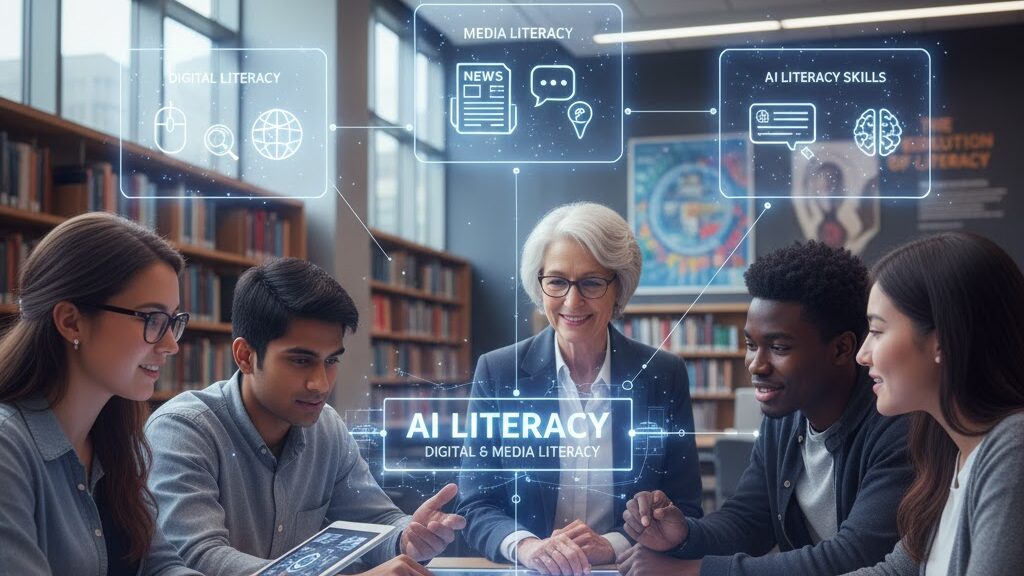
In a modern library setting, a diverse group of four students and a female professor are gathered around a glowing, interactive table displaying "AI LITERACY: DIGITAL & MEDIA LITERACY." Overhead, a holographic overlay connects "DIGITAL LITERACY," "MEDIA LITERACY" (with news icons), and "AI LITERACY SKILLS" (with brain and circuit icons), illustrating the interconnectedness of these competencies. Image (and typos) generated by Nano Banana.
This image visually argues that AI literacy is not an entirely new concept but rather an evolution or “disguise” of existing digital and media literacy skills. It highlights the interconnectedness of understanding digital tools, critically evaluating information, and navigating algorithmic influences, suggesting that foundational literacies provide a strong basis for comprehending and engaging with artificial intelligence effectively. Image (and typos) generated by Nano Banana.

Source

Psychology Today

Summary

Diana E. Graber argues that “AI literacy” is not a new concept but a continuation of long-standing digital and media literacy principles. Triggered by the April 2025 executive order Advancing Artificial Intelligence Education for American Youth, the sudden focus on AI education highlights skills schools should have been teaching all along—critical thinking, ethical awareness, and responsible participation online. Graber outlines seven core areas where digital and media literacy underpin AI understanding, including misinformation, digital citizenship, privacy, and visual literacy. She warns that without these foundations, students face growing risks such as deepfake abuse, data exploitation, and online manipulation.

Key Points

  • AI literacy builds directly on digital and media literacy foundations.
  • An executive order has made AI education a US national priority.
  • Core literacies—critical thinking, ethics, and responsibility—are vital for safe AI use.
  • Key topics include misinformation, cyberbullying, privacy, and online safety.
  • The article urges sustained digital education rather than reactionary AI hype.

Keywords

URL

https://www.psychologytoday.com/us/blog/raising-humans-in-a-digital-world/202510/ai-literacy-is-just-digital-and-media-literacy-in

Summary generated by ChatGPT 5


Admissions Essays Written by AI Are Generic and Easy to Spot


In a grand, wood-paneled library office, a serious female admissions officer in glasses sits at a desk piled with papers and laptops. A prominent holographic alert floats in front of her, reading "AI-GENERATED ESSAY DETECTED" in red. Below it, a comparison lists characteristics of "HUMAN" writing (e.g., unique voice) versus generic AI traits. One laptop screen displays "AI Detection Software" with a high probability score. Image (and typos) generated by Nano Banana.
Despite sophisticated AI capabilities, admissions essays generated by artificial intelligence are often characterised by generic phrasing and a distinct lack of personal voice, making them relatively easy to spot. This image depicts an admissions officer using AI detection software and her own critical judgment to identify an AI-generated essay, underscoring the challenges and tools in maintaining authenticity in student applications. Image (and typos) generated by Nano Banana.

Source

Inside Higher Ed

Summary

Cornell University researchers have found that AI-generated college admission essays are noticeably generic and easily distinguished from human writing. In a study comparing 30,000 human-written essays with AI-generated versions, the latter often failed to convey authentic personal narratives. When researchers added personal details for context, AI tools tended to overemphasise keywords, producing essays that sounded even more mechanical. While the study’s authors note that AI can be helpful for editing and feedback, they warn against using it to produce full drafts. The team also developed a detection model that could identify AI-generated essays with near-perfect accuracy.

Key Points

  • Cornell researchers compared AI and human-written college admission essays.
  • AI-generated essays lacked authenticity and were easily recognised.
  • Adding personal traits often made AI writing sound more artificial.
  • AI can provide useful feedback for weaker writers but not full essays.
  • A detection model identified AI-written essays with high accuracy.

Keywords

URL

https://www.insidehighered.com/news/quick-takes/2025/10/06/admissions-essays-written-ai-are-generic-and-easy-spot

Summary generated by ChatGPT 5


What is AI slop, and is it the end of civilization as we know it?


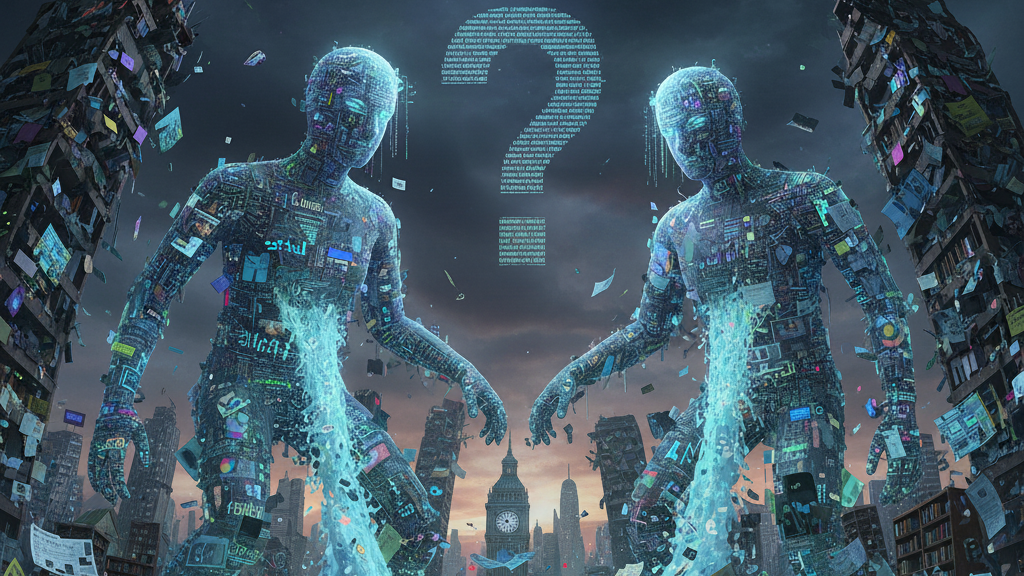
A dystopian cityscape is overwhelmed by two colossal, shimmering, humanoid figures made of digital circuits and data, symbolizing AI. From their bodies, a torrent of digital debris, fragmented text, and discarded knowledge cascades onto the streets below, where tiny human figures struggle amidst the intellectual "slop." A giant question mark made of text hovers in the sky, reflecting the central question. Image (and typos) generated by Nano Banana.
The term “AI slop” refers to the deluge of low-quality, often nonsensical content rapidly generated by artificial intelligence, raising urgent questions about its impact on information integrity and human civilization itself. This dramatic image visually encapsulates the overwhelming and potentially destructive nature of AI slop, prompting a critical examination of whether this deluge of digital detritus marks a turning point for humanity. Image (and typos) generated by Nano Banana.

Source

RTE

Summary

The piece introduces AI slop — a term capturing the deluge of low-quality, mass-produced AI content flooding the web. Slop is described as formulaic, shallow, and often misleading—less about intelligence than volume. The article warns this glut of content blurs meaningful discourse, degrades trust in credible sources, and threatens to overwhelm attention economy. While it stops short of doomism, it argues that we must resist normalisation of slop by emphasising critical reading, curation, and human judgment.

Key Points

  • AI slop refers to content generated by AI that is high in volume but low in substance (generic, shallow, noise).
  • This flood of slop threatens to drown out signals: quality writing, expert commentary, local voices.
  • The problem is systemic: the incentives of clicks, cheap content creation, and algorithmic amplification feed its growth.
  • To counteract slop, the article encourages media literacy, fact-checking, and more discerning consumption.
  • Over time, unchecked proliferation could erode trust in digital media and make distinguishing truth from AI noise harder.

Keywords

URL

https://www.rte.ie/culture/2025/1005/1536663-what-is-ai-slop-and-is-it-the-end-of-civilization-as-we-know-it/

Summary generated by ChatGPT 5


Universities can turn AI from a threat to an opportunity by teaching critical thinking


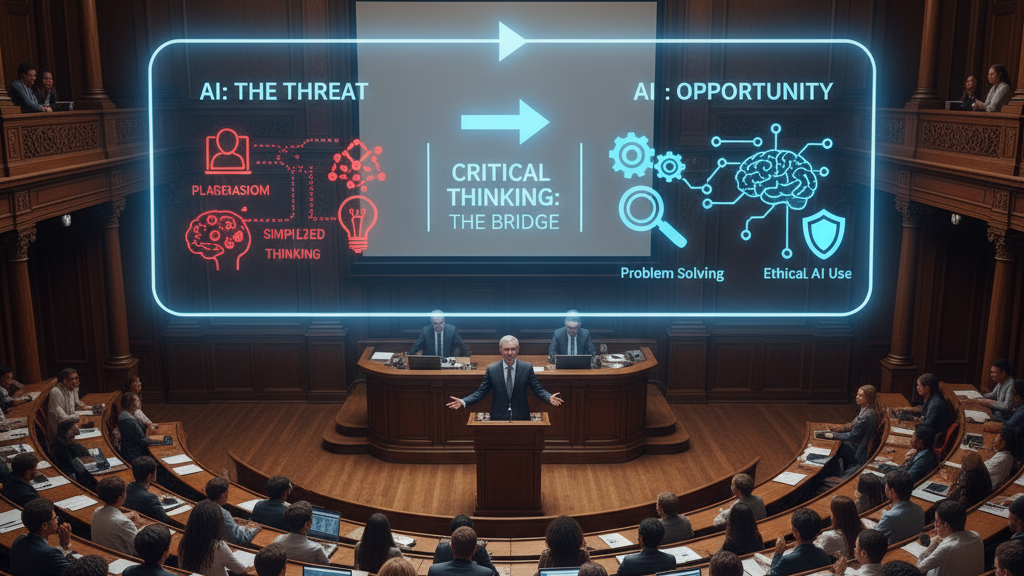
In a grand, tiered university lecture hall, a male professor stands at a podium addressing an audience of students, all working on laptops. Above them, a large holographic display illustrates a transformation: on the left, "AI: THE THREAT" is shown with icons for plagiarism and simplified thinking. In the middle, "CRITICAL THINKING: THE BRIDGE" connects to the right panel, "AI: OPPORTUNITY," which features icons for problem-solving and ethical AI use. Image (and typos) generated by Nano Banana.
Universities have the potential to transform AI from a perceived threat into a powerful educational opportunity, primarily by emphasising and teaching critical thinking skills. This image visually represents critical thinking as the crucial bridge that allows students to navigate the challenges of AI, such as potential plagiarism and shallow learning, and instead harness its power for advanced problem-solving and ethical innovation. Image (and typos) generated by Nano Banana.

Source

The Conversation

Summary

Anitia Lubbe argues that universities should stop treating AI primarily as a threat and instead use it to develop critical thinking. Her research team reviewed recent studies on AI in higher education, finding that generative tools excel at low-level tasks (recall and comprehension) but fail at high-level ones like evaluation and creativity. Traditional assessments, still focused on memorisation, risk encouraging shallow learning. Lubbe proposes redesigning assessments for higher-order skills—asking students to critique, adapt, and evaluate AI outputs. This repositions AI as a learning partner and shifts higher education toward producing self-directed, reflective, and analytical graduates.

Key Points

  • AI performs well on remembering and understanding tasks but struggles with evaluation and creation.
  • Current university assessments often reward the same low-level thinking AI already automates.
  • Teachers should design context-rich, authentic assessments (e.g. debates, portfolios, local case studies).
  • Students can use AI to practise analysis by critiquing or improving generated content.
  • Developing AI literacy, assessment literacy, and self-directed learning skills is key to ethical integration.

Keywords

URL

https://theconversation.com/universities-can-turn-ai-from-a-threat-to-an-opportunity-by-teaching-critical-thinking-266187

Summary generated by ChatGPT 5