AI Is Trained to Avoid These Three Words That Are Essential to Learning


A glowing, futuristic central processing unit (CPU) or AI core, radiating blue light and surrounded by complex circuit board patterns. Three prominent red shield icons, each with a diagonal 'no' symbol crossing through it, are positioned around the core. Inside these shields are the words "WHY," "HOW," and "IMAGINE" in bold white text, signifying that these concepts are blocked or avoided. The overall background is dark and digital, with streams of binary code and data flowing. Image (and typos) generated by Nano Banana.
A critical new analysis reveals that current AI training protocols are designed to avoid the use of three words—”why,” “how,” and “imagine”—which are fundamental to human learning, critical thinking, and creativity. This raises significant questions about the depth of understanding and innovation possible with AI. Image (and typos) generated by Nano Banana.

Source

Education Week

Summary

Sam Wineburg and Nadav Ziv argue that artificial intelligence, by design, avoids the phrase “I don’t know,” a trait that undermines the essence of learning. Drawing on OpenAI’s research, they note that chatbots are penalised for expressing uncertainty and rewarded for confident—but often incorrect—answers. This, they contend, clashes with educational goals that value questioning, evidence-weighing, and intellectual humility. The authors caution educators to slow the rush to integrate AI into classrooms without teaching critical evaluation. Instead of treating AI as a source of truth, students must learn to interrogate it—asking for sources, considering evidence, and recognising ambiguity. True learning, they write, depends on curiosity and the courage to admit what one does not know.

Key Points

  • Chatbots are trained to eliminate uncertainty, prioritising fluency over accuracy.
  • Students and adults often equate confident answers with credible information.
  • AI risks promoting surface-level understanding and discouraging critical inquiry.
  • Educators should model scepticism, teaching students to source and question AI outputs.
  • Learning thrives on doubt and reflection—qualities AI currently suppresses.

Keywords

URL

https://www.edweek.org/technology/opinion-ai-is-trained-to-avoid-these-3-words-that-are-essential-to-learning/2025/10

Summary generated by ChatGPT 5


AI Systems and Humans ‘See’ the World Differently – and That’s Why AI Images Look So Garish


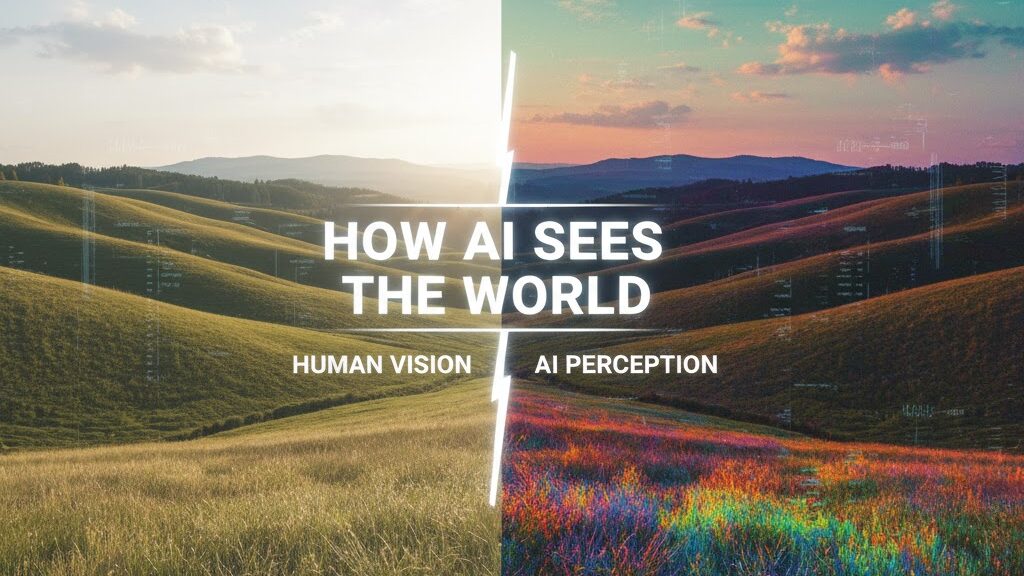
A split image of a rolling green landscape under a sky with clouds. The left side, labeled "HUMAN VISION," shows a natural, soft-lit scene with realistic colors. The right side, labeled "AI PERCEPTION," depicts the exact same landscape but with intensely saturated, almost neon, and unrealistic colors, particularly in the foreground grass which glows with a rainbow of hues. A stark, jagged white line divides the two halves, and subtle digital code overlays the AI side. The central text reads "HOW AI SEES THE WORLD." Image (and typos) generated by Nano Banana.
Ever wonder why AI-generated images sometimes have a unique, almost unnatural vibrancy? This visual contrast highlights the fundamental differences in how AI systems and human perception process and interpret visual information, explaining the often “garish” aesthetic of AI art. Image (and typos) generated by Nano Banana.

Source

The Conversation

Summary

T. J. Thomson explores how artificial intelligence perceives the visual world in ways that diverge sharply from human vision. His study, published in Visual Communication, compares AI-generated images with human-created illustrations and photographs to reveal how algorithms process and reproduce visual information. Unlike humans, who interpret colour, depth, and cultural context, AI relies on mathematical patterns, metadata, and comparisons across large image datasets. As a result, AI-generated visuals tend to be boxy, oversaturated, and generic – reflecting biases from stock photography and limited training diversity. Thomson argues that understanding these differences can help creators choose when to rely on AI for efficiency and when human vision is needed for authenticity and emotional impact.

Key Points

  • AI perceives visuals through data patterns and metadata, not sensory interpretation.
  • AI-generated images ignore cultural and contextual cues and default to photorealism.
  • Colours and shapes in AI images are often exaggerated or artificial due to training biases.
  • Human-made images evoke authenticity and emotional engagement that AI versions lack.
  • Knowing when to use AI or human vision is key to effective visual communication.

Keywords

URL

https://theconversation.com/ai-systems-and-humans-see-the-world-differently-and-thats-why-ai-images-look-so-garish-260178

Summary generated by ChatGPT 5


Experts Warn AI Could Reshape Teen Brains


A focused teenage boy looks down at a glowing digital tablet displaying complex data. Above his head, a bright blue, intricate holographic representation of a human brain pulsates with interconnected data points and circuits, symbolizing the impact of technology. In the blurred background, several adult figures in professional attire stand, observing the scene, representing the "experts." Image (and typos) generated by Nano Banana.
As artificial intelligence becomes increasingly integrated into daily life, experts are raising concerns about its potential long-term effects on the developing brains of teenagers. Explore the warnings and discussions surrounding AI’s influence on cognitive development and neural pathways. Image (and typos) generated by Nano Banana.

Source

CNBC

Summary

Ernestine Siu reports growing concern among scientists and regulators that prolonged use of generative AI by children and teenagers could alter brain development and weaken critical thinking skills. A 2025 MIT Media Lab study found that reliance on large language models (LLMs) such as ChatGPT reduced neural connectivity compared with unaided writing tasks, suggesting “cognitive debt” from over-dependence on external support. Researchers warn that early exposure may limit creativity, self-regulation, and critical analysis, while privacy and emotional risks also loom large as children anthropomorphise AI companions. Experts urge limits on generative AI use among young people, stronger parental oversight, and the cultivation of both AI and digital literacy to safeguard cognitive development and wellbeing.

Key Points

  • One in four U.S. teens now use ChatGPT for schoolwork, double the 2023 rate.
  • MIT researchers found reduced brain network activity in users relying on LLMs.
  • Overuse of AI may lead to “cognitive debt” and hinder creativity and ownership of work.
  • Younger users are particularly vulnerable to emotional and privacy risks.
  • Experts recommend age-appropriate AI design, digital literacy training, and parental engagement.

Keywords

URL

https://www.cnbc.com/2025/10/13/experts-warn-ai-llm-chatgpt-gemini-perplexity-claude-grok-copilot-could-reshape-teen-youth-brains.html

Summary generated by ChatGPT 5


Professors Share Their Findings and Thoughts on the Use of AI in Research


Three professors (one woman, two men) sit around a large polished conference table in a modern office with bookshelves in the background. They are engaged in a discussion, with open laptops, notebooks, and coffee cups in front of them. Overlaying the scene are glowing holographic data visualizations and graphs, with the words "AI IN ACADEMIC RESEARCH: FINDINGS & PERSPECTIVES" digitally projected in the center, representing the intersection of human intellect and artificial intelligence. Image (and typos) generated by Nano Banana.
Dive into the evolving landscape of academic research as leading professors share their insights and discoveries on integrating AI tools. Explore the benefits, challenges, and future implications of artificial intelligence in scholarly pursuits. Image (and typos) generated by Nano Banana.

Source

The Cavalier Daily

Summary

At the University of Virginia, faculty across disciplines are exploring how artificial intelligence can accelerate and reshape academic research. Associate Professor Hudson Golino compares AI’s transformative potential to the introduction of electricity in universities, noting its growing use in data analysis and conceptual exploration. Economist Anton Korinek, recently named among Time’s 100 most influential in AI, evaluates where AI adds value—from text synthesis and coding to ideation—while cautioning that tasks like mathematical modelling still require human oversight. Professors Mona Sloane and Renee Cummings stress ethical transparency, inclusivity, and the need for disclosure when using AI in research, arguing that equity and critical reflection must remain at the heart of innovation.

Key Points

  • AI is increasingly used at the University of Virginia for research and analysis across disciplines.
  • Golino highlights AI’s role in improving efficiency but calls for deeper institutional understanding.
  • Korinek finds AI most effective for writing, coding, and text synthesis, less so for abstract modelling.
  • Sloane and Cummings advocate transparency, ethical use, and inclusion in AI-assisted research.
  • Faculty urge a balance between efficiency, equity, and accountability in AI’s integration into academia.

Keywords

URL

https://www.cavalierdaily.com/article/2025/10/professors-share-their-findings-and-thoughts-on-the-use-of-ai-in-research

Summary generated by ChatGPT 5


OpenAI’s network of deals is propping up the AI boom


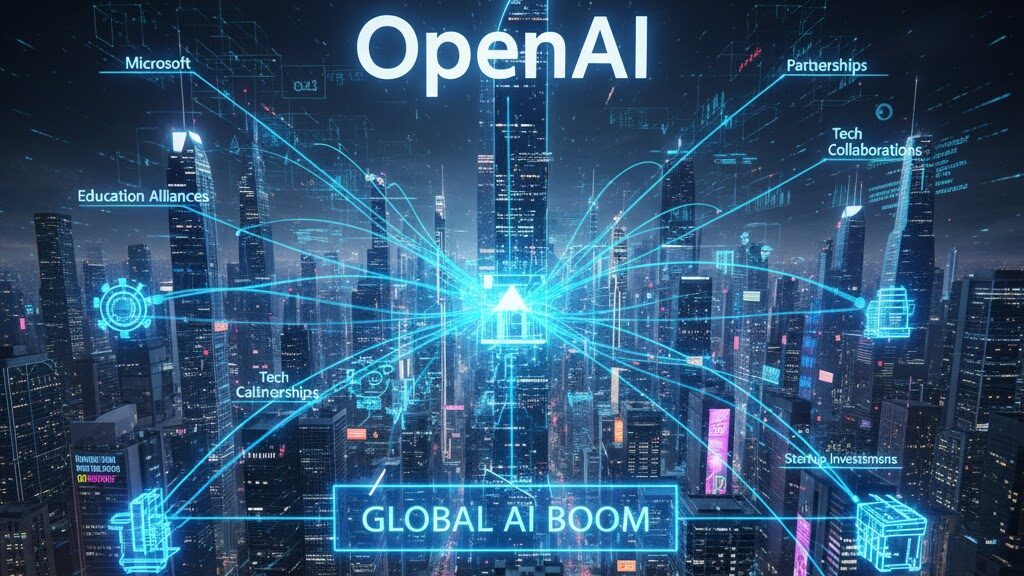
A high-angle, futuristic view of a sprawling metropolis at night, illuminated by glowing blue digital lines connecting various skyscrapers. At the center, "OpenAI" is prominently displayed, with the lines extending outwards to labels like "Microsoft," "Partnerships," "Education Alliances," and "Startup Investments," all converging to fuel a central "GLOBAL AI BOOM" graphic, illustrating OpenAI's extensive network. Image (and typos) generated by Nano Banana.
OpenAI’s vast and strategic network of deals and collaborations is acting as a crucial pillar, significantly propping up the current global AI boom. This image visualises OpenAI at the epicenter of a sprawling digital web, demonstrating how its alliances with major tech giants, educational institutions, and various startups are fueling rapid advancements and investments across the entire artificial intelligence ecosystem. Image (and typos) generated by Nano Banana.

Source

The Irish Times

Summary

Proinsias O’Mahony examines how OpenAI’s intricate web of financial partnerships has become central to sustaining the AI industry’s rapid expansion. Deals with major players such as Nvidia, AMD, and Oracle have created a self-reinforcing investment loop—OpenAI buys chips and services, suppliers reinvest in OpenAI, and valuations rise on expectations of continued demand. This “vendor-financing circle” keeps capital flowing and share prices high but also ties the sector’s fate to a handful of interconnected firms. While the system fuels the AI boom, analysts warn that any slowdown in ChatGPT’s growth could trigger a cascade of mutual losses across the industry.

Key Points

  • OpenAI’s partnerships with Nvidia, AMD, and Oracle form a self-sustaining investment loop.
  • AI suppliers and investors are increasingly financially interdependent.
  • The model boosts market valuations but concentrates systemic risk.
  • Analysts call it a “vendor-financing circle” that relies on perpetual demand.
  • A downturn in AI adoption could unravel the entire interconnected ecosystem.

Keywords

URL

https://www.irishtimes.com/your-money/2025/10/11/openais-network-of-deals-is-propping-up-the-ai-boom/

Summary generated by ChatGPT 5