Building the Manifesto: How We Got Here and What Comes Next

By Ken McCarthy
Estimated reading time: 6 minutes

A minimalist illustration featuring the silhouette of a person standing and gazing toward a horizon line formed by soft, glowing digital patterns and abstract light streams. The scene blends naturalistic contemplation with modern technology, symbolizing human agency in shaping the future of AI against a clean, neutral background. Image (and typos) generated by Nano Banana.
Looking ahead: As we navigate the complexities of generative AI in higher education, it is crucial to remember that technology does not dictate our path. Through ethical inquiry and reimagined learning, the horizon is still ours to shape. Image (and typos) generated by Nano Banana.

When Hazel and I started working with GenAI in higher education, we did not set out to write a manifesto. We were simply trying to make sense of a fast-moving landscape. GenAI arrived quickly, finding its way into classrooms and prompting new questions about academic integrity and AI integration long before we had time to work through what it all meant. Students were experimenting earlier than many staff felt prepared for. Policies were still forming.

What eventually became the Manifesto for Generative AI in Higher Education began as our attempt to capture our thoughts. Not a policy, not a fully fledged framework, not a strategy. Just a way to hold the questions, principles, and tensions that kept surfacing. It took shape through notes gathered in margins, comments shared after workshops, ideas exchanged in meetings, and moments in teaching sessions that stayed with us long after they ended. It was never a single project. It gathered itself slowly.

From the start, we wanted it to be a short read that opened the door to big ideas. The sector already has plenty of documents that run to seventy or eighty pages. Many of them are helpful, but they can be difficult to take into a team meeting or a coffee break. We wanted something different. Something that could be read in ten minutes, but still spark thought and conversation. A series of concise statements that felt recognisable to anyone grappling with the challenges and possibilities of GenAI. A document that holds principles without pretending to offer every answer. We took inspiration from the Edinburgh Manifesto for Teaching Online, which reminded us that a series of short, honest statements can travel further than a long policy ever will.

The manifesto is a living reflection. It recognises that we stand at a threshold between what learning has been and what it might become. GenAI brings possibility and uncertainty together, and our role is to respond with imagination and integrity to keep learning a deeply human act .

Three themes shaped the work

As the ideas settled, three themes emerged that helped give structure to the thirty statements.

Rethinking teaching and learning responds to an age of abundance. Information is everywhere. The task of teaching shifts toward helping students interpret, critique, and question rather than collect. Inquiry becomes central. Several statements address this shift, emphasising that GenAI does not replace thinking. It reveals the cost of not thinking. They point toward assessment design that rewards insight over detection and remind us that curiosity drives learning in ways that completion never can .

Responsibility, ethics, and power acknowledges that GenAI is shaped by datasets, values, and omissions. It is not neutral. This theme stresses transparency, ethical leadership, and the continuing importance of academic judgement. It challenges institutions to act with care, not just efficiency. It highlights that prompting is an academic skill, not a technical trick, and that GenAI looks different in every discipline, which means no single approach will fit all contexts.

Imagination, humanity, and the future encourages us to look beyond the disruption of the present moment and ask what we want higher education to become. It holds inclusion as a requirement rather than an aspiration. It names sustainability as a learning outcome. It insists that ethics belong at the beginning of design processes. It ends with the reminder that the horizon is still ours to shape and that the future classroom is a conversation where people and systems learn in dialogue without losing sight of human purpose

How it came together

The writing process was iterative. Some statements arrived whole. Others needed several attempts. We removed the ones that tried to do too much and kept the ones that stayed clear in the mind after a few days. We read them aloud to test the rhythm. The text only settled into its final shape once we noticed the three themes forming naturally.

The feedback from our reviewers, Tom Farrelly and Sue Beckingham, strengthened the final version. Their comments helped us tighten the language and balance the tone. The manifesto may have two named authors, but it is built from many voices.

Early responses from the sector

In the short time since the manifesto was released, the webpage has been visited by more than 750 people from 40 countries. For a document that began as a few lines in a notebook, this has been encouraging. It suggests the concerns and questions we tried to capture are widely shared. More importantly, it signals that there is an appetite for a conversation that is thoughtful, practical, and honest about the pace of change.

This early engagement reinforces something we felt from the start. The manifesto is only the beginning. It is not a destination. It is a point of departure for a shared journey.

Next steps: a book of voices across the sector

To continue that journey, we are developing a book of short essays and chapters that respond to the manifesto. Each contribution will explore a statement within the document. The chapters will be around 1,000 words. They can draw on practice, research, disciplinary experience, student partnership, leadership, policy, or critique. They can support, question, or challenge the manifesto. The aim is not agreement. The aim is insight.

We want to bring together educators, librarians, technologists, academic developers, researchers, students, and professional staff. The only requirement is that contributors have something to say about how GenAI is affecting their work, their discipline, or their students.

An invitation to join us

If you would like to contribute, we would welcome your expression of interest. You do not need specialist expertise in AI. You only need a perspective that might help the sector move forward with clarity and confidence.

Your chapter should reflect on a single statement. It could highlight emerging practice or ask questions that do not yet have answers. It could bring a disciplinary lens or a broader institutional one.

The manifesto was built from shared conversations. The next stage will be shaped by an even wider community. If this work is going to stay alive, it needs many hands.

The horizon is still ours to shape. If you would like to help shape it with us, please submit an expression of interest through the following link: https://forms.gle/fGTR9tkZrK1EeoLH8

Ken McCarthy

Head of Centre for Academic Practice
South East Technological University

As Head of the Centre for Academic Practice at SETU, I lead strategic initiatives to enhance teaching, learning, and assessment across the university. I work collaboratively with academic staff, professional teams, and students to promote inclusive, research-informed, and digitally enriched education.
I’m passionate about fostering academic excellence through professional development, curriculum design, and scholarship of teaching and learning. I also support and drive innovation in digital pedagogy and learning spaces.

Keywords


Teaching the Future: How Tomorrow’s Music Educators Are Reimagining Pedagogy

By James Hanley, Oliver Harris, Caitlin Walsh, Sam Blanch, Dakota Venn-Keane, Eve Whelan, Luke Kiely, Jake Power, and Alex Rockett Power in collaboration with ChatGPT and Dr Hazel Farrell
Estimated reading time: 7 minutes
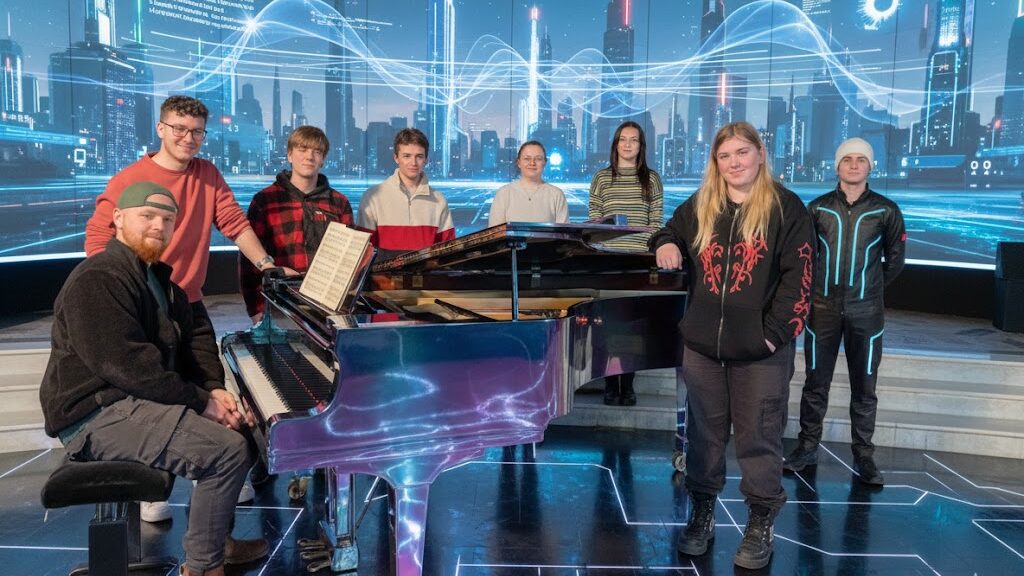
A group of eight music students from the BA (Hons) Music program at SETU are pictured in a futuristic, neon-lit "futureville" setting. They are gathered around a piano, which glows with digital accents, against a backdrop of towering, illuminated cityscapes and flowing data streams.
The future is now! BA (Hons) Music students from SETU in a vibrant “futureville” setting, blending the timeless artistry of music with cutting-edge technological imagination.

In recognition of how deeply AI is becoming embedded in the educational landscape, a co-created assignment exploring possibilities for music educators was considered timely. As part of the Year 3 Music Pedagogy module at South East Technological University (SETU), students were tasked with designing a learning activity that meaningfully integrated AI into the process. They were asked not only to create a resource but to trial it, evaluate it, and critically reflect on how AI shaped the learning experience. A wide range of free AI tools were used, including ChatGPT, SUNO, Audacity, Napkin, Google Gemini, Notebook LM, and Eleven Labs, and each student focused on a teaching resource that resonated with them, such as interactive tools, infographics, lesson plans, and basic websites.

Across their written and audio reflections, a rich picture emerged: AI is powerful, fallible, inspiring, frustrating, and always dependent on thoughtful human oversight. This blog is based on their reflections which reveal a generation of educators learning not just how to use AI, but why it must be used with care.

Expanding Pedagogical Possibilities

Students consistently highlighted AI’s ability to accelerate creativity and resource development. Several noted that AI made it easier to create visually engaging materials, such as diagrams, colourful flashcards, or child‑friendly graphics. One student reflected, “With just a click of the mouse, anyone can generate their own diagrams and flash cards for learning,” emphasising how AI allowed them to design tools they would otherwise struggle to produce manually.

Others explored AI‑generated musical content. One student used a sight‑reading generator to trial melodic exercises, observing that while the exercises themselves were well‑structured, “the feedback was exceedingly generous.” Another used ChatGPT to build a lesson structure, describing the process as “seamless and streamlined,” though still requiring adjustments to ensure accuracy and alignment with Irish terminology. One reflection explained, “AI can create an instrumental track in a completely different style, but it still needs human balance through EQ, compression, and reverb to make it sound natural.” This demonstrated how AI and hands-on editing can work together to develop both musical and technical skills.

An interactive rhythm game for children was designed by another student who used ChatGPT to progressively refine layout, colour schemes, difficulty levels, and supportive messages such as “Nice timing!” and “Perfect rhythm!” They described an iterative process requiring over 30 versions as the model continuously adapted to new instructions. The result was a working single‑player prototype that demonstrated both the creative potential and technical limits of AI‑assisted design.

The Teacher’s Role Remains Central

Across all reflections, students expressed strong awareness that AI cannot replace fundamental aspects of music teaching. Human judgment, accuracy, musical nuance, and relational connection were seen as irreplaceable. One student wrote that although AI can generate ideas and frameworks, “the underlying educational thinking remained a human responsibility.” Another reflected on voice‑training tools, noting that constant pitch guidance from AI could become “a crutch,” misleading students into believing they were singing correctly even when not. Many recognised that while AI can speed up creative processes, the emotional control, balance, and overall musical feel must still come from human input. One reflection put it simply: “AI gives you the idea, but people give it life.”

There was also a deep recognition of the social dimension of teaching. As one student put it, the “teacher–student relationship bears too much of an impact” to be substituted by automated tools. Many emphasised that confidence‑building, emotional support, and adaptive feedback come from real educators, not algorithms.

Challenges, Risks, and Ethical Considerations

The assignment surfaced several important realisations, including the fact that technical inaccuracies were common. Students identified incorrect musical examples, inconsistent notation, malfunctioning website features, and audio‑mixing problems. One student documented how, over time, the “quality of the site got worse,” illustrating AI’s tendency to forget earlier instructions in long interactions. This reinforced the need for rigorous verification when creating learning materials.

Another reflection noted that not all AI websites perform equally; some produce excellent results, while others generate distorted or incomplete outputs, forcing teachers to try multiple tools before finding one that works. It also reminded educators that even free or simple programs, like basic versions of Audacity, can still teach valuable mixing and editing skills without needing expensive software. A parallel concern was over‑reliance. Students worried that teachers might outsource too much planning to AI or that learners might depend on automated feedback rather than developing critical listening skills. As one reflection warned, “AI can and will become a key tool… the crucial factor is that we as real people know where the line is between a ‘tool’ and a ‘free worker.’”

Equity of access also arose as a barrier. Subscription‑based AI tools required credits or payment, creating challenges for students and highlighting ethical tensions between commercial technologies and educational use. Students demonstrated strong awareness of academic integrity. They distinguished between using AI to support structure and clarity versus allowing AI to generate entire lessons or presentations. One student cautioned that presenting AI‑produced content as one’s own is “blatant plagiarism,” highlighting the need for transparent and ethical practice.

Learning About Pedagogy and Professional Identity

Many students described developing a clearer sense of themselves as educators. They reflected on the complexity of communicating clearly, engaging learners, and designing accessible content. Some discovered gaps in their teaching confidence; others found new enthusiasm for pedagogical design. One wrote, “Teaching and clearly communicating my views was more challenging than I assumed,” acknowledging the shift from student to teacher mindset. Another recognised that while AI could support efficiency, it made them more aware of their responsibility for accuracy and learner experience.

Imagining the Future of AI in Music Education

Students were divided between optimism and caution. Some saw AI becoming a standard part of educational resource creation, enabling personalised practice, interactive learning, and rapid content generation. Others expressed concern about the possibility of AI replacing human instruction if not critically managed. However, all students agreed on one point: AI works best when treated as a supportive tool rather than an autonomous teacher. As one reflection summarised, “It is clear to me that AI is by no means a replacement for musical knowledge or teaching expertise.” Another added, “AI can make the process faster and more creative, but it still needs the human touch to sound right.”

Dr Hazel Farrell

Academic Lead for GenAI, Programme Leader BA (Hons) Music
South East Technological University

Dr Hazel Farrell is the SETU Academic Lead for Generative AI, and lead for the N-TUTORR National Gen AI Network project GenAI:N3, which aims to draw on expertise across the higher education sector to create a network and develop resources to support staff and students. She has presented her research on integrating AI into the classroom in a multitude of national and international forums focusing on topics such as Gen AI and student engagement, music education, assessment re-design, and UDL.

Keywords


The Transformative Power of Communities of Practice in AI Upskilling for Educators

By Bernie Goldbach, RUN EU SAP Lead
Estimated reading time: 5 minutes
A diverse group of five educators collaboratively studying a glowing, holographic network of digital lines and nodes on a table, symbolizing their shared learning and upskilling in Artificial Intelligence (AI) within a modern, book-lined academic setting. Image (and typos) generated by Nano Banana.
The power of collaboration: Communities of Practice are essential for educators to collectively navigate and integrate new AI technologies, transforming teaching and learning through shared knowledge and support. Image (and typos) generated by Nano Banana.

When the N-TUTORR programme ended in Ireland, I remained seated in the main Edtech25 auditorium to hear some of the final conversations by key players. They stood at a remarkable intersection of professional development and technological innovation. And some of them issued a call to action for continued conversation, perhaps engaging with generative AI tools within a Community of Practice (CoP).

Throughout my 40 year teaching career, I have walked pathways to genuine job satisfaction that extended far beyond simple skill acquisition. In my specific case, this satisfaction emerged from the synergy between collaborative learning, pedagogical innovation, and an excitement that the uncharted territory is unfolding alongside peers who share their commitment to educational excellence.

Finding Professional Fulfillment Through Shared Learning

The journey of upskilling in generative AI feels overwhelming when undertaken in isolation. I am still looking for a structured CoP for Generativism in Education. This would be a rich vein of collective discovery. At the moment, I have three colleagues who help me develop my skills with ethical and sustainable use of AI.

Ethan Mollick, whose research at the Wharton School has illuminated the practical applications of AI in educational contexts, consistently emphasises that the most effective learning about AI tools happens through shared experimentation and peer discussion. His work demonstrates that educators who engage collaboratively with AI technologies develop more sophisticated mental models of how these tools can enhance rather than replace pedagogical expertise. This collaborative approach alleviates the anxiety many educators feel about technological change, replacing it with curiosity and professional confidence.

Mairéad Pratschke, whose work emphasises the importance of collaborative professional learning, has highlighted how communities create safe spaces where educators can experiment, fail, and succeed together without judgment. This psychological safety becomes the foundation upon which genuine professional growth occurs.

Frances O’Donnell, whose insights at major conferences have become invaluable resources for educators navigating the AI landscape, directs the most effective AI workshops I have attended. O’Donnell’s hands-on training at conferences such as CESI (https://www.cesi.ie), EDULEARN (https://iceri.org), ILTA (https://ilta.ie), and Online Educa Berlin (https://oeb.global) have illuminated the engaging features of instructional design that emerge when educators thoughtfully integrate AI tools. Her instructional design frameworks demonstrate how AI can support the creation of personalised learning pathways, adaptive assessments, and multimodal content that engages diverse learners. O’Donnell’s emphasis on the human element in AI-assisted design resonates deeply with Communities of Practice

And thanks to Frances O’Donnell, I discovered the AI assistants inside H5P.

Elevating Instructional Design Through AI-Assisted Tools

The quality of instructional design, personified by clever educators, represents the most significant leap I have made when combining AI tools with collaborative professional learning. The commercial version of H5P (https://h5p.com) has revolutionised my workflow when creating interactive educational content. The smart import feature of H5P.com complements my teaching practice. I can quickly design rich, engaging learning experiences that would previously have required specialised technical skills or significant time investments. I have discovered ways to create everything from interactive videos with embedded questions to gamified quizzes and sophisticated branching scenarios.

I hope I find a CoP in Ireland that is interested in several of the H5P workflows I have adopted. For the moment, I’m revealing these remarkable capabilities while meeting people at education events in Belgium, Spain, Portugal, and the Netherlands. It feels like I’m a town crier who has a notebook full of shared templates. I want to offer links to the interactive content that I have created with H5P AI and gain feedback from interested colleagues. But more than the conversations at the conferences, I’m interested in making real connections with educators who want to actively participate in vibrant online communities where sustained professional learning continues.

Sustaining Innovation with Community

Job satisfaction among educators has always been closely tied to their sense of efficacy and their ability to make meaningful impacts on student learning. Communities of Practice focused on AI upskilling amplify this satisfaction by creating networks of mutual support where members celebrate innovations, troubleshoot challenges, and collectively develop best practices. When an educator discovers an effective way to use AI for differentiation or assessment design, sharing that discovery with colleagues who understand the pedagogical context creates a profound sense of professional contribution.

These communities also combat the professional tension that currently faces proficient AI users. Mollick’s observations about blowback against widespread AI adoption in education reveal a critical imperative to stand together with a network that validates the quality of teaching and provides constructive feedback. When sharing with a community, individual risk-taking morphs into collective innovation, making the professional development experience inherently more satisfying and sustainable.

We need the spark of N-TUTORR inside an AI-focused Community of Practice. We need to amplify voices. Together we need to become confident navigators of innovation. We need to co-create contextually appropriate pedagogical approaches that effectively leverage AI in education.


Keywords


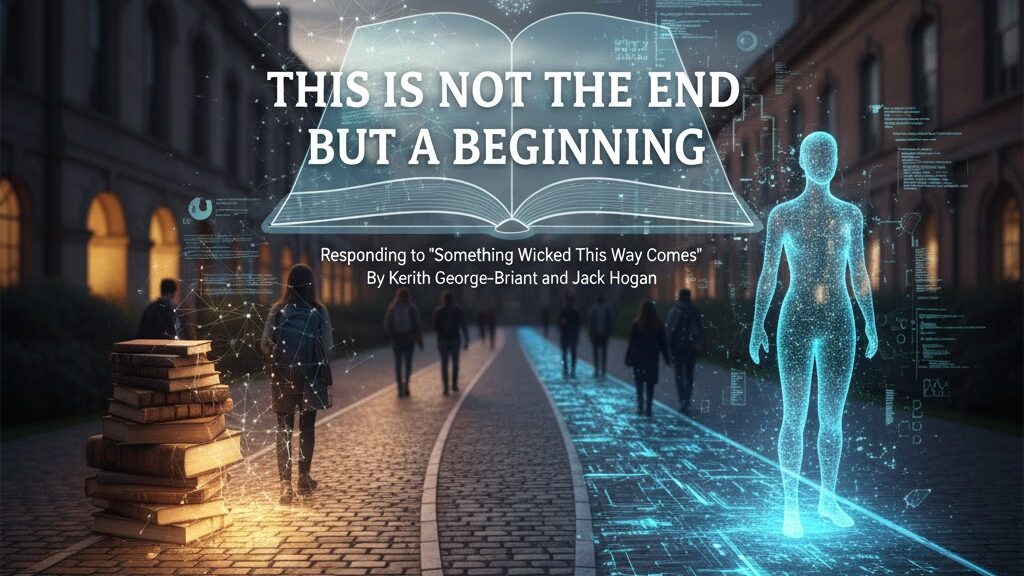
This is not the end but a beginning: Responding to “Something Wicked This Way Comes”

By Kerith George-Briant and Jack Hogan, Abertay University Dundee
Estimated reading time: 5 minutes
A conceptual illustration showing a digital roadmap splitting into two distinct, glowing paths, one labeled "Secure Assessment" and the other "Open Assessment." The background blends subtle academic motifs with swirling binary code, symbolizing the strategic integration of Generative AI into higher education assessment practices. Image (and typos) generated by Nano Banana.
Navigating the future: The “Two-Lane Approach” to Generative AI in assessment—balancing secure testing of threshold concepts (Lane 1) with open collaboration for developing AI literacy and critical thinking (Lane 2). Image (and typos) generated by Nano Banana.

O’Mahony’s provocatively titled “Something Wicked This Way Comes” blog outlined feelings we recognised from across the sector, which were that Generative AI (GenAI) tools have created unease, disruption, and uncertainty. In addition, we felt that GenAI provided huge opportunities, and as higher education has led and celebrated innovation in all disciplines over centuries, how this translated into our assessment practices intrigued us. 

At Abertay University, we’ve been exploring the “wicked problem” of whether to change teaching practices through a small-scale research project entitled “Lane Change Ahead: Artificial Intelligence’s Impact on Assessment Practices.” Our findings agree with O’Mahony’s observations that while GenAI does pose a challenge to academic integrity and traditional assessment models, it also offers opportunities for innovation, equity, and deeper learning, but we must respond thoughtfully and acknowledge that there are a variety of views on GenAI.

Academic Sensemaking

To understand colleagues’ perspectives and experiences, we applied Degn’s (2016) concept of academic sensemaking to understand how the colleagues we interviewed felt about GenAI. Findings showed that some assessment designers are decoupling, designing assessments that use GenAI outputs without requiring students to engage with the tools. Others are defiant or defeatist, allowing limited collaboration with GenAI tools but awarding a low percentage of the grade to that output. And some are strategic and optimistic, embracing GenAI as a tool for learning, creativity, and employability.

The responses show the reasons for unease are not just pedagogical; they’re deeply personal. GenAI challenges academic identity. Recognising this emotional response is essential to supporting staff if change is needed.

Detection and the Blurred Line

And change is needed, we would argue. Back in 2023, Perkin et al’s analysis of Turnitin’s AI detection capabilities revealed that while 91% of fully AI-generated submissions were flagged, the average detection within each paper was only 54.8% and only half of those flagged papers would have been referred for academic misconduct. Similar studies since then have continued to show the same types of results. And if detection isn’t possible, setting an absurd line as referred to by Corbin et al is ever more incongruous. There is no reliable way to indicate whether a student has stopped at the point of using AI for brainstorming or has engaged critically with AI paraphrased output. Some may read this and think that it’s game over, however if we embrace these challenges and adapt our approaches, we find solutions that are fit for purpose.

From Fear to Framework: The Two-Lane Approach

So, what is the solution? Our research explored whether the two-lane approach developed by Liu and Bridgeman would work at Abertay, where:

  • Lane 1: Secure Assessments would be conducted under controlled conditions to assure learning of threshold concepts and
  • Lane 2: Open Assessments would allow unrestricted use of GenAI.

Our case studies revealed three distinct modes of GenAI integration:

  • AI Output Only – Students critiqued AI-generated content without using GenAI themselves. This aligned with Lane 1 and a secure assessment method focusing on threshold concepts.
  • Limited Collaboration – Students used GenAI for planning and a minimal piece of output within a larger piece of assessment, which did not allow GenAI use. Students developed some critical thinking, but weren’t able to apply this learning to the whole assessment.
  • Unlimited Collaboration – Students were fully engaged with GenAI, with reflection and justification built into the assessment. Assessment designers reporting that students produced higher quality work and demonstrated enhanced critical thinking.

Each mode reflected a different balance of trust, control, and pedagogical intent. Interestingly, the AI Output pieces were secure and used to build AI literacy while meeting PSRB requirements, which asked for certain competencies and skills to be tested. The limited collaboration had an element of open assessment, but the percentage of the grade awarded to the output was minimal, and an absurd line was created by asking for no AI use in the larger part of the assessment. Finally, the assessments with unlimited collaboration were designed because those colleagues believed that writing without GenAI was not authentic, and they believed that employers would expect AI literacy skills, perhaps not misplaced based on the figure given in O’Mahony’s blog.

Reframing the Narrative: GenAI as Opportunity

We see the need to treat GenAI as a partner in education, one that encourages critical reflection. This will require carefully scaffolded teaching activities to develop the AI literacy of students and avoid cognitive offloading. Thankfully, ways forward have begun to appear, as noted in the work of Gerlick and Jose et al.

Conclusion: From Wicked to ‘Witch’ lane?

As educators, we have a choice. We can resist, decouple from GenAI or we can choose to lead the narrative strategically and optimistically. Although the pathway forward may not be a yellow brick road, we believe it’s worth considering which lane may suit us best. The key is that we don’t do this in isolation, but we take a pragmatic approach across our entire degree programme considering the level of study and the appropriate AI literacy skills.

GenAI acknowledgement:
Microsoft Copilot (https://copilot.microsoft.com) – used to create a draft blog from our research paper.

Kerith George-Briant

Learner Development Manager
Abertay University

Kerith George-Briant manages the Learner Development Service at Abertay. Her key interests are in building best practices in using AI, inclusivity, and accessibility.

Jack Hogan

Lecturer in Academic Practice
Abertay University

Jack Hogan works within the Abertay Learning Enhancement (AbLE) Academy as a Lecturer in Academic Practice. His research interests include student transitions and the first-year experience, microcredentials, skills development and employability. 


Keywords


AI Could Revolutionise Higher Education in a Way We Did Not Expect

by Brian Mulligan – e-learning consultant with Universal Learning Systems (ulsystems.com)
Estimated reading time: 5 minutes
grand, expansive, and ornate university library or academic hall with high ceilings and classical architecture. In the center, a towering, swirling helix of glowing blue digital data, code, books, and educational icons rises dramatically, representing the transformative power of AI. Around the hall, students are seated at tables with glowing laptops, and many more students are walking and interacting. Holographic projections of famous busts and academic figures are subtly integrated into the scene. The entire environment is infused with a futuristic, digital glow. Image (and typos) generated by Nano Banana.
Artificial intelligence is poised to unleash a revolution in higher education, not in the ways we’ve conventionally imagined, but through unexpected and profound transformations. This image visualises AI as a central, dynamic force reshaping academic landscapes, curriculum delivery, and the very nature of learning in universities. Image (and typos) generated by Nano Banana.

The current conversation about Artificial Intelligence (AI) in higher education primarily focuses on efficiency and impact. People talk about how AI can personalise learning, streamline administrative tasks, and help colleges “do more with less.” For decades, every new technology, from online training to MOOCs, promised a similar transformation. Generative AI certainly offers powerful tools to enhance existing processes.

However, perhaps the revolutionary potential of AI in higher education may come from a more critical and urgent pressure: its significant challenge to the integrity of academic credentials and the learning processes they are supposed to represent.

Historically, colleges haven’t had a strong incentive to completely overhaul their teaching models just because new technology arrived. Traditional lectures, established assessment methods, and the value of a physical campus have remained largely entrenched. Technology usually just served to augment existing practices, not to transform the underlying structures of teaching, learning, and accreditation.

AI, however, may be a different kind of catalyst for change.

The Integrity Challenge

AI’s ability to create human-quality text, solve complex problems, and produce creative outputs has presented a serious challenge to academic integrity. Reports show a significant rise in AI-driven cheating, with many students now routinely using these tools to complete their coursework. For a growing number of students, offloading cognitive labour, from summarising readings to generating entire essays, to AI is becoming the new norm.

This widespread and mostly undetectable cheating compromises the entire purpose of assessment: to verify genuine learning and award credible qualifications. Even students committed to authentic learning feel compromised, forced to compete against peers using AI for an unfair advantage.

Crucially, even when AI use is approved, there’s a legitimate concern that it can undermine the learning process itself. If students rely on AI for foundational tasks like summarisation and idea generation, they may bypass the essential cognitive engagement and critical thinking development. This reliance can lead to intellectual laziness, meaning the credentials universities bestow may no longer reliably signify genuine knowledge and skills. This creates an urgent imperative for institutions to act.

The Shift to Authentic Learning

While many believe we can address this just by redesigning assignments, the challenge offers, and may even require, a structural shift towards more radical educational models. These new approaches,which have been emerging to address the challenges of quality, access and cost, may also prove to be the most effective ways of addressing academic integrity challenges.

To illustrate the point, let’s look at three examples of such emerging models:

  1. Flipped Learning: Students engage with core content independently online. Valuable in-person time is then dedicated to active learning like problem-solving, discussions, and collaborative projects. Educators can directly observe the application of knowledge, allowing for a more authentic assessment of understanding.
  2. Project-Based Learning (PBL): Often seen as an integrated flipped model, PBL immerses students in complex, integrated projects over extended periods. The focus is on applying knowledge from multiple modules and independent research to solve real-world problems. These projects demand sustained, supervised engagement, creative synthesis, and complex problem-solving, capabilities that are very hard to simply outsource to AI.
  3. Work-Based Learning (WBL): A significant part of the student’s journey takes place in authentic workplace settings. The emphasis shifts entirely to the demonstrable application of skills and knowledge in genuine professional contexts, a feat AI alone cannot achieve. Assessment moves to evaluating how a student performs and reflects in their role, including how they effectively and ethically integrate AI tools professionally.

AI as the Enabler of Change

Shifting to these models isn’t easy. Can institutions afford the resources to develop rich content, intricate project designs, and robust supervisory frameworks? Creating and assessing numerous, varied, and authentic tasks requires significant time and financial investment.

This is where technology, now including AI itself, becomes the key enabler for the feasibility of these new pedagogical approaches. Learning technologies, intelligently deployed, can help by:

  • Affordably Creating Content: AI tools rapidly develop diverse learning materials, including texts, videos and formative quizzes as well as more sophisticated assessment designs.
  • Providing Automated Learning Support: AI-powered tutors and chatbots offer 24/7 support, guiding students through challenging material, which personalises the learning journey.
  • Monitoring Independent Work: Learning analytics, enhanced by AI, track student engagement and flag struggling individuals. This allows educators to provide timely, targeted human intervention.
  • Easing the Assessment Burden: Technology can streamline the heavy workload associated with more varied assignments. Simple digital tools like structured rubrics and templated feedback systems free up educator time for nuanced, human guidance.

In summary, the most significant impact of AI isn’t the familiar promise of doing things better or faster. By undermining traditional methods of learning verification through the ease of academic dishonesty, AI has created an unavoidable pressure for systemic change. It forces colleges to reconsider what they are assessing and what value their degrees truly represent.

It’s that AI, by challenging the old system so thoroughly, makes the redesign of higher education a critical necessity.

Brian Mulligan

E-learning Consultant
Universal Learning Systems (ulsystems.com)

Brian Mulligan is an e-learning consultant with Universal Learning Systems (ulsystems.com) having retired as Head of Online Learning Innovation at Atlantic Technological University in Sligo in 2022. His current interests include innovative models of higher education and the strategic use of learning technologies in higher education.


Keywords