Google’s top AI scientist says ‘learning how to learn’ will be next generation’s most needed skill


Four diverse young individuals (three female, one male) are seated around a futuristic round table in a high-rise room overlooking a city. In the center of the table, glowing holographic icons emanate from a central lightbulb, representing concepts like 'METACOGNITION,' 'CRITICAL THINKING,' 'PROBLEM SOLVING,' and 'ADAPTABILITY.' The scene symbolises the importance of fundamental learning skills for the next generation. Generated by Nano Banana.
In an era of rapid technological change and readily available information, the ability to ‘learn how to learn’ is emerging as the paramount skill for the next generation. This image illustrates a collaborative, future-focused environment where metacognition, critical thinking, and continuous adaptation are the core competencies being cultivated to thrive in an unpredictable world. Image generated by Nano Banana.

Source

AP News

Summary

At a public talk in Athens, Demis Hassabis, CEO of DeepMind and 2024 Nobel laureate, stressed that rapid advances in AI demand the human meta-skill of “learning how to learn.” He argued that traditional education (math, science, humanities) will remain important, but people must develop adaptability and the capacity to continuously upskill. Hassabis warned that artificial general intelligence (AGI) might arrive within a decade, making continuous learning essential. He also warned of inequality risks if AI’s benefits remain in the hands of a few, urging both societal awareness and human agency.

Key Points

  • Hassabis proposes that meta-learning (knowing how to learn) will become a critical human skill as AI rises.
  • He predicts AGI could emerge in ~10 years, accelerating the need to adapt.
  • Traditional knowledge (math, humanities) will remain relevant, but must be complemented by agility.
  • He cautions against inequality: if gains flow only to a few, social mistrust may grow.
  • The pace of AI change is so fast that fixed curricula risk becoming obsolete.

Keywords

URL

https://www.apnews.com/article/greece-google-artificial-intelligence-hassabis-85bff114c30cbea4b951ab93dcc1e6d1

Summary generated by ChatGPT 5


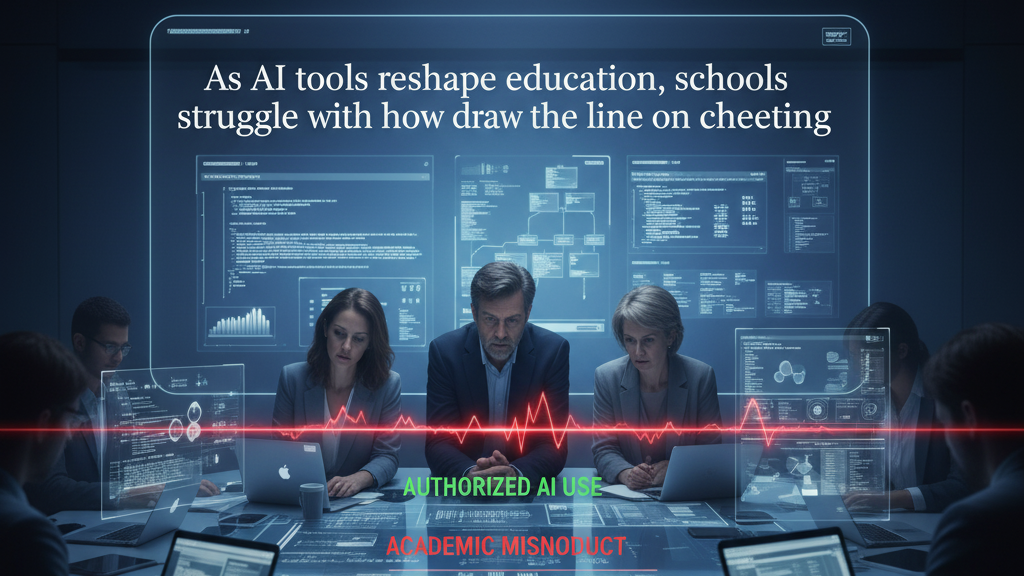
As AI tools reshape education, schools struggle with how to draw the line on cheating


A group of educators and administrators in business attire are seated around a modern conference table, intensely focused on laptops. A glowing red line, fluctuating like a waveform, runs down the center of the table, separating 'AUTHORIZED AI USE' from 'ACADEMIC MISCONDUCT'. A large holographic screen above displays the headline 'As AI tools reshape education, schools struggle with how to how to draw the line on cheeting'. The scene visualizes the challenge of defining ethical boundaries for AI in academia. Generated by Nano Banana.
As AI tools become ubiquitous in education, schools are grappling with the complex and often ambiguous task of defining the line between legitimate AI assistance and academic misconduct. This image captures the intensity of discussions among educators striving to establish clear policies and maintain academic integrity in an evolving technological landscape. Image (and typos) generated by Nano Banana.

Source

ABC News

Summary

AI is now so widespread among students that traditional assessments (take‑home essays, homework) are often considered invitations to ‘cheat.’ Teachers are responding by shifting to in‑class writing, using lockdown browsers, blocking device access, redesigning assignments, and clarifying AI policies. But confusion remains: students don’t always have clarity on what’s allowed, and teaching methods lag behind the technology. There’s growing consensus that blanket bans are not enough — what matters more is teaching students how to use AI responsibly, with transparent guidelines that protect academic integrity without stifling learning.

Key Points

  • High prevalence of student use of AI is challenging existing norms around homework & take‑home essays.
  • Teachers increasingly require in‑class work, verbal assessments, or technology controls (lockdown browser).
  • Students often unsure where the line is: what counts as cheating isn’t always clear.
  • Institutions & faculty are drafting clearer policies and guidelines; bans alone are unviable.
  • Equity issues emerge: AI access/use varies, raising fairness concerns.

Keywords

URL

https://abcnews.go.com/US/wireStory/ai-tools-reshape-education-schools-struggle-draw-line-125501970

Summary generated by ChatGPT 5


The Question All Colleges Should Ask Themselves About AI


In a grand, traditional university library, a glowing holographic question mark formed from digital circuitry. Inside the question mark, the text reads "WHAT IS OUR PURPOSE IN THE AGE OF AI?". Image (and typos) generated by Nano Banana.
As Artificial Intelligence reshapes industries and societies, colleges and universities are confronted with a fundamental challenge: redefining their core purpose. This image powerfully visualises the critical question that all academic institutions must now address regarding their relevance, value, and role in an increasingly AI-driven world. Image (and typos) generated by Nano Banana.

Source

The Atlantic

Summary

AI is now deeply embedded in college life — often unauthorised — and colleges are struggling with responses. Many institutions fail to enforce coherent, system‑wide policies, risking degradation of learning, peer relationships, and integrity of scholarship. The article suggests radical measures like tech/device bans or stronger honour codes to defend educational values, while teaching responsible AI use where appropriate. Colleges must choose whether to integrate AI or resist it, guided by their core values.

Key Points

  • Unauthorised AI use undermines learning and fairness.
  • Removes opportunities for deep thinking and writing.
  • Institutional goals like originality are compromised by AI’s fabrications and IP issues.
  • Proposals: banning devices, honour codes, strict penalties.
  • Colleges must clarify values and boundaries for AI use.

Keywords

URL

https://www.theatlantic.com/culture/archive/2025/09/ai-colleges-universities-solution/684160/

Summary generated by ChatGPT 5


Social media is teaching children how to use AI. How can teachers keep up?


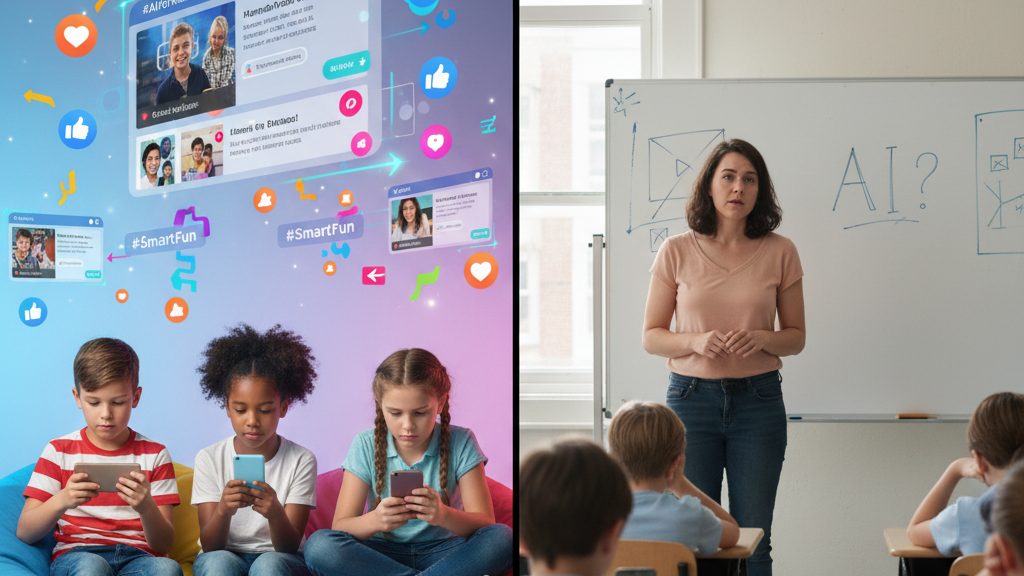
A split image contrasting two scenes. On the left, three young children are engrossed in tablets and smartphones, surrounded by vibrant social media interfaces featuring AI-related content and hashtags like "#AIforkids." On the right, a teacher stands in a traditional classroom looking somewhat perplexed at a whiteboard with "AI?" written on it, while students sit at desks, symbolizing the challenge for educators to keep pace with children's informal AI learning. Image (and typos) generated by Nano Banana.
While children are rapidly learning about AI through pervasive social media platforms, educators face the challenge of integrating this knowledge into formal learning environments. This image highlights the growing disconnect between how children are acquiring AI literacy informally and the efforts teachers must make to bridge this gap and keep classroom instruction relevant and engaging. Image (and typos) generated by Nano Banana.

Source

The Conversation

Summary

Students are learning to use AI mainly through TikTok, Discord, and peer networks, while teachers rely on informal exchanges and LinkedIn. This creates quick but uneven knowledge transfer that often skips deeper issues such as bias, equity, and ethics. A Canadian pilot project showed that structured teacher education transforms enthusiasm into critical AI literacy, giving educators both vocabulary and judgment to integrate AI responsibly. The article stresses that without institutional clarity and professional development, AI adoption risks reinforcing inequity and mistrust.

Key Points

  • Informal learning (TikTok, Discord, staff rooms) drives AI uptake but lacks critical depth.
  • Teacher candidates benefit from structured AI education, gaining language and tools to discuss ethics and bias.
  • Institutional AI policies are fragmented, leaving instructors without support and creating confusion.
  • Equity and bias are central concerns; multilingual learners may be disadvantaged by uncritical AI use.
  • Embedding AI literacy in teacher education and learning communities is critical to move from casual adoption to critical engagement.

Keywords

URL

https://theconversation.com/social-media-is-teaching-children-how-to-use-ai-how-can-teachers-keep-up-264727

Summary generated by ChatGPT 5


Harvard Professors Are Adapting To AI. It’s Time Students Do the Same.


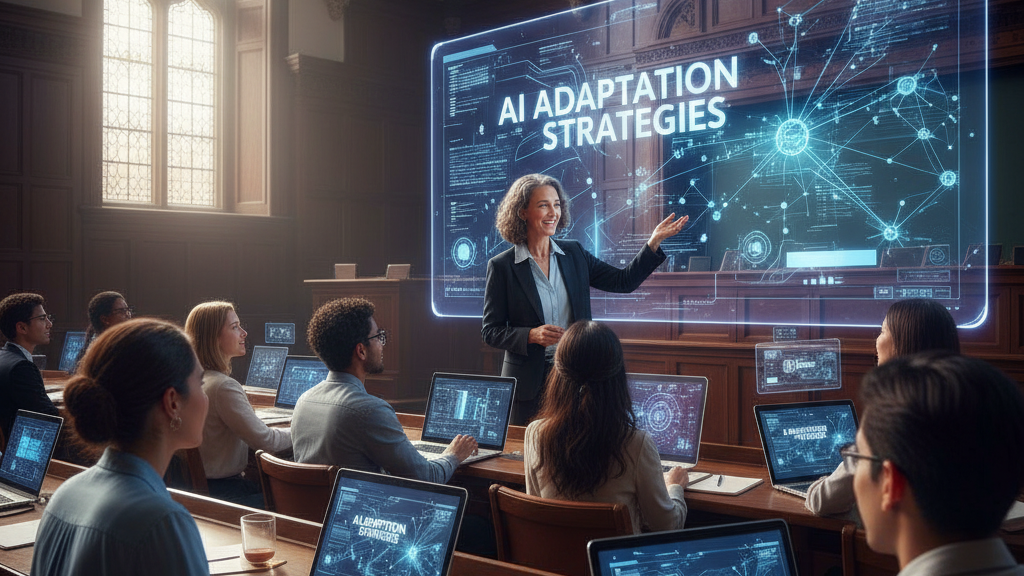
In a collegiate lecture hall, a female professor stands at the front, gesturing towards a large transparent screen displaying "AI ADAPTATION STRATEGIES" and a network of connected digital nodes. Students are seated at wooden desks with laptops, many showing similar AI-related content, actively engaged in learning about AI. Image (and typos) generated by Nano Banana.
As institutions like Harvard embrace and adapt to the integration of AI, the educational landscape is shifting rapidly. This image depicts a professor leading a class on “AI Adaptation Strategies,” underscoring the vital need for students to also acquire the skills and mindset necessary to effectively navigate and utilise artificial intelligence in their academic and future professional lives. Image (and typos) generated by Nano Banana.

Source

The Harvard Crimson

Summary

Harvard professors are moving away from blanket bans on AI and shifting toward nuanced, transparent policies that balance academic integrity with practical realities. Assignments are being redesigned to reduce misuse, and students are urged to treat AI as a tool for learning rather than a shortcut. Success depends on both institutional frameworks and student responsibility.

Key Points

  • 80% of faculty suspect or know AI is used in assignments.
  • Shift from total bans to clearer, nuanced policies.
  • AI often used as shortcut, undermining learning.
  • New assessments: oral exams, group work, AI-use disclosures.
  • Framework success depends on student buy-in.

Keywords

URL

https://www.thecrimson.com/article/2025/9/10/previn-harvard-ai-polocies/

Summary generated by ChatGPT 5