From Textbook to a Second Teacher: How AI Has Changed Study


A split image illustrating the evolution of studying. The left side shows a young male student in a warmly lit, traditional setting, deeply engrossed in reading a physical textbook under a desk lamp, with other books around him. The right side shows the same student, but in a modern, blue-lit setting, smiling as he interacts with a laptop. A glowing, holographic AI tutor in the shape of a friendly, simplistic figure hovers above his laptop, surrounded by intricate data visualizations and educational content, symbolizing AI as a "second teacher." Image (and typos) generated by Nano Banana.
The landscape of learning is transforming dramatically. This image contrasts the traditional method of studying with textbooks against the modern approach, where AI has emerged as a dynamic “second teacher,” offering personalised guidance and insights that are fundamentally changing how students learn. Image (and typos) generated by Nano Banana.

Source

The Post (New Zealand)

Summary

Hanna McCallum reports on how artificial intelligence is reshaping study habits, teaching methods, and classroom culture in New Zealand schools. Students at Wellington East Girls’ College describe AI as a “second teacher” that provides on-demand academic support, while educators work to build digital literacy and responsible-use frameworks. Some students view AI as empowering—enhancing access to personalised study tools and creative learning—while others fear it undermines independent thinking and deep learning. Teachers and experts note growing divides between schools that embrace AI and those that resist it, with potential long-term effects on cognitive development. As one lecturer observes, AI can either accelerate learning or encourage intellectual shortcuts depending on how students use it.

Key Points

  • Students describe AI as a “second teacher” offering instant academic assistance.
  • Wellington East Girls’ College is developing an AI strategy focusing on staff training and digital literacy.
  • Some students report overreliance on AI, while others feel left behind without it.
  • Educators warn that unmanaged AI use may reduce critical thinking and motivation.
  • University experts note widening gaps between AI-literate students and those from AI-restricted schools.

Keywords

URL

https://www.thepost.co.nz/nz-news/360856298/textbook-second-teacher-how-ai-has-changed-study

Summary generated by ChatGPT 5

AI in School Affects Pupils’ Ability to Create Original Work, Report Finds


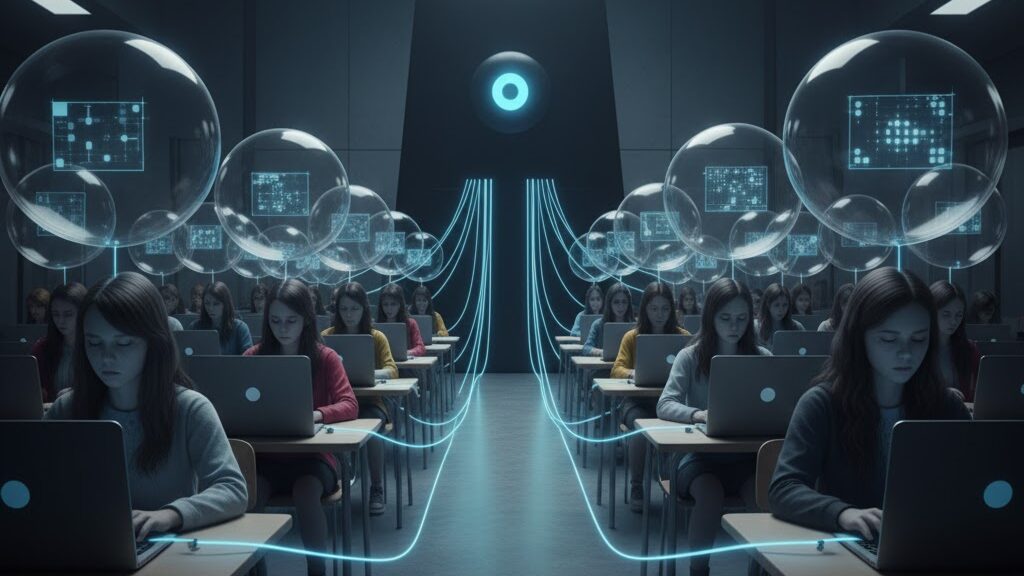
A dimly lit, futuristic classroom with rows of young students, predominantly girls, seated at individual desks, each intensely focused on an open laptop. Above each student's head, a clear, transparent bubble contains glowing digital circuitry and data, symbolizing ideas or creativity. These bubbles are connected by glowing blue lines that lead back to a large, imposing, glowing blue eye or orb on a dark monolith at the front of the classroom, suggesting a central AI influence. The students appear subdued and uniform. Image (and typos) generated by Nano Banana.
A concerning new report indicates that the increasing integration of AI in schools may be diminishing students’ capacity for original thought and creative work. This image visualizes the potential impact, raising questions about how technology might inadvertently hinder the development of essential human skills. Image (and typos) generated by Nano Banana.

Source

The Stage

Summary

A new Oxford University Press report warns that secondary school students in the UK fear artificial intelligence is limiting their creativity and originality. The study found that 80 per cent of pupils aged 13 to 18 use AI regularly for schoolwork, and while 90 per cent said it has helped them develop at least one skill, many expressed concern that it encourages imitation rather than innovation. Sixty per cent reported that AI makes them more likely to copy existing content, while 12 per cent said it hinders creative thinking and writing. Over half also feared AI tools reinforce biased or inaccurate stereotypes. The Writers’ Guild of Great Britain has called on schools and government to protect young people’s creative development and critical independence in the classroom.

Key Points

  • 80 per cent of pupils regularly use AI for schoolwork; only 2 per cent have never used it.
  • 60 per cent say AI encourages imitation and reduces originality.
  • 12 per cent believe AI negatively affects their creative thinking and writing.
  • 51 per cent worry AI tools reinforce bias and untrue stereotypes.
  • The Writers’ Guild urges policies to safeguard creativity and human-centred learning.

Keywords

URL

https://www.thestage.co.uk/news/ai-in-school-affects-pupils-ability-to-create-original-work-report

Summary generated by ChatGPT 5


ChatGPT Has Been My Tutor for the Last Year. I Still Have Concerns.


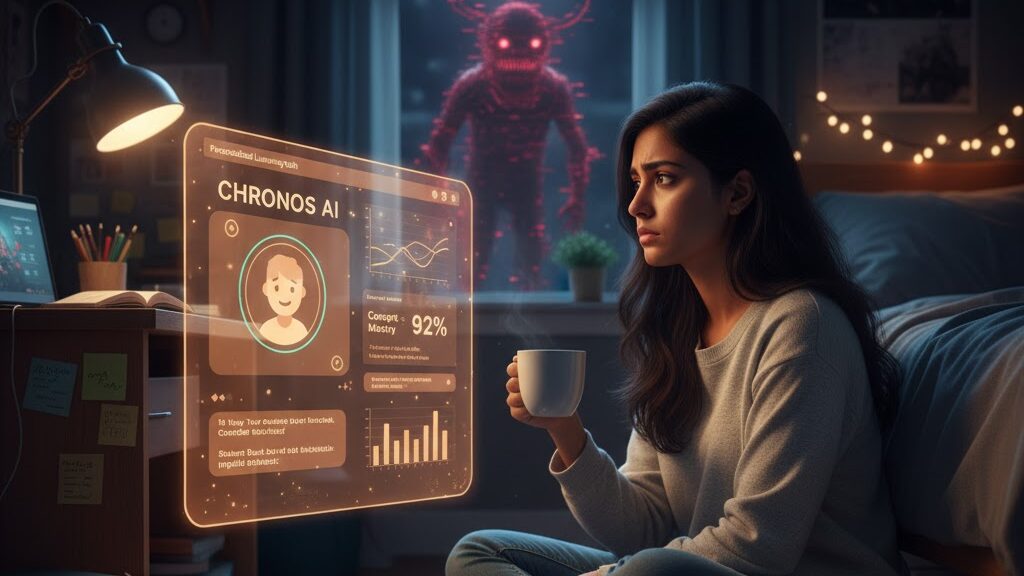
In a cozy, slightly cluttered student bedroom at night, a young female student sits on the floor with her laptop and books, looking pensively at a glowing holographic interface displaying "CHRONOS AI - Your Personal Learning Hub," showing a tutor avatar, progress, and various metrics. In the window behind her, a shadowy, horned monster with red eyes ominously peers in, symbolizing underlying concerns despite the AI's utility. Image (and typos) generated by Nano Banana.
While ChatGPT has served as a personal tutor for many students over the past year, its pervasive integration into learning also brings forth lingering concerns. This image captures a student’s thoughtful yet wary engagement with an AI tutor, visually juxtaposing its apparent utility with an ominous background figure, representing the unresolved anxieties about AI’s deeper implications for education and personal development. Image (and typos) generated by Nano Banana.

Source

The Harvard Crimson

Summary

Harvard student Sandhya Kumar reflects on a year of using ChatGPT as a learning companion, noting both its benefits and the university’s inconsistent response to generative AI. While ChatGPT has become a common study aid for debugging, essay support, and brainstorming, unclear academic guidelines have led to confusion about acceptable use. Some professors ban AI entirely, while others encourage it, leaving students without a shared framework for responsible integration. Kumar argues that rather than restricting AI, universities should teach AI literacy—helping students understand when and how to use these tools thoughtfully to enhance learning, not replace it.

Key Points

  • AI tools like ChatGPT are now embedded in student life and coursework.
  • Harvard’s response to AI use remains fragmented across departments.
  • Students face unclear ethical and authorship boundaries when using AI.
  • The author calls for structured AI literacy education rather than bans.
  • Thoughtful engagement with AI requires defined boundaries and shared guidance.

Keywords

URL

https://www.thecrimson.com/article/2025/10/7/kumar-harvard-chatgpt-tutor/

Summary generated by ChatGPT 5


Enacting Assessment Reform in a Time of Artificial Intelligence


Source

Tertiary Education Quality and Standards Agency (TEQSA), Australian Government

Summary

This resource addresses how Australian higher education can reform assessment in response to the rise of generative AI. Building on earlier work (Assessment Reform for the Age of Artificial Intelligence), it sets out strategies that align with the Higher Education Standards Framework while acknowledging that gen AI is now ubiquitous in student learning and professional practice. The central message is that detection alone is insufficient; instead, assessment must be redesigned to assure learning authentically, ethically, and sustainably.

The report outlines three main pathways: (1) program-wide assessment reform, which integrates assessment as a coherent system across degrees; (2) unit/subject-level assurance of learning, where each subject includes at least one secure assessment task; and (3) a hybrid approach combining both. Each pathway carries distinct advantages and challenges, from institutional resourcing and staff coordination to maintaining program coherence and addressing integrity risks. Critical across all approaches is the need to balance immediate integrity concerns with long-term goals of preparing students for an AI-integrated future.

Key Points

  • Generative AI necessitates structural assessment reform, not reliance on detection.
  • Assessments must equip students to participate ethically and critically in an AI-enabled society.
  • Assurance of learning requires multiple, inclusive, and contextualised approaches.
  • Program-level reform provides coherence and alignment but demands significant institutional commitment.
  • Unit-level assurance offers quick implementation but risks fragmentation.
  • Hybrid approaches balance flexibility with systemic assurance.
  • Over-reliance on traditional supervised exams risks reducing authenticity and equity.
  • Critical questions must guide reform: alignment across units, disciplinary variation, and student experience.
  • Assessment must reflect authentic professional practices where gen AI is legitimately used.
  • Ongoing collaboration and evidence-sharing across the sector are vital for sustainable reform.

Conclusion

The report concludes that assessment reform in the age of AI is not optional but essential. Institutions must move beyond short-term fixes and design assessment systems that assure learning, uphold integrity, and prepare students for future professional contexts. This requires thoughtful strategy, collaboration, and a willingness to reimagine assessment as a developmental, systemic, and values-driven practice.

Keywords

URL

https://www.teqsa.gov.au/guides-resources/resources/corporate-publications/enacting-assessment-reform-time-artificial-intelligence

Summary generated by ChatGPT 5