AI in School Affects Pupils’ Ability to Create Original Work, Report Finds


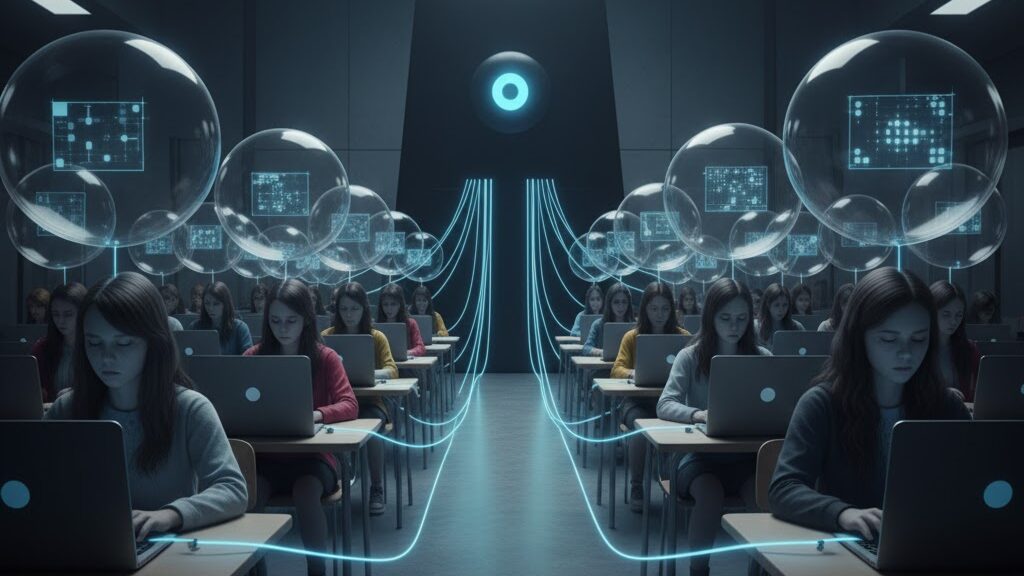
A dimly lit, futuristic classroom with rows of young students, predominantly girls, seated at individual desks, each intensely focused on an open laptop. Above each student's head, a clear, transparent bubble contains glowing digital circuitry and data, symbolizing ideas or creativity. These bubbles are connected by glowing blue lines that lead back to a large, imposing, glowing blue eye or orb on a dark monolith at the front of the classroom, suggesting a central AI influence. The students appear subdued and uniform. Image (and typos) generated by Nano Banana.
A concerning new report indicates that the increasing integration of AI in schools may be diminishing students’ capacity for original thought and creative work. This image visualizes the potential impact, raising questions about how technology might inadvertently hinder the development of essential human skills. Image (and typos) generated by Nano Banana.

Source

The Stage

Summary

A new Oxford University Press report warns that secondary school students in the UK fear artificial intelligence is limiting their creativity and originality. The study found that 80 per cent of pupils aged 13 to 18 use AI regularly for schoolwork, and while 90 per cent said it has helped them develop at least one skill, many expressed concern that it encourages imitation rather than innovation. Sixty per cent reported that AI makes them more likely to copy existing content, while 12 per cent said it hinders creative thinking and writing. Over half also feared AI tools reinforce biased or inaccurate stereotypes. The Writers’ Guild of Great Britain has called on schools and government to protect young people’s creative development and critical independence in the classroom.

Key Points

  • 80 per cent of pupils regularly use AI for schoolwork; only 2 per cent have never used it.
  • 60 per cent say AI encourages imitation and reduces originality.
  • 12 per cent believe AI negatively affects their creative thinking and writing.
  • 51 per cent worry AI tools reinforce bias and untrue stereotypes.
  • The Writers’ Guild urges policies to safeguard creativity and human-centred learning.

Keywords

URL

https://www.thestage.co.uk/news/ai-in-school-affects-pupils-ability-to-create-original-work-report

Summary generated by ChatGPT 5


AI Defeats the Purpose of a Humanities Education


In a grand, traditional university library, a massive, monolithic black AI construct with glowing blue circuit patterns and red text displaying "HUMANITIES INTEGRITY: 0%" is violently crashing into a long wooden conference table, scattering books and ancient busts. A group of somber-faced academics in robes stands around, observing the destruction with concern. Image (and typos) generated by Nano Banana.
This image powerfully visualises the concern that AI’s capabilities might fundamentally undermine the core purpose of a humanities education. The crashing digital monolith symbolises AI’s disruptive force, threatening to erode the value of human critical thought, interpretation, and creativity that humanities disciplines aim to cultivate. Image (and typos) generated by Nano Banana.

Source

The Harvard Crimson

Summary

The authors argue that generative AI tools fundamentally conflict with what a humanities education aims to do: teach students how to think, read, write, and argue as humans do, rather than delegating those tasks to machines. They claim AI can polish writing but misses the point of learning through struggle, critique, and revision. The piece calls for banning generative AI in humanities courses, saying that even mild uses still sidestep essential intellectual growth. Imperfect, difficult writing is better for learning than polished AI‑assisted work.

Key Points

  • AI polishing undermines the learning process of struggle and critique.
  • Imperfect essays without AI are more educational.
  • Inconsistent policies across faculty cause confusion.
  • Humanities should preserve authentic human expression and critical thinking.
  • Banning AI helps preserve rigor and humanistic values.

Keywords

URL

https://www.thecrimson.com/article/2025/9/9/chiocco-farrell-harvard-ai/

Summary generated by ChatGPT 5