Preparing Students for the World of Work Means Embracing an AI-Positive Culture


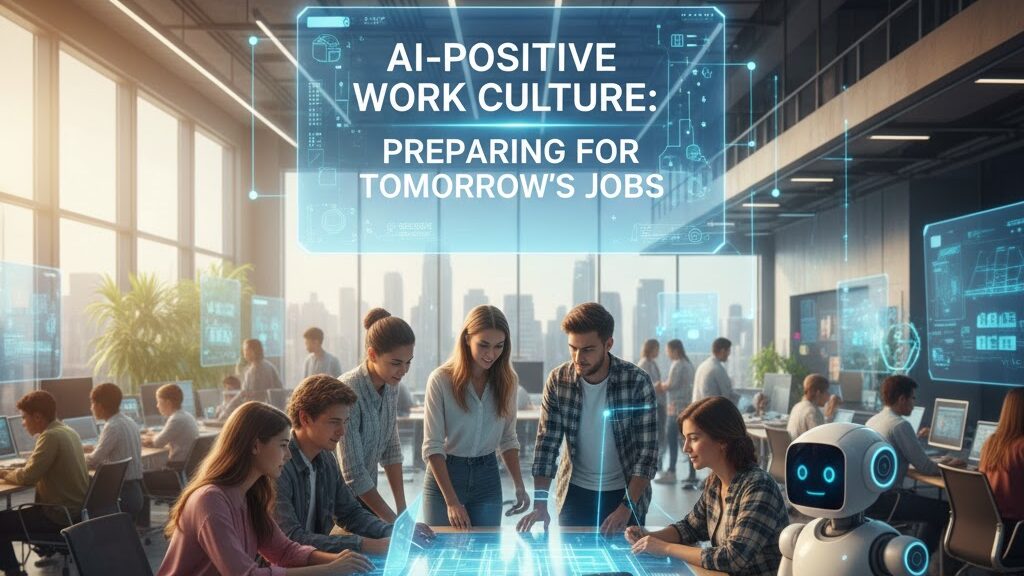
A vibrant, modern open-plan office setting, bustling with young professionals and students collaborating. In the foreground, a diverse group of five young adults is gathered around a table, intensely focused on glowing, interactive holographic projections emanating from the table surface, displaying data and digital interfaces. A friendly, white humanoid robot stands nearby, observing or assisting. In the background, other individuals are working at desks with computers, and various screens display data. Overlaid text reads "AI-POSITIVE WORK CULTURE: PREPARING FOR TOMORROW'S JOBS." Image (and typos) generated by Nano Banana.
To truly prepare students for tomorrow’s workforce, higher education must foster an AI-positive culture. This involves embracing artificial intelligence not as a threat, but as a transformative tool that enhances skills and creates new opportunities in the evolving world of work. Image (and typos) generated by Nano Banana.

Source

Wonkhe

Summary

Alastair Robertson argues that higher education must move beyond piecemeal experimentation with generative AI and instead embed an “AI-positive culture” across teaching, learning, and institutional practice. While universities have made progress through policies such as the Russell Group’s principles on generative AI, most remain in an exploratory phase lacking strategic coherence. Robertson highlights the growing industry demand for AI literacy—especially foundational skills like prompting and evaluating outputs—contrasting this with limited student support in universities. He advocates co-creation among students, educators, and AI, where generative tools enhance learning personalisation, assessment, and data-driven insights. To succeed, universities must invest in technology, staff development, and policy frameworks that align AI with institutional values and foster innovation through strategic leadership and partnership with industry.

Key Points

  • Industry demand for AI literacy far outpaces current higher education provision.
  • Universities remain at an early stage of AI adoption, lacking coherent strategic approaches.
  • Co-creation between students, educators, and AI can deepen engagement and improve outcomes.
  • Embedding AI requires investment in infrastructure, training, and ethical policy alignment.
  • An AI-positive culture depends on leadership, collaboration, and flexibility to adapt as technology evolves.

Keywords

URL

https://wonkhe.com/blogs/preparing-students-for-the-world-of-work-means-embracing-an-ai-positive-culture/

Summary generated by ChatGPT 5


AI and Assessment Training Initiative Empowers Lecturers


A group of diverse lecturers and educators in a modern meeting room, actively participating in a training session. A male presenter stands in front of a large, interactive screen displaying "AI-POWERED ASSESSMENT STRATEGIES" and various glowing data visualizations, charts, and a central brain icon representing AI. Participants around a large table are engaged with laptops and tablets, with some looking towards the screen and others discussing amongst themselves. The overall atmosphere is collaborative and focused on learning new technologies.  Image (and typos) generated by Nano Banana.
Empowering educators for the future: A new AI and assessment training initiative is equipping lecturers with the knowledge and tools to effectively integrate artificial intelligence into their evaluation strategies, enhancing teaching and learning outcomes. Image (and typos) generated by Nano Banana.

Source

North-West University News (South Africa)

Summary

North-West University (NWU) has launched a large-scale professional development initiative to promote responsible use of artificial intelligence in teaching, learning, and assessment. The AI and Assessment course, supported by the Senior Deputy Vice-Chancellor for Teaching and Learning, the AI Hub, and the Centre for Teaching and Learning, awarded R500 Takealot vouchers to the first 800 lecturers who completed all eleven modules. Participants earned fifteen digital badges by achieving over 80 per cent in assessments and submitting a portfolio of evidence. The initiative underscores NWU’s commitment to digital transformation and capacity building. Lecturers praised the programme for strengthening their understanding of ethical and effective AI integration in higher education.

Key Points

  • 800 NWU lecturers were incentivised to complete the AI and Assessment training course.
  • The programme awarded fifteen digital badges for verified completion and assessment success.
  • Leadership highlighted AI’s transformative role in teaching and learning innovation.
  • Participants reported improved confidence in using AI tools responsibly and ethically.
  • The initiative reinforces NWU’s institutional focus on digital capability and staff development.

Keywords

URL

https://news.nwu.ac.za/ai-and-assessment-training-initiative-empowers-lecturers

Summary generated by ChatGPT 5


Harvard Business School Uses AI to Evaluate Students’ Work, Dean Says


In a sophisticated university lecture hall, reminiscent of Harvard, a female speaker stands at a podium, gesturing towards a large interactive screen. The screen prominently displays "AI EVALUATION SYSTEM" along with various complex charts, graphs, and data points, indicating detailed assessment metrics. An audience of students in business attire are seated at tiered desks, working on laptops. Image (and typos) generated by Nano Banana.
Harvard Business School is at the forefront of integrating artificial intelligence into academic assessments, with its Dean confirming the use of AI to evaluate students’ work. This image illustrates a high-tech academic environment where advanced AI evaluation systems are being employed, signifying a significant shift in how student performance is analyzed and graded in prestigious institutions. Image (and typos) generated by Nano Banana.

Source

The Harvard Crimson

Summary

Dean Srikant M. Datar revealed that Harvard Business School (HBS) is actively using AI tools to evaluate student assignments and provide rapid feedback, such as on spreadsheets. At Boston AI Week, he explained that HBS faculty are integrating AI into teaching and research, including through Foundry, a platform connecting entrepreneurs with HBS content. Administrators emphasised that AI supplements, not replaces, classroom learning—supporting tasks like condensing student feedback into actionable insights and offering 24/7 support. HBS leaders frame AI as part of an ongoing digital transformation, stressing the importance of adaptability and a “30 percent rule” for AI literacy.

Key Points

  • HBS uses AI to evaluate coursework and give students rapid feedback.
  • The Foundry platform leverages AI to connect entrepreneurs globally with HBS resources.
  • AI tools condense student feedback for faculty, improving teaching design.
  • Administrators stress AI complements, not replaces, the classroom experience.
  • HBS promotes the “30 percent rule”: basic literacy is enough to work with AI effectively.

Keywords

URL

https://www.thecrimson.com/article/2025/10/2/hbs-dean-ai-use/

Summary generated by ChatGPT 5


2025 Horizon Action Plan: Building Skills and Literacy for Teaching with GenAI


Source

Jenay Robert, EDUCAUSE (2025)

Summary

This collection of essays explores how artificial intelligence—particularly generative AI (GenAI)—is reshaping the university sector across teaching, research, and administration. Contributors, including Dame Wendy Hall, Vinton Cerf, Rose Luckin, and others, argue that AI represents a profound structural shift rather than a passing technological wave. The report emphasises that universities must respond strategically, ethically, and holistically: developing AI literacy among staff and students, redesigning assessment, and embedding responsible innovation into governance and institutional strategy.

AI is portrayed as both a disruptive and creative force. It automates administrative processes, accelerates research, and transforms strategy-making, while simultaneously challenging ideas of authorship, assessment, and academic integrity. Luckin and others call for universities to foster uniquely human capacities—critical thinking, creativity, emotional intelligence, and metacognition—so that AI augments rather than replaces human intellect. Across the essays, there is strong consensus that AI literacy, ethical governance, and institutional agility are vital if universities are to remain credible and relevant in the AI era.

Key Points

  • GenAI is reshaping all aspects of higher education teaching and learning.
  • AI literacy must be built into curricula, staff training, and institutional culture.
  • Faculty should use GenAI to enhance creativity and connection, not replace teaching.
  • Clear, flexible policies are needed for responsible and ethical AI use.
  • Institutions must prioritise equity, inclusion, and closing digital divides.
  • Ongoing professional development in AI is essential for staff and administrators.
  • Collaboration across institutions and with industry accelerates responsible adoption.
  • Assessment and pedagogy must evolve to reflect AI’s role in learning.
  • GenAI governance should balance innovation with accountability and transparency.
  • Shared toolkits and global practice networks can scale learning and implementation.

Conclusion

The Action Plan positions GenAI as both a challenge and a catalyst for renewal in higher education. Institutions that foster literacy, ethics, and innovation will not only adapt but thrive. Teaching with AI is framed as a collective, values-led enterprise—one that keeps human connection, creativity, and critical thinking at the centre of the learning experience.

Keywords

URL

https://library.educause.edu/resources/2025/9/2025-educause-horizon-action-plan-building-skills-and-literacy-for-teaching-with-genai

Summary generated by ChatGPT 5


2025 Horizon Report: Teaching and Learning Edition


Source

EDUCAUSE

Summary

The 2025 Horizon Report highlights generative AI (GenAI) as one of the most disruptive forces shaping higher education teaching and learning. It frames GenAI not merely as a technological trend but as a catalyst for rethinking pedagogy, assessment, ethics, and institutional strategy. GenAI tools are now widely available, reshaping how students learn, produce work, and engage with knowledge. The report emphasises both opportunities—personalisation, creativity, and efficiency—and risks, including misinformation, bias, overreliance, and threats to academic integrity.

Institutions are urged to move beyond reactive bans or detection measures and instead adopt values-led, strategic approaches to GenAI integration. This involves embedding AI literacy across curricula, supporting staff development, and redesigning assessments to focus on authentic, process-based demonstrations of learning. Ethical considerations are central: ensuring equity of access, safeguarding privacy, addressing sustainability, and clarifying boundaries of responsible use. GenAI is framed as a general-purpose technology—akin to the internet or electricity—that will transform higher education in profound and ongoing ways.

Key Points

  • GenAI is a general-purpose technology reshaping teaching and learning.
  • Opportunities include personalised learning, enhanced creativity, and staff efficiency.
  • Risks involve misinformation, bias, overreliance, and compromised academic integrity.
  • Detection tools are unreliable; focus should shift to assessment redesign.
  • AI literacy is essential for both staff and students across disciplines.
  • Equity and access must be prioritised to avoid deepening divides.
  • Ethical frameworks should guide responsible, transparent use of GenAI.
  • Sustainability concerns highlight the energy and resource costs of AI.
  • Institutional strategy must integrate GenAI into digital transformation plans.
  • Faculty development and sector-wide collaboration are critical for adaptation.

Conclusion

The report concludes that generative AI is no passing trend but a structural shift in higher education. Its potential to augment teaching and learning is significant, but only if institutions adopt proactive, ethical, and pedagogically grounded approaches. Success lies not in resisting GenAI, but in reimagining educational practices so that students and staff can use it critically, creatively, and responsibly.

Keywords

URL

https://library.educause.edu/resources/2025/5/2025-educause-horizon-report-teaching-and-learning-edition

Summary generated by ChatGPT 5