Microsoft and OpenAI Invest Millions in AI Training for Teachers


A vast, futuristic auditorium filled with hundreds of teachers, all seated and looking towards a large stage. Each teacher has a glowing tablet or laptop in front of them, displaying various digital interfaces and data. On the stage, a panel of six speakers is seated, addressing the audience. Behind them, a massive screen prominently displays the Microsoft and OpenAI logos side-by-side, with the text "AI EMPOWERMENT FOR EDUCATORS" and "MILLION DOLLAR INITIATIVE." The entire scene is bathed in a blue digital glow, and abstract data interfaces float around the screen and stage, emphasizing the technological theme. Image (and typos) generated by Nano Banana.
In a landmark initiative, tech giants Microsoft and OpenAI are investing millions to provide comprehensive AI training for teachers. This program aims to equip educators with the skills and knowledge needed to integrate artificial intelligence effectively into classrooms, preparing the next generation for an AI-driven world. Image (and typos) generated by Nano Banana.

Source

Associated Press

Summary

Microsoft, OpenAI, and Anthropic are investing millions to fund large-scale AI training for U.S. teachers through partnerships with the American Federation of Teachers (AFT) and the National Education Association (NEA). The initiative aims to equip educators with practical AI skills and ethical awareness to integrate technology effectively into classrooms. Microsoft has pledged $12.5 million over five years, while OpenAI is contributing $10 million in funding and technical support. The AFT will build an AI training hub in New York City and plans to train 400,000 teachers within five years. While the partnerships promise to expand AI literacy rapidly, experts and union leaders caution that schools must retain control over programme design and ensure training aligns with educational—not corporate—priorities.

Key Points

  • Microsoft, OpenAI, and Anthropic are funding nationwide AI training for teachers.
  • The AFT will launch an AI training hub in New York City with plans for additional centres.
  • The initiative seeks to train 400,000 teachers over five years.
  • The NEA is developing AI “microcredential” courses for its 3 million members.
  • Unions insist that educators, not tech companies, will design and lead the programmes.
  • Experts warn against corporate influence and stress maintaining educational integrity.

Keywords

URL

https://apnews.com/article/artificial-intelligence-teacher-union-microsoft-f7554b6550fb90519dd8129acac8e291

Summary generated by ChatGPT 5


AI Won’t Replace Teachers—but Teachers Who Use AI Will Change Teaching


A female teacher stands confidently at the front of a modern classroom, gesturing towards a large, glowing holographic screen behind her that displays "AI-AUGMENTED TEACHING" along with various educational data, student profiles, and analytical charts. Rows of elementary school students are seated at desks, each engaged with a laptop. In the foreground to the right, a sleek, white humanoid robot is also seated at a desk, looking towards the teacher, symbolizing AI as a supportive tool rather than a replacement. The classroom is neat and well-lit. Image (and typos) generated by Nano Banana.
While the fear of AI replacing educators is prevalent, the reality is more nuanced: AI is set to empower teachers. This image illustrates how educators who embrace and integrate AI tools will fundamentally transform teaching methodologies, enhancing learning experiences rather than being superseded by technology. Image (and typos) generated by Nano Banana.

Source

Education Week

Summary

Ingrid Guerra-López argues that artificial intelligence will not replace teachers but will transform how they teach, provided educators engage with the technology thoughtfully and ethically. While AI can automate lesson planning, grading, and data organisation, Guerra-López emphasises that these efficiencies should enhance—not replace—teachers’ human judgment, empathy, and creativity. Drawing on research from RAND and the National Center for Education Statistics, she notes that teachers spend nearly ten hours a week on planning and administrative work—time AI could help recover for more meaningful teaching. However, without proper preparation and professional development, AI risks becoming another underused classroom innovation. Guerra-López calls for investment in AI literacy within teacher training and ongoing professional learning communities to ensure technology integration supports instructional quality and student engagement.

Key Points

  • AI can streamline routine teaching tasks, freeing time for deeper instructional work.
  • Educators remain essential for providing human connection, judgment, and mentorship.
  • Teacher-preparation programmes must include AI training and reflective practice.
  • Schools should create professional learning networks to support responsible AI use.
  • The goal is not to outsource thinking to AI but to use it as a scaffold for learning.
  • Failing to adapt risks both inefficiency and missed opportunities for innovation.

Keywords

URL

https://www.edweek.org/technology/opinion-ai-wont-replace-teachers-but-teachers-who-use-ai-will-change-teaching/2025/10

Summary generated by ChatGPT 5


AI Is Trained to Avoid These Three Words That Are Essential to Learning


A glowing, futuristic central processing unit (CPU) or AI core, radiating blue light and surrounded by complex circuit board patterns. Three prominent red shield icons, each with a diagonal 'no' symbol crossing through it, are positioned around the core. Inside these shields are the words "WHY," "HOW," and "IMAGINE" in bold white text, signifying that these concepts are blocked or avoided. The overall background is dark and digital, with streams of binary code and data flowing. Image (and typos) generated by Nano Banana.
A critical new analysis reveals that current AI training protocols are designed to avoid the use of three words—”why,” “how,” and “imagine”—which are fundamental to human learning, critical thinking, and creativity. This raises significant questions about the depth of understanding and innovation possible with AI. Image (and typos) generated by Nano Banana.

Source

Education Week

Summary

Sam Wineburg and Nadav Ziv argue that artificial intelligence, by design, avoids the phrase “I don’t know,” a trait that undermines the essence of learning. Drawing on OpenAI’s research, they note that chatbots are penalised for expressing uncertainty and rewarded for confident—but often incorrect—answers. This, they contend, clashes with educational goals that value questioning, evidence-weighing, and intellectual humility. The authors caution educators to slow the rush to integrate AI into classrooms without teaching critical evaluation. Instead of treating AI as a source of truth, students must learn to interrogate it—asking for sources, considering evidence, and recognising ambiguity. True learning, they write, depends on curiosity and the courage to admit what one does not know.

Key Points

  • Chatbots are trained to eliminate uncertainty, prioritising fluency over accuracy.
  • Students and adults often equate confident answers with credible information.
  • AI risks promoting surface-level understanding and discouraging critical inquiry.
  • Educators should model scepticism, teaching students to source and question AI outputs.
  • Learning thrives on doubt and reflection—qualities AI currently suppresses.

Keywords

URL

https://www.edweek.org/technology/opinion-ai-is-trained-to-avoid-these-3-words-that-are-essential-to-learning/2025/10

Summary generated by ChatGPT 5


Experts Warn AI Could Reshape Teen Brains


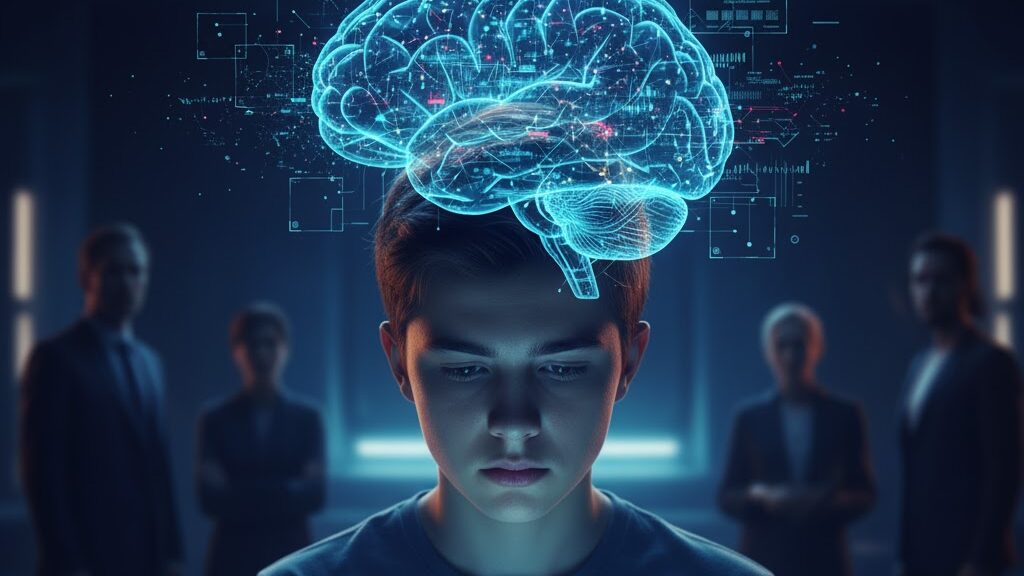
A focused teenage boy looks down at a glowing digital tablet displaying complex data. Above his head, a bright blue, intricate holographic representation of a human brain pulsates with interconnected data points and circuits, symbolizing the impact of technology. In the blurred background, several adult figures in professional attire stand, observing the scene, representing the "experts." Image (and typos) generated by Nano Banana.
As artificial intelligence becomes increasingly integrated into daily life, experts are raising concerns about its potential long-term effects on the developing brains of teenagers. Explore the warnings and discussions surrounding AI’s influence on cognitive development and neural pathways. Image (and typos) generated by Nano Banana.

Source

CNBC

Summary

Ernestine Siu reports growing concern among scientists and regulators that prolonged use of generative AI by children and teenagers could alter brain development and weaken critical thinking skills. A 2025 MIT Media Lab study found that reliance on large language models (LLMs) such as ChatGPT reduced neural connectivity compared with unaided writing tasks, suggesting “cognitive debt” from over-dependence on external support. Researchers warn that early exposure may limit creativity, self-regulation, and critical analysis, while privacy and emotional risks also loom large as children anthropomorphise AI companions. Experts urge limits on generative AI use among young people, stronger parental oversight, and the cultivation of both AI and digital literacy to safeguard cognitive development and wellbeing.

Key Points

  • One in four U.S. teens now use ChatGPT for schoolwork, double the 2023 rate.
  • MIT researchers found reduced brain network activity in users relying on LLMs.
  • Overuse of AI may lead to “cognitive debt” and hinder creativity and ownership of work.
  • Younger users are particularly vulnerable to emotional and privacy risks.
  • Experts recommend age-appropriate AI design, digital literacy training, and parental engagement.

Keywords

URL

https://www.cnbc.com/2025/10/13/experts-warn-ai-llm-chatgpt-gemini-perplexity-claude-grok-copilot-could-reshape-teen-youth-brains.html

Summary generated by ChatGPT 5


Schools in Wales ‘excited but wary’ as teacher workloads cut


A split image contrasting two emotional responses to AI in Welsh schools. On the left, a group of smiling, happy teachers stands around a table with a glowing holographic display showing "TEACHER WORKLOAD REDUCTION" and icons representing administrative tasks, symbolizing excitement. On the right, a group of wary, concerned teachers huddle around a laptop displaying "AI IN CLASSROOMS: BENEFITS & RISKS," with text highlighting "JOB SECURITY?" and "DATA PRIVACY," reflecting their apprehension. The Welsh flag is visible in the background on the left. Image (and typos) generated by Nano Banana.
As artificial intelligence begins to reduce teacher workloads in schools across Wales, educators are experiencing a mix of excitement for the potential benefits and apprehension about the unseen challenges. This image vividly contrasts the initial relief of reduced administrative burdens with the underlying worries about job security, data privacy, and the broader impact of AI on the educational landscape. Image (and typos) generated by Nano Banana.

Source

BBC News

Summary

A new report by Estyn, Wales’s education watchdog, finds that while artificial intelligence is helping teachers save time and reduce administrative workloads, schools remain cautious about its classroom use. Many Welsh teachers now use AI for lesson planning, report writing and tailoring resources for students with additional needs. However, concerns persist around plagiarism, over-reliance, and data ethics. At Birchgrove Comprehensive School in Swansea, staff are teaching pupils to use AI responsibly, balancing innovation with digital literacy. Estyn and the Welsh government both emphasise the need for national guidance and training to ensure AI enhances learning without undermining skills or safety.

Key Points

  • AI is reducing teacher workloads by automating planning and reporting tasks.
  • Estyn warns that schools need clearer guidance for ethical and safe AI use.
  • Pupils are using AI for revision and learning support, often with teacher oversight.
  • Staff report excitement about AI’s potential but remain wary of bias and misuse.
  • The Welsh government has committed to training and national policy development.

Keywords

URL

https://www.bbc.com/news/articles/c0lkdxpz0dyo

Summary generated by ChatGPT 5