Eight AI Tools That Can Help Generate Ideas for Your Classroom


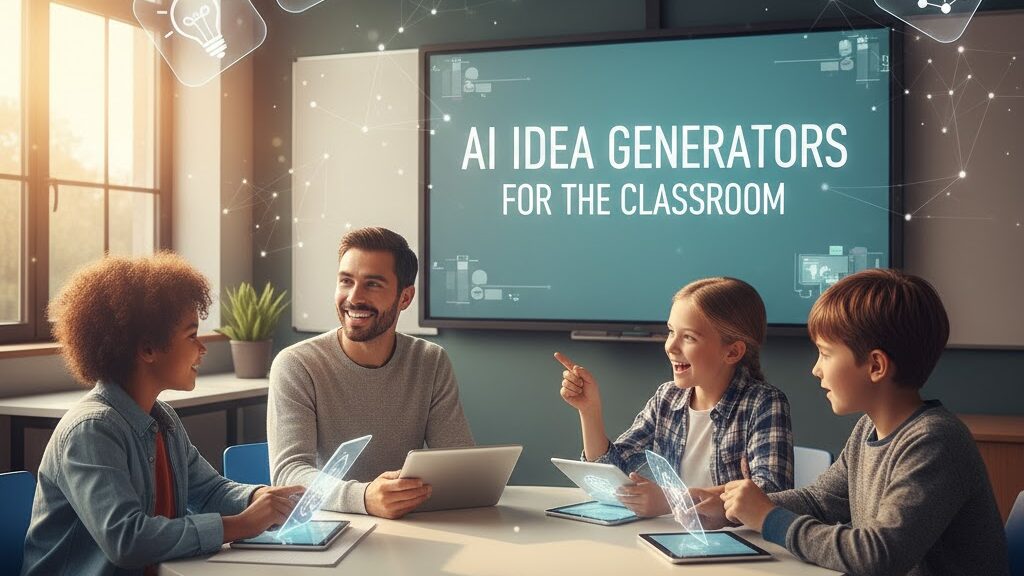
A diverse group of three elementary school children and one male teacher sitting around a table, actively engaged with tablets. Above them, a network of glowing AI-related icons (like a brain, speech bubble, robot, books, question mark, and a data network) floats, connected by lines, symbolizing idea generation. In the background, a large screen displays "AI IDEA GENERATORS FOR THE CLASSROOM." Image (and typos) generated by Nano Banana.
Spark creativity and innovation in your classroom with the power of artificial intelligence. Discover how AI tools can unlock new ideas and enhance learning experiences for both educators and students. Image (and typos) generated by Nano Banana.

Source

Edutopia

Summary

Alana Winnick outlines eight educator-tested AI tools that can help teachers overcome creative blocks and generate new lesson ideas. Emphasising accessibility, she distinguishes between advanced large language models such as ChatGPT, Gemini, and Claude, and beginner-friendly platforms like Curipod, Brisk, and SchoolAI, which require little technical skill. These tools can draft outlines, design interactive slides, and create tailored quizzes or discussion prompts. Curipod helps build engaging presentations, Brisk turns existing videos or articles into lesson plans, and SchoolAI enables personalised AI tutor spaces for students. Winnick encourages teachers to use AI as a creative partner rather than a replacement for their own professional insight.

Key Points

  • AI tools can boost creativity and save time during lesson planning.
  • Platforms like Curipod, Brisk, and SchoolAI simplify AI use for teachers.
  • ChatGPT, Gemini, and Claude offer greater flexibility for custom prompts.
  • AI can generate lesson outlines, discussion questions, and formative checks.
  • Educators should view AI as a collaborative support, not a substitute for teaching expertise.

Keywords

URL

https://www.edutopia.org/article/using-ai-generate-lesson-ideas/

Summary generated by ChatGPT 5


ChatGPT can hallucinate: College dean in Dubai urges students to verify data


In a modern, high-tech lecture hall with a striking view of the Dubai skyline at night, a female college dean stands at a podium, gesturing emphatically towards a large holographic screen. The screen prominently displays the ChatGPT logo surrounded by numerous warning signs and error messages such as "ERROR: FACTUAL INACCURACY" and "DATA HALLUCINATION DETECTED," with a bold command at the bottom: "VERIFY YOUR DATA!". Students in traditional Middle Eastern attire are seated, working on laptops. Image (and typos) generated by Nano Banana.
Following concerns over ChatGPT’s tendency to “hallucinate” or generate factually incorrect information, a college dean in Dubai is issuing a crucial directive to students: always verify data provided by AI. This image powerfully visualises the critical importance of scrutinising AI-generated content, emphasising that while AI can be a powerful tool, human verification remains indispensable for academic integrity and accurate knowledge acquisition. Image (and typos) generated by Nano Banana.

Source

Gulf News

Summary

Dr Wafaa Al Johani, Dean of Batterjee Medical College in Dubai, cautioned students against over-reliance on generative AI tools like ChatGPT during the Gulf News Edufair Dubai 2025. Speaking on the panel “From White Coats to Smart Care: Adapting to a New Era in Medicine,” she emphasised that while AI is transforming medical education, it can also produce false or outdated information—known as “AI hallucination.” Al Johani urged students to verify all AI-generated content, practise ethical use, and develop AI literacy. She stressed that AI will not replace humans but will replace those who fail to learn how to use it effectively.

Key Points

  • AI is now integral to medical education but poses risks through misinformation.
  • ChatGPT and similar tools can generate false or outdated medical data.
  • Students must verify AI outputs and prioritise ethical use of technology.
  • AI literacy, integrity, and continuous learning are essential for future doctors.
  • Simulation-based and hybrid training models support responsible tech adoption.

Keywords

URL

https://gulfnews.com/uae/chatgpt-can-hallucinate-college-dean-in-dubai-urges-students-to-verify-data-1.500298569

Summary generated by ChatGPT 5


ChatGPT Has Been My Tutor for the Last Year. I Still Have Concerns.


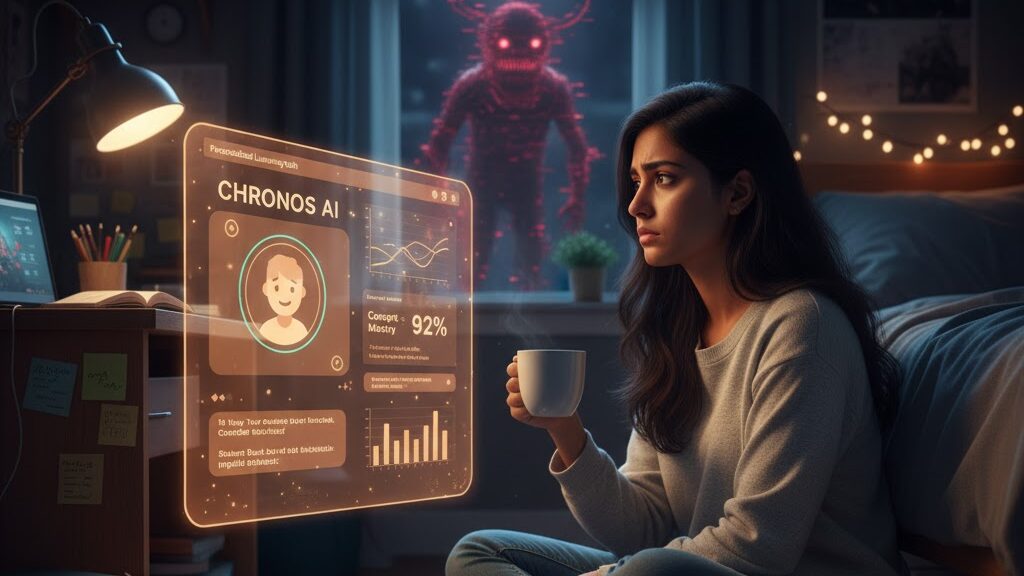
In a cozy, slightly cluttered student bedroom at night, a young female student sits on the floor with her laptop and books, looking pensively at a glowing holographic interface displaying "CHRONOS AI - Your Personal Learning Hub," showing a tutor avatar, progress, and various metrics. In the window behind her, a shadowy, horned monster with red eyes ominously peers in, symbolizing underlying concerns despite the AI's utility. Image (and typos) generated by Nano Banana.
While ChatGPT has served as a personal tutor for many students over the past year, its pervasive integration into learning also brings forth lingering concerns. This image captures a student’s thoughtful yet wary engagement with an AI tutor, visually juxtaposing its apparent utility with an ominous background figure, representing the unresolved anxieties about AI’s deeper implications for education and personal development. Image (and typos) generated by Nano Banana.

Source

The Harvard Crimson

Summary

Harvard student Sandhya Kumar reflects on a year of using ChatGPT as a learning companion, noting both its benefits and the university’s inconsistent response to generative AI. While ChatGPT has become a common study aid for debugging, essay support, and brainstorming, unclear academic guidelines have led to confusion about acceptable use. Some professors ban AI entirely, while others encourage it, leaving students without a shared framework for responsible integration. Kumar argues that rather than restricting AI, universities should teach AI literacy—helping students understand when and how to use these tools thoughtfully to enhance learning, not replace it.

Key Points

  • AI tools like ChatGPT are now embedded in student life and coursework.
  • Harvard’s response to AI use remains fragmented across departments.
  • Students face unclear ethical and authorship boundaries when using AI.
  • The author calls for structured AI literacy education rather than bans.
  • Thoughtful engagement with AI requires defined boundaries and shared guidance.

Keywords

URL

https://www.thecrimson.com/article/2025/10/7/kumar-harvard-chatgpt-tutor/

Summary generated by ChatGPT 5


Admissions Essays Written by AI Are Generic and Easy to Spot


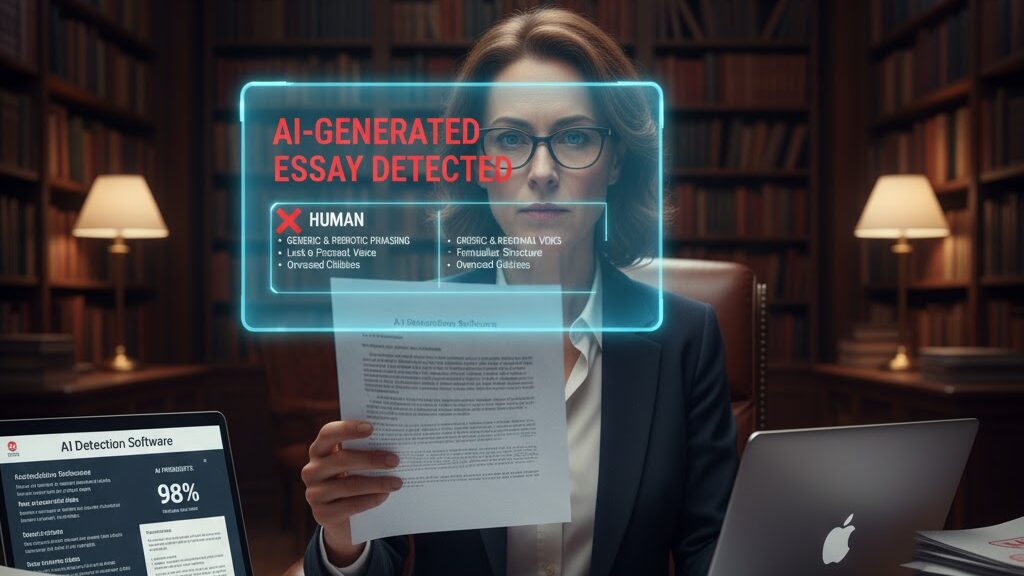
In a grand, wood-paneled library office, a serious female admissions officer in glasses sits at a desk piled with papers and laptops. A prominent holographic alert floats in front of her, reading "AI-GENERATED ESSAY DETECTED" in red. Below it, a comparison lists characteristics of "HUMAN" writing (e.g., unique voice) versus generic AI traits. One laptop screen displays "AI Detection Software" with a high probability score. Image (and typos) generated by Nano Banana.
Despite sophisticated AI capabilities, admissions essays generated by artificial intelligence are often characterised by generic phrasing and a distinct lack of personal voice, making them relatively easy to spot. This image depicts an admissions officer using AI detection software and her own critical judgment to identify an AI-generated essay, underscoring the challenges and tools in maintaining authenticity in student applications. Image (and typos) generated by Nano Banana.

Source

Inside Higher Ed

Summary

Cornell University researchers have found that AI-generated college admission essays are noticeably generic and easily distinguished from human writing. In a study comparing 30,000 human-written essays with AI-generated versions, the latter often failed to convey authentic personal narratives. When researchers added personal details for context, AI tools tended to overemphasise keywords, producing essays that sounded even more mechanical. While the study’s authors note that AI can be helpful for editing and feedback, they warn against using it to produce full drafts. The team also developed a detection model that could identify AI-generated essays with near-perfect accuracy.

Key Points

  • Cornell researchers compared AI and human-written college admission essays.
  • AI-generated essays lacked authenticity and were easily recognised.
  • Adding personal traits often made AI writing sound more artificial.
  • AI can provide useful feedback for weaker writers but not full essays.
  • A detection model identified AI-written essays with high accuracy.

Keywords

URL

https://www.insidehighered.com/news/quick-takes/2025/10/06/admissions-essays-written-ai-are-generic-and-easy-spot

Summary generated by ChatGPT 5


How to use ChatGPT at university without cheating: ‘Now it’s more like a study partner’


Three university students (two male, one female) are seated at a table with laptops and books, smiling and engaged in discussion. Behind them, a large transparent screen displays a glowing blue humanoid AI figure pointing to various academic data and charts. The setting is a modern library, conveying a collaborative study environment where AI acts as a helpful, non-cheating resource. Generated by Nano Banana.
Moving beyond fears of academic dishonesty, many students are now leveraging ChatGPT as an ethical ‘study partner’ to enhance their learning experience at university. This image illustrates a collaborative approach where AI supports understanding and exploration, rather than providing shortcuts, thereby fostering a new era of academic assistance. Image generated by Nano Banana.

Source

The Guardian

Summary

Many students now treat ChatGPT less like a cheating shortcut and more like a study partner: for grammar checks, revision, practice questions, and organising notes. Usage jumped from 66% to 92% in a year. Universities are clarifying rules: AI can support study but not generate assignment content. Educators stress AI literacy, awareness of risks (hallucinations, fake references), and critical thinking to ensure AI complements rather than replaces learning.

Key Points

  • Student AI use rose from ~66% to ~92% in a year; viewed more as a partner than a cheat tool.
  • Valid uses: organising notes, summarising, and generating practice questions.
  • Risks: overreliance, hallucinations, using AI to write assignments still banned.
  • Some universities track AI usage or require logs; policies clearer.
  • Message: AI should be supplemental, not a substitute; build literacy and critical skills.

Keywords

URL

https://www.theguardian.com/education/2025/sep/14/how-to-use-chatgpt-at-university-without-cheating-now-its-more-like-a-study-partner

Summary generated by ChatGPT 5