AI and Assessment Training Initiative Empowers Lecturers


A group of diverse lecturers and educators in a modern meeting room, actively participating in a training session. A male presenter stands in front of a large, interactive screen displaying "AI-POWERED ASSESSMENT STRATEGIES" and various glowing data visualizations, charts, and a central brain icon representing AI. Participants around a large table are engaged with laptops and tablets, with some looking towards the screen and others discussing amongst themselves. The overall atmosphere is collaborative and focused on learning new technologies.  Image (and typos) generated by Nano Banana.
Empowering educators for the future: A new AI and assessment training initiative is equipping lecturers with the knowledge and tools to effectively integrate artificial intelligence into their evaluation strategies, enhancing teaching and learning outcomes. Image (and typos) generated by Nano Banana.

Source

North-West University News (South Africa)

Summary

North-West University (NWU) has launched a large-scale professional development initiative to promote responsible use of artificial intelligence in teaching, learning, and assessment. The AI and Assessment course, supported by the Senior Deputy Vice-Chancellor for Teaching and Learning, the AI Hub, and the Centre for Teaching and Learning, awarded R500 Takealot vouchers to the first 800 lecturers who completed all eleven modules. Participants earned fifteen digital badges by achieving over 80 per cent in assessments and submitting a portfolio of evidence. The initiative underscores NWU’s commitment to digital transformation and capacity building. Lecturers praised the programme for strengthening their understanding of ethical and effective AI integration in higher education.

Key Points

  • 800 NWU lecturers were incentivised to complete the AI and Assessment training course.
  • The programme awarded fifteen digital badges for verified completion and assessment success.
  • Leadership highlighted AI’s transformative role in teaching and learning innovation.
  • Participants reported improved confidence in using AI tools responsibly and ethically.
  • The initiative reinforces NWU’s institutional focus on digital capability and staff development.

Keywords

URL

https://news.nwu.ac.za/ai-and-assessment-training-initiative-empowers-lecturers

Summary generated by ChatGPT 5
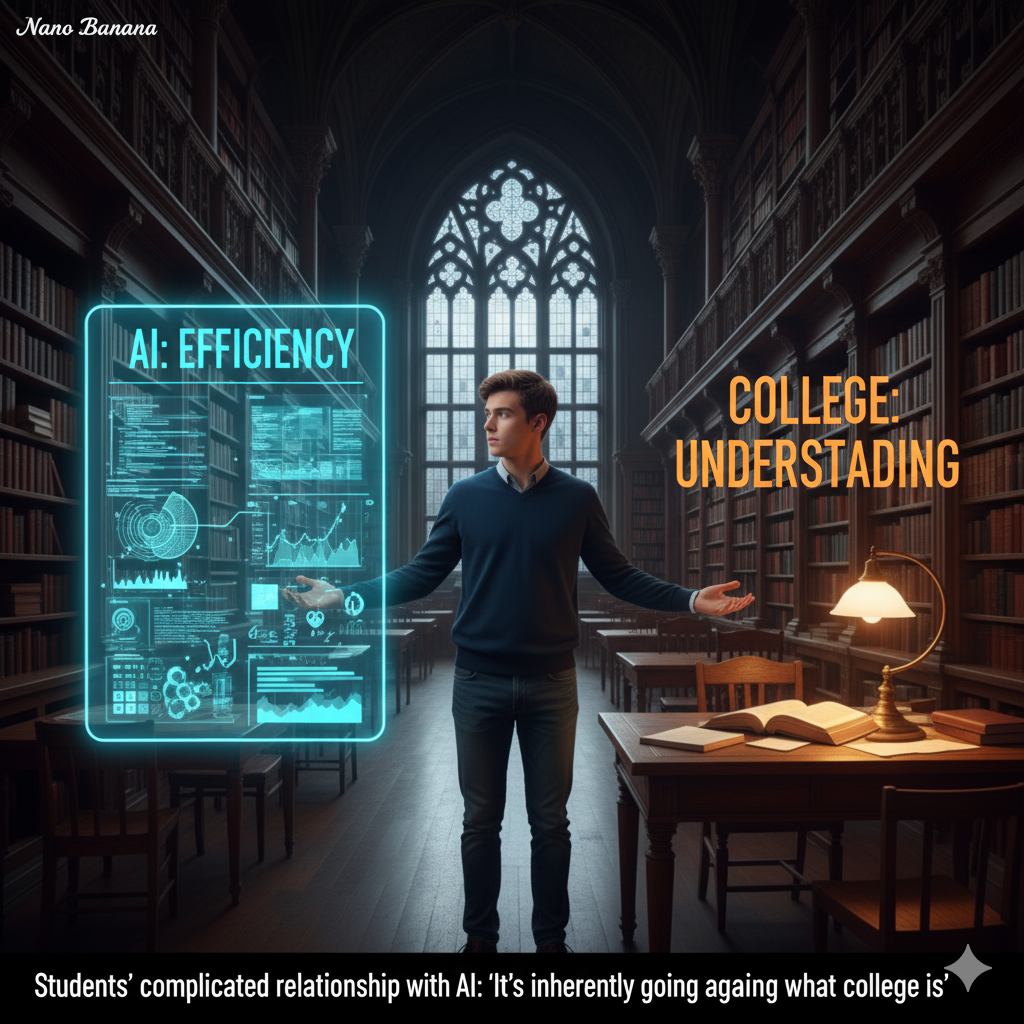

Students’ complicated relationship with AI: ‘It’s inherently going against what college is’


A student stands in a grand, traditional library, looking conflicted between two glowing holographic displays. To the left, a blue 'AI: EFFICIENCY' display shows data and code. To the right, an orange 'COLLEGE: UNDERSTANDING' display hovers over an open book and desk lamp. The image symbolizes the internal conflict students face regarding AI in academia. Generated by Nano Banana.
Navigating the academic world with new AI tools presents a complex dilemma for students. This image illustrates the tension between the efficiency offered by AI and the foundational pursuit of deep understanding inherent to college education. It captures the internal debate students face as technology challenges traditional learning. Image generated by and typos courtesy of Nano Banana.

Source

The Irish Times

Summary

Many students express tension between using generative AI (GenAI) tools like ChatGPT and the traditional values of university education. Some avoid AI because they feel it undermines academic integrity or the effort they invested; others see benefit in using it for organising study, generating ideas, or off-loading mundane parts of coursework. Concerns include fairness (getting better grades for less effort), accuracy of chatbot-generated content, and environmental impact. Students also worry about loss of critical thinking and the changing nature of assignments as AI becomes more common. There is a call for clearer institutional guidelines, more awareness of policies, and equitable access and use.

Key Points

  • Using GenAI can feel like “offloading work,” conflicting with the idea of self-learning which many students believe defines college life.
  • Students worry about fairness: those who use AI may gain advantage over those who do not.
  • Accuracy is a concern: ChatGPT sometimes provides false information; students are aware of this risk.
  • Some students avoid using AI to avoid suspicion or accusation of cheating, even when not using it.
  • Others find helpful uses: organising references, creating study timetables, acting as a “second pair of eyes” or “study companion.”

Keywords

URL

https://www.irishtimes.com/life-style/people/2025/09/20/students-complicated-relationship-with-ai-chatbots-its-inherently-going-against-what-college-is/

Summary generated by ChatGPT 5


Education report calling for ethical AI use contains over 15 fake sources


In the foreground, a robotic hand holds a red pen, poised over documents labeled 'THE FUTURE OF ETHICAL AI'. A glowing red holographic screen above the desk displays 'FAKE SOURCE DETECTED' and 'OVER 15 FABRICATED ENTRIES', showing snippets of text and data. The scene powerfully illustrates the irony of an ethics report containing fake sources, highlighting the challenges of AI and misinformation. Generated by Nano Banana.
In a striking testament to the complex challenges of the AI era, a recent education report advocating for ethical AI use has itself been found to contain over 15 fabricated sources. This image captures the alarming irony and the critical need for vigilance in an information landscape increasingly blurred by AI-generated content and potential misinformation. Image generated by Nano Banana.

Source

Ars Technica

Summary

An influential Canadian government report advocating ethical AI in education was found to include over 15 fake or misattributed sources upon scrutiny. Experts examining the document flagged that many citations led to dead links, non-existent works, or outlets that had no record of publication. The revelations raise serious concerns about how “evidence” is constructed in policy advisories and may undermine the credibility of calls for AI ethics in education. The incident stands as a caution: even reports calling for rigour must themselves be rigorous.

Key Points

  • The Canadian report included more than 15 citations that appear to be fabricated or misattributed.
  • Some sources could not be found in public databases, and some journal names were incorrect or non-existent.
  • The errors weaken the report’s authority and open it to claims of hypocrisy in calls for ethical use of AI.
  • Experts argue that policy documents must adhere to the same standards they demand of educational AI tools.
  • This case underscores how vulnerable institutional narratives are to “junk citations” and sloppy vetting.

Keywords

URL

https://arstechnica.com/ai/2025/09/education-report-calling-for-ethical-ai-use-contains-over-15-fake-sources/

Summary generated by ChatGPT 5