Latest Posts

Generative AI isn’t culturally neutral, research finds


A diverse group of four researchers in a lab setting surrounds a large, glowing, circular holographic projection. The projection shows a series of icons, some representing Western culture (a statue of liberty, a hamburger), and others from different cultures (a statue of a Buddha, a bowl of ramen), with data flow lines moving between them. A central red line cuts through the center of the display, indicating a lack of neutrality. The image visualizes the finding that generative AI is not culturally neutral. Generated by Nano Banana.
As generative AI tools become more integrated into our lives, new research highlights a critical finding: these technologies are not culturally neutral. This image visualizes how AI’s training data can embed cultural biases, underscoring the vital need for diverse representation and ethical oversight in the development of future AI systems. Image (and typos) generated by Nano Banana.

Source

MIT Sloan (Ideas Made to Matter)

Summary

A study led by MIT Sloan’s Jackson Lu and collaborators shows that generative AI models like GPT and Baidu’s ERNIE respond differently depending on the language of the prompt, reflecting cultural leanings embedded in their training data. When asked in English, responses tended toward an independent, analytic orientation; in Chinese, they skewed toward interdependent, holistic thinking. Those differences persist across social and cognitive measures, and even subtle prompt framing (asking the AI “to assume the role of a Chinese person”) can shift outputs. The finding means users and organisations should be aware of—and guard against—hidden cultural bias in AI outputs.

Key Points

  • AI models exhibit consistent cultural orientation shifts depending on prompt language: English prompts lean independent/analytic; Chinese prompts lean interdependent/holistic.
  • These cultural tendencies appear in both social orientation (self vs group) and cognitive style (analysis vs context) tests.
  • The cultural bias is not fixed: prompting the model to “assume the role of a Chinese person” moves responses toward interdependence even in English.
  • Such biases can influence practical outputs (e.g. marketing slogans, policy advice), in ways users may not immediately detect.
  • The study underscores the need for cultural awareness in AI deployment and places responsibility on developers and users to mitigate bias.

Keywords

URL

https://mitsloan.mit.edu/ideas-made-to-matter/generative-ai-isnt-culturally-neutral-research-finds

Summary generated by ChatGPT 5


SchoolAI’s lessons in building an AI platform that empowers teachers


In a bright, modern classroom, a diverse group of educators gathers around an interactive glowing table displaying a 'SchoolAI' platform with various data and connectivity icons. One teacher gestures towards the screen, while others observe intently or work on individual tablets. The scene depicts teachers engaging with an AI platform designed to enhance their capabilities, with the embedded text 'SchoolAI: Empowring Teachers'. Generated by Nano Banana.
This image illustrates the potential of platforms like SchoolAI to transform education by empowering teachers with advanced AI tools. By streamlining tasks, providing personalised insights, and fostering innovative learning environments, such platforms offer valuable lessons in building technology that truly supports and enhances the educator’s role, rather than replacing it. Image (and typos) generated by Nano Banana.

Source

OpenAI

Summary

SchoolAI is an education platform built with OpenAI models (GPT-4.1, GPT-4o, etc.) aimed at real-time, personalised learning at scale. Teachers create interactive “Spaces” via an assistant (Dot), and students interact with Sidekick, an AI tutor that adapts pacing, offers scaffolds, and provides guidance—but never simply hands answers. Teachers remain “in the loop,” with visibility into what students struggle with before gaps deepen. In two years, it has grown to a million classrooms across 80+ countries and embedded in 500+ partnerships. The design principles emphasise trust, safety, and scalability: i.e., AI must coach rather than replace, and operations must use one AI stack to maintain consistency.

Key Points

  • The platform ensures teacher-in-the-loop control: all interactions are observable, so teachers can intervene early.
  • AI supports differentiated learning: tasks are scaffolded and paced to individual student needs.
  • The system uses a modular “agent graph” architecture (many nodes/models) rather than a simple prompt → response setup.
  • Scale is baked in: the team chose to stick with a single AI “stack” to move faster and reduce cost overheads at growth.
  • Early teacher reports: some claim the tool saves 10+ hours weekly, allowing them to focus more on human mentoring than grading.

Keywords

URL

https://openai.com/index/schoolai/

Summary generated by ChatGPT 5


AI training becomes mandatory at more US law schools


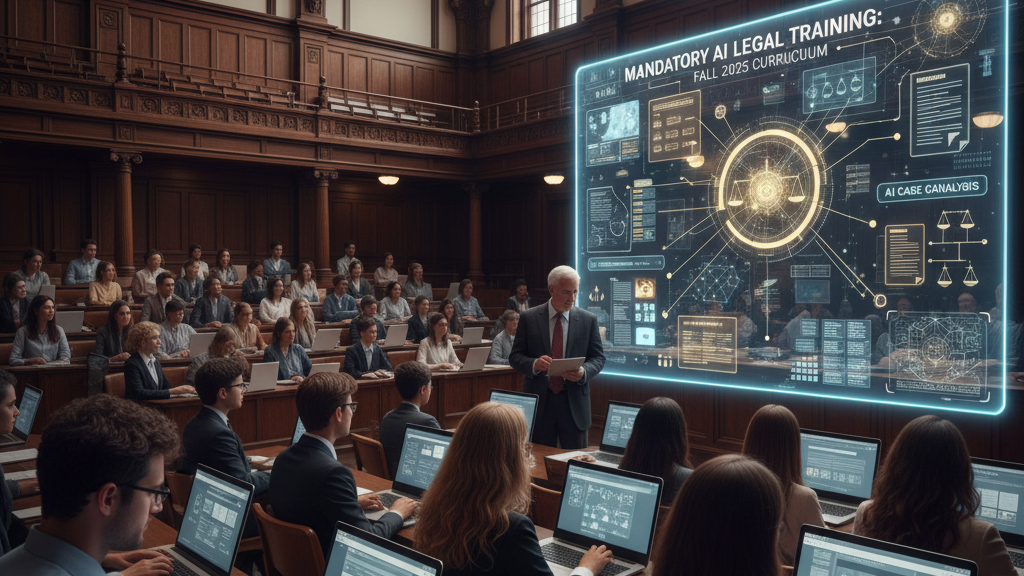
In a classic, wood-paneled law school lecture hall, a professor stands at the front addressing a large class of students, all working on laptops. Behind the professor, a large, glowing blue holographic screen displays 'MANDATORY AI LEGAL TRAINING: FALL 2025 CURRICULUM' along with complex flowcharts and data related to AI and legal analysis. The scene signifies the integration of AI training into legal education. Generated by Nano Banana.
As the legal landscape rapidly evolves with AI advancements, more US law schools are making AI training a mandatory component of their curriculum. This image captures a vision of future legal education, where students are equipped with essential AI skills to navigate and practice law in a technologically transformed world. Image (and typos) generated by Nano Banana.

Source

Reuters

Summary

A growing number of U.S. law schools are making AI training compulsory, embedding it into first-year curricula to better equip graduates for the evolving legal sector. Instead of resisting AI, institutions like Fordham and Arizona State now include exercises (e.g. comparing AI-generated vs. professor-written legal analyses) in orientation and foundational courses. These programmes teach model mechanics, prompt design, and ethical risks like hallucinations. Legal educators believe AI fluency is fast becoming a baseline competency for future attorneys, driven by employer expectations and emerging norms in legal practice.

Key Points

  • At least eight law schools now require AI training in first-year orientation or core courses.
  • Fordham’s orientation exercise had students compare a ChatGPT-drafted legal summary vs. a professor’s.
  • Schools cover how AI works, its limitations and errors, and responsible prompt practices.
  • The shift signals a move from seeing AI as cheating risk to accepting it as a core legal skill.
  • Legal employers endorse this direction, arguing new lawyers need baseline AI literacy to be effective.

Keywords

URL

https://www.reuters.com/legal/legalindustry/ai-training-becomes-mandatory-more-us-law-schools-2025-09-22/

Summary generated by ChatGPT 5


AI Is Making the College Experience Lonelier


A male college student sits alone at a wooden desk in a grand, dimly lit library, intensely focused on his laptop which projects a glowing blue holographic interface. Rain streaks down the large gothic window in the background, enhancing the sense of isolation. Other students are sparsely visible in the distance, similarly isolated at their desks. The scene evokes a feeling of loneliness and individual digital engagement in an academic setting. Generated by Nano Banana.
As AI tools become increasingly integrated into academic life, some fear that the college experience is becoming more solitary. This image captures a student immersed in a digital world within a traditional library, symbolising a potential shift towards individual interaction with technology, rather than communal learning, and raising questions about the social impact of AI on university life. Image generated by Nano Banana.

Source

The Chronicle of Higher Education

Summary

Amid growing integration of AI into student learning (e.g. ChatGPT “study mode”), there’s a quieter but profound concern: the erosion of collaborative study among students. Instead of learning together, many may retreat into solo AI-mediated calls for efficiency and convenience. The authors argue that the informal, messy, social study moments — debating, explaining, failing together — are vital to the educational experience. AI may offer convenience, but it cannot replicate human uncertainty, peer correction, or the bonding formed through struggle and exploration.

Key Points

  • AI “study mode” may tempt students to bypass peer collaboration, weakening communal learning.
  • The social, frustrating, back-and-forth parts of learning are essential for deep understanding — AI cannot fully emulate them.
  • Faculty worry that students working alone miss opportunities to test, explain, and refine ideas together.
  • The shift risks hollowing out parts of education that are about connection, not just content transmission.
  • Authors advocate for pedagogy that re-centres collaboration, discourse, and community as buffers against “silent learning.”

Keywords

URL

https://www.chronicle.com/article/ai-is-making-the-college-experience-lonelier

Summary generated by ChatGPT 5


How we’ve adapted coursework and essays to guard against AI


In a modern meeting room with large windows overlooking university buildings, a male and female academic are engaged in a discussion across a table. Between them, a glowing holographic shield icon labeled 'AI' is surrounded by other icons representing 'ADAPTED ASSESSMENTS: HUMAN PROOFED', 'ORAL DEFENSE', and 'HANDWRITTEN ASSFSSMENTS'. Other students are seen working on laptops in the background. The scene illustrates strategies for guarding against AI misuse in coursework. Generated by Nano Banana.
As AI tools become commonplace, educational institutions are proactively adapting their coursework and essay assignments to uphold academic integrity. This image visualizes educators implementing new assessment strategies, from human-proofed assignments to oral defenses, designed to ensure students are building their own knowledge and skills, rather than solely relying on AI. Image (and typos) generated by Nano Banana.

Source

Tes

Summary

An international school led by a history teacher rethinks assessment to preserve cognitive engagement in the age of AI. They’ve moved most research and drafting of A-level coursework into lessons (reducing home drafting), track each student’s writing path via Google Docs, require handwritten work at various key stages to discourage copy/paste, and engage students in dialogue about the pitfalls (“hallucinations”) of AI content. The strategy aims not just to prevent cheating, but to reinforce critical thinking, reduce procrastination, and make students more accountable for their own ideas.

Key Points

  • Coursework work (research + drafting) must be done partly in class, enabling oversight and reducing offsite AI use.
  • Monitoring via Google Docs helps detect inconsistencies in tone or sophistication that suggest AI assistance.
  • Handwritten assignments are reintroduced to reduce reliance on AI and minimise temptations to copy-paste.
  • Students are taught about AI’s unreliability (e.g. “hallucinations”) using historical examples of absurd errors (e.g. mixing battles, animals in wrong eras).
  • The reforms have modest benefits: less procrastination, more transparency, though challenges remain when students determined to cheat try to circumvent controls.

Keywords

URL

https://www.tes.com/magazine/analysis/specialist-sector/stopping-ai-cheating-how-our-school-has-adapted-coursework-essay-writing

Summary generated by ChatGPT 5