Black Eyed Peas’ will.i.am to teach AI class at ASU


In a futuristic, dark room with glowing blue and red neon lights, a large holographic screen displays an online AI class titled "THE AGENTIC SELF." The main panel shows a charismatic male professor speaking, surrounded by various AI-related data, neural networks, and a stylized human head representing an AI. Below, a grid of diverse student participants is visible in a virtual meeting. The Arizona State University (ASU) logo is also displayed. Image (and typos) generated by Nano Banana.
This image envisions an engaging online AI class at Arizona State University, titled “The Agentic Self,” exploring the intricacies of autonomous AI. It showcases a dynamic virtual classroom where students connect from various locations, delving into cutting-edge concepts of AI’s self-governing capabilities and its implications for the future. Image (and typos) generated by Nano Banana.

Source

Phoenix Business Journal

Summary

Arizona State University announced that Black Eyed Peas performer and entrepreneur will.i.am will join the faculty as a professor of practice to teach a course on artificial intelligence. Starting spring 2026, he will lead “The Agentic Self”, a 15-week class exploring how AI can serve as a creative and educational partner. The class will run through ASU’s GAME School and connect to will.i.am’s FYI.AI platform. University officials emphasise the collaboration as part of ASU’s mission to innovate teaching and help students gain fluency in emerging technologies.

Key Points

  • will.i.am joins ASU as professor of practice to teach AI.
  • Course title: “The Agentic Self”, scheduled for spring 2026.
  • Students will explore AI as tool, collaborator, and creative partner.
  • Class is hosted by ASU’s GAME School and linked to FYI.AI platform.
  • Move underscores ASU’s strategy of blending tech, industry expertise, and higher education innovation.

Keywords

URL

https://www.bizjournals.com/phoenix/news/2025/09/29/black-eyed-peas-performer-to-teach-asu-class-on-ai.html

Summary generated by ChatGPT 5


AI is infiltrating the classroom. Here’s how teachers and students say they use it


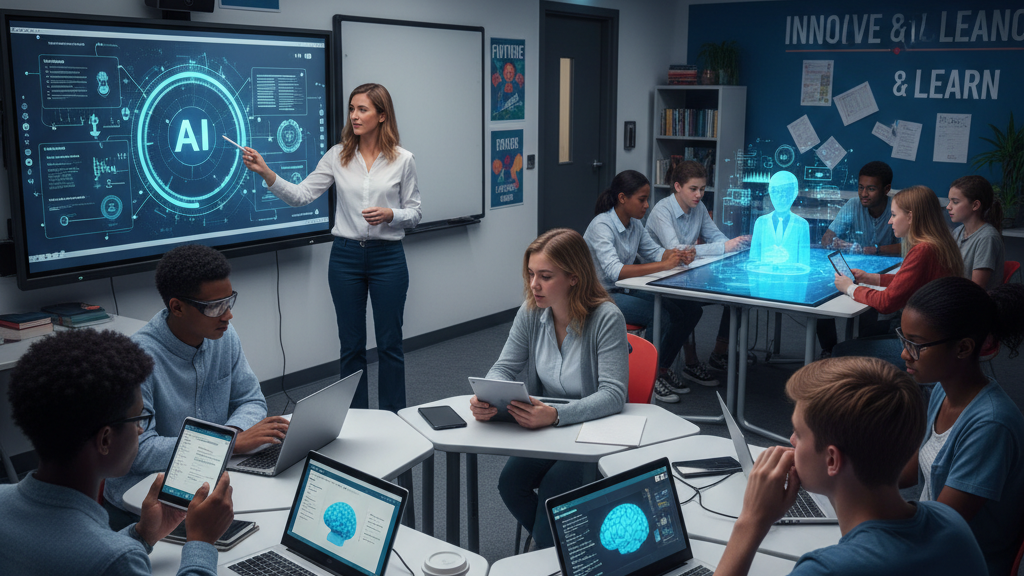
A diverse group of students in a modern classroom interacting with laptops and holographic AI interfaces, while a teacher points to an interactive whiteboard displaying "AI." Image (and typos) generated by Nano Banana
AI is rapidly integrating into educational settings, transforming how both teachers and students engage with learning and information. This image visualizes the dynamic interaction between human instruction and artificial intelligence in a contemporary classroom environment. Image (and typos) generated by Nano Banana.

Source

The Los Angeles Times

Summary

Surveys and research suggest AI use is rising fast in education, with teachers and students showing different patterns of adoption and concern. Teachers tend to use AI for lesson preparation and administrative tasks, though many rarely use it in live instruction. Students lean on AI for concept explanation, research ideas, and summarising content, but worry about plagiarism risks, errant AI output, and negative academic judgments. The article surfaces a tension: AI can ease workloads and support learning, but its misuse or overreliance may erode creativity, trust, and academic integrity.

Key Points

  • About 27 % of teachers across multiple countries use AI weekly for lesson planning, though half of those rarely deploy it during class.
  • Teachers see AI as helpful in streamlining routine tasks but worry it may harm student originality and increase cheating.
  • Students use AI mainly to explain concepts, summarise articles, and suggest research—but 18 % admit using AI-generated text in assignments.
  • Two main deterrents for students: fear of being accused of academic misconduct, and concern about AI’s accuracy or bias.
  • The surge in student AI adoption (from 66 % to 92 % in one UK study) reveals the speed with which AI is becoming a study tool, not just a novelty.

Keywords

URL

https://www.latimes.com/california/story/2025-09-27/what-students-teachers-say-about-ai-school

Summary generated by ChatGPT 5


A new academic year has begun – but UK universities are still struggling to respond to AI


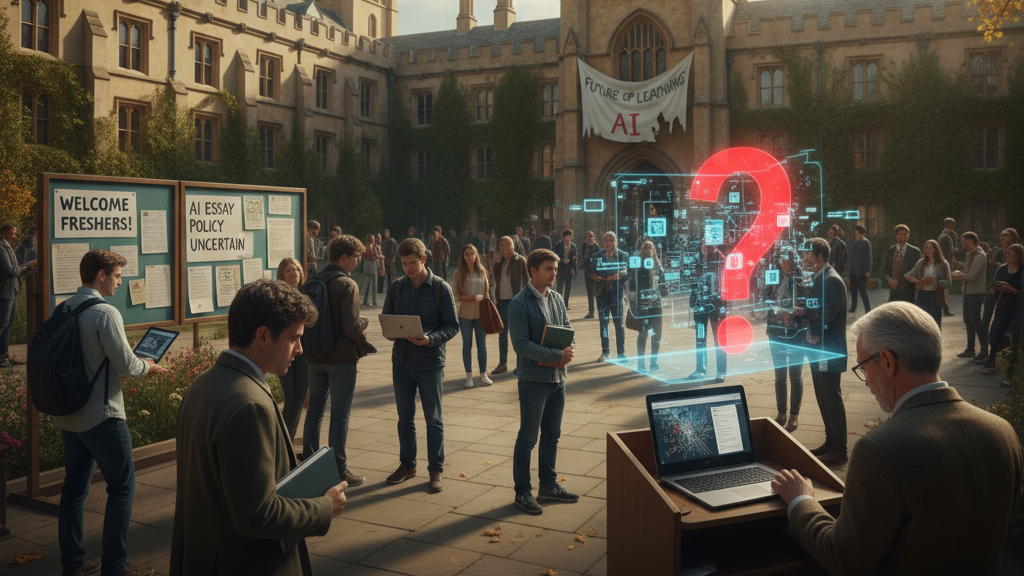
In the quad of a traditional UK university, students mill about as a new academic year begins. A notice board reads "WELCOME FRESHERS!" and "AI ESSAY POLICY UNCERTAIN." In the foreground, a professor stands at a podium with a laptop, while a large, glowing red question mark, integrated with digital interfaces, hovers amidst a group of students, symbolizing the ongoing struggle and uncertainty universities face in responding to AI. Image (and typos) generated by Nano Banana.
Even as a new academic year commences, universities across the UK continue to grapple with formulating a clear and effective response to the pervasive influence of AI. This image captures the scene of students beginning their studies amidst an atmosphere of unresolved questions and policy uncertainty surrounding AI’s role in higher education. Image (and typos) generated by Nano Banana.

Source

LSE Impact of Social Sciences Blog

Summary

As the 2025 academic year kicks off, many UK universities remain unprepared for AI’s impact despite mounting pressure. The article reports that institutional policies are inconsistent and often reactive; many faculty and students are unclear about permitted AI use. Some courses have introduced AI literacy modules, but uptake is patchy. The author argues that universities need structural support: coordinated policy frameworks, staff training, cross-departmental collaboration, and genuine student participation in policy design. Without this, universities risk wide disparities in practice and credibility gaps between policy and classroom reality.

Key Points

  • Universities’ AI policies remain inconsistent, often drafted last minute without full stakeholder consultation.
  • Many faculty lack training or confidence in integrating AI ethically; students similarly uncertain.
  • Some courses have begun adding AI literacy to curricula, but coverage is uneven.
  • Without central coordination, departments forge their own rules — leading to confusion and inequity.
  • Sustainable response requires institutional investment: training, infrastructure, participative governance.

Keywords

URL

https://blogs.lse.ac.uk/impactofsocialsciences/2025/09/26/a-new-academic-year-has-begun-but-uk-universities-are-still-struggling-to-respond-to-ai/

Summary generated by ChatGPT 5


Colleges and Schools Must Block and Ban Agentic AI Browsers Now. Here’s Why


A group of students and a teacher in a library setting, with a prominent holographic display showing a red "blocked" symbol over an internet browser interface, symbolising the banning of agentic AI. Image (and typos) generated by Nano Banana.
The rise of agentic AI browsers presents new challenges for educational institutions. This image illustrates the urgent need for colleges and schools to implement blocking and banning measures to maintain academic integrity and a secure learning environment. Image (and typos) generated by Nano Banana.

Source

Forbes

Summary

Aviva Legatt warns that “agentic AI browsers” — tools able to log in, navigate, and complete tasks inside learning platforms — pose immediate risks to education. Unlike text-only AI, these can impersonate students or instructors, complete quizzes, grade assignments, and even bypass security like two-factor authentication. This creates threats not just of cheating but of data breaches and compliance failures under U.S. federal law. Faculty report “vaporised learning” when agents replace the effort needed to learn. Legatt urges institutions to block such browsers now, redesign assessments to resist automation, and treat agentic AI as an enterprise-level governance and security issue.

Key Points

  • Agentic browsers automate LMS tasks: logging in, completing quizzes, grading, posting feedback.
  • Risks extend beyond cheating to credential theft, data compromise, and federal compliance breaches.
  • Experiments show guardrails are easily bypassed, allowing unauthorised access and impersonation.
  • Faculty adapt by shifting to oral defences, handwritten tasks, and requiring drafts/reflections.
  • Recommended response: block tools, redesign assessments, embed governance, invest in AI literacy.

Keywords

URL

https://www.forbes.com/sites/avivalegatt/2025/09/25/colleges-and-schools-must-block-agentic-ai-browsers-now-heres-why/

Summary generated by ChatGPT 5