SchoolAI’s lessons in building an AI platform that empowers teachers


In a bright, modern classroom, a diverse group of educators gathers around an interactive glowing table displaying a 'SchoolAI' platform with various data and connectivity icons. One teacher gestures towards the screen, while others observe intently or work on individual tablets. The scene depicts teachers engaging with an AI platform designed to enhance their capabilities, with the embedded text 'SchoolAI: Empowring Teachers'. Generated by Nano Banana.
This image illustrates the potential of platforms like SchoolAI to transform education by empowering teachers with advanced AI tools. By streamlining tasks, providing personalised insights, and fostering innovative learning environments, such platforms offer valuable lessons in building technology that truly supports and enhances the educator’s role, rather than replacing it. Image (and typos) generated by Nano Banana.

Source

OpenAI

Summary

SchoolAI is an education platform built with OpenAI models (GPT-4.1, GPT-4o, etc.) aimed at real-time, personalised learning at scale. Teachers create interactive “Spaces” via an assistant (Dot), and students interact with Sidekick, an AI tutor that adapts pacing, offers scaffolds, and provides guidance—but never simply hands answers. Teachers remain “in the loop,” with visibility into what students struggle with before gaps deepen. In two years, it has grown to a million classrooms across 80+ countries and embedded in 500+ partnerships. The design principles emphasise trust, safety, and scalability: i.e., AI must coach rather than replace, and operations must use one AI stack to maintain consistency.

Key Points

  • The platform ensures teacher-in-the-loop control: all interactions are observable, so teachers can intervene early.
  • AI supports differentiated learning: tasks are scaffolded and paced to individual student needs.
  • The system uses a modular “agent graph” architecture (many nodes/models) rather than a simple prompt → response setup.
  • Scale is baked in: the team chose to stick with a single AI “stack” to move faster and reduce cost overheads at growth.
  • Early teacher reports: some claim the tool saves 10+ hours weekly, allowing them to focus more on human mentoring than grading.

Keywords

URL

https://openai.com/index/schoolai/

Summary generated by ChatGPT 5
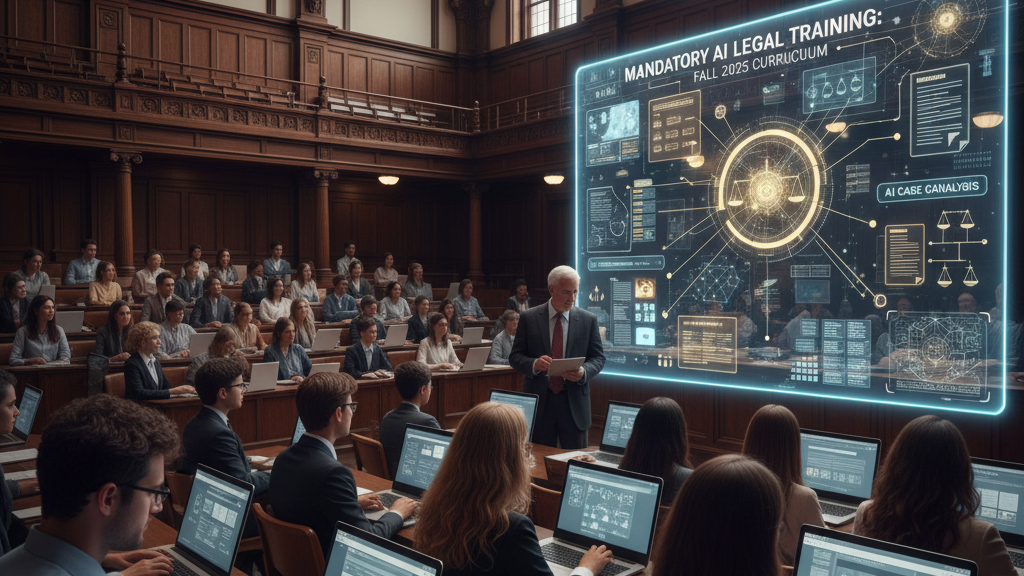

AI training becomes mandatory at more US law schools


In a classic, wood-paneled law school lecture hall, a professor stands at the front addressing a large class of students, all working on laptops. Behind the professor, a large, glowing blue holographic screen displays 'MANDATORY AI LEGAL TRAINING: FALL 2025 CURRICULUM' along with complex flowcharts and data related to AI and legal analysis. The scene signifies the integration of AI training into legal education. Generated by Nano Banana.
As the legal landscape rapidly evolves with AI advancements, more US law schools are making AI training a mandatory component of their curriculum. This image captures a vision of future legal education, where students are equipped with essential AI skills to navigate and practice law in a technologically transformed world. Image (and typos) generated by Nano Banana.

Source

Reuters

Summary

A growing number of U.S. law schools are making AI training compulsory, embedding it into first-year curricula to better equip graduates for the evolving legal sector. Instead of resisting AI, institutions like Fordham and Arizona State now include exercises (e.g. comparing AI-generated vs. professor-written legal analyses) in orientation and foundational courses. These programmes teach model mechanics, prompt design, and ethical risks like hallucinations. Legal educators believe AI fluency is fast becoming a baseline competency for future attorneys, driven by employer expectations and emerging norms in legal practice.

Key Points

  • At least eight law schools now require AI training in first-year orientation or core courses.
  • Fordham’s orientation exercise had students compare a ChatGPT-drafted legal summary vs. a professor’s.
  • Schools cover how AI works, its limitations and errors, and responsible prompt practices.
  • The shift signals a move from seeing AI as cheating risk to accepting it as a core legal skill.
  • Legal employers endorse this direction, arguing new lawyers need baseline AI literacy to be effective.

Keywords

URL

https://www.reuters.com/legal/legalindustry/ai-training-becomes-mandatory-more-us-law-schools-2025-09-22/

Summary generated by ChatGPT 5


How we’ve adapted coursework and essays to guard against AI


In a modern meeting room with large windows overlooking university buildings, a male and female academic are engaged in a discussion across a table. Between them, a glowing holographic shield icon labeled 'AI' is surrounded by other icons representing 'ADAPTED ASSESSMENTS: HUMAN PROOFED', 'ORAL DEFENSE', and 'HANDWRITTEN ASSFSSMENTS'. Other students are seen working on laptops in the background. The scene illustrates strategies for guarding against AI misuse in coursework. Generated by Nano Banana.
As AI tools become commonplace, educational institutions are proactively adapting their coursework and essay assignments to uphold academic integrity. This image visualizes educators implementing new assessment strategies, from human-proofed assignments to oral defenses, designed to ensure students are building their own knowledge and skills, rather than solely relying on AI. Image (and typos) generated by Nano Banana.

Source

Tes

Summary

An international school led by a history teacher rethinks assessment to preserve cognitive engagement in the age of AI. They’ve moved most research and drafting of A-level coursework into lessons (reducing home drafting), track each student’s writing path via Google Docs, require handwritten work at various key stages to discourage copy/paste, and engage students in dialogue about the pitfalls (“hallucinations”) of AI content. The strategy aims not just to prevent cheating, but to reinforce critical thinking, reduce procrastination, and make students more accountable for their own ideas.

Key Points

  • Coursework work (research + drafting) must be done partly in class, enabling oversight and reducing offsite AI use.
  • Monitoring via Google Docs helps detect inconsistencies in tone or sophistication that suggest AI assistance.
  • Handwritten assignments are reintroduced to reduce reliance on AI and minimise temptations to copy-paste.
  • Students are taught about AI’s unreliability (e.g. “hallucinations”) using historical examples of absurd errors (e.g. mixing battles, animals in wrong eras).
  • The reforms have modest benefits: less procrastination, more transparency, though challenges remain when students determined to cheat try to circumvent controls.

Keywords

URL

https://www.tes.com/magazine/analysis/specialist-sector/stopping-ai-cheating-how-our-school-has-adapted-coursework-essay-writing

Summary generated by ChatGPT 5


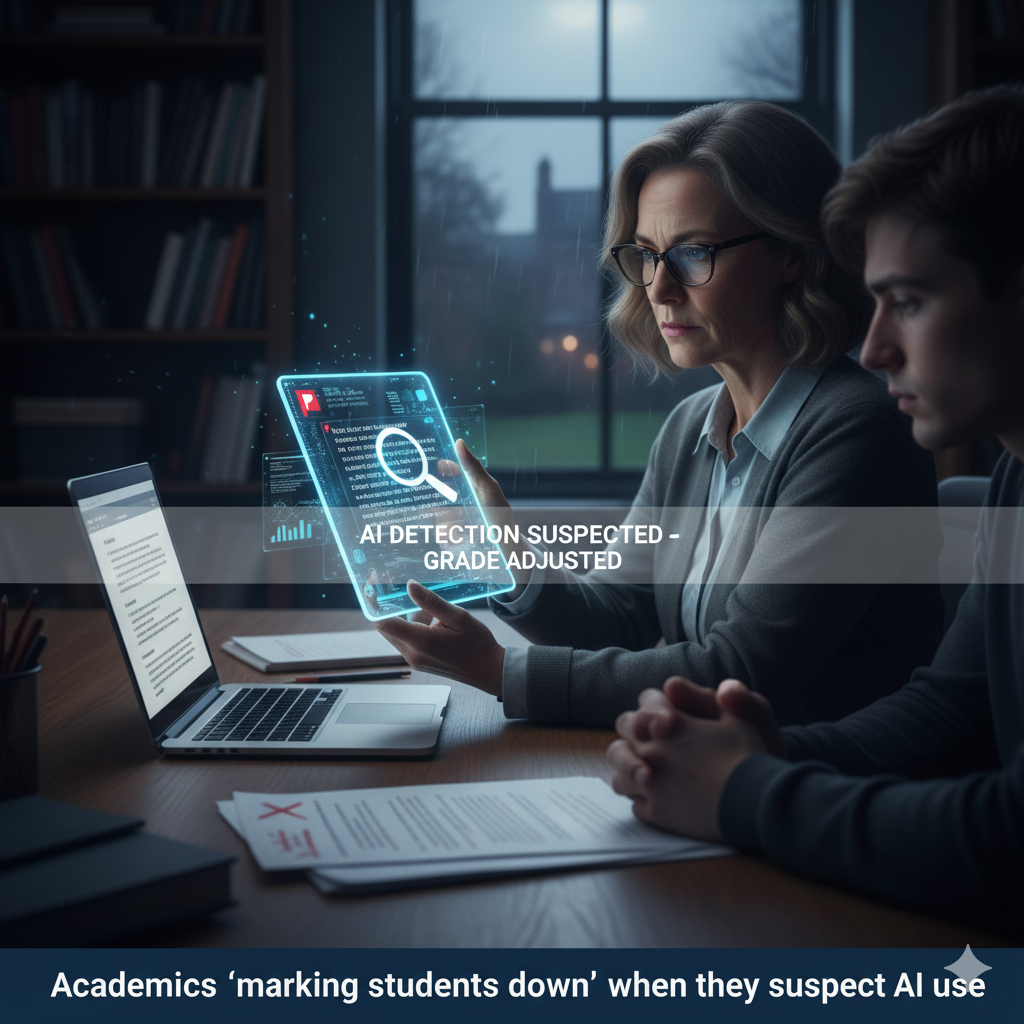
Academics ‘marking students down’ when they suspect AI use


A concerned academic, wearing glasses, sits across from a student, both looking at a transparent tablet displaying 'AI detection suspected - Grade Adjusted' with code and charts. A laptop with an essay is open on the left, and a document with a large red 'X' is on the table, symbolizing suspicion of AI use in academic work. Generated by Nano Banana.
The rise of AI in education presents new challenges for assessment. This image visualizes the tension and scrutiny faced by students as academics grapple with suspected AI use in assignments, leading to difficult conversations and potential grade adjustments. Image generated by Nano Banana.

Source

Times Higher Education

Summary

A recent study of academics in China’s Greater Bay Area reveals that some lecturers are reducing student marks if they suspect AI use, even when the students have declared using it or when institutional policy allows such use. The research, involving 33 academics, highlights that ambiguity around what constitutes legitimate AI use and norms emphasising originality and independence, leads to inconsistent grading. Particularly in the humanities, suspicion of AI can lead to harsher penalties. The lack of explicit expectations communicated to students exacerbates the issue, risking distrust and undermining the credibility of academic grading unless clearer standards are established.

Key Points

  • Academics are sometimes deducting marks based on suspicion of AI use, despite declared or permitted use.
  • The study involved 33 academics, many of whom report tension between policies that permit AI and traditional values of originality and independence.
  • Humanities lecturers are more likely to penalise AI-use suspicion than those in other disciplines.
  • Many institutions lack clear policies; expectations about AI use are often implicit, not explicitly communicated to students.
  • Without clarity, there is a risk of unfair marking, loss of trust between students and staff, and damage to the credibility of academic certifications.

Keywords

URL

https://www.timeshighereducation.com/news/academics-marking-students-down-when-they-suspect-ai-use

Summary generated by ChatGPT 5


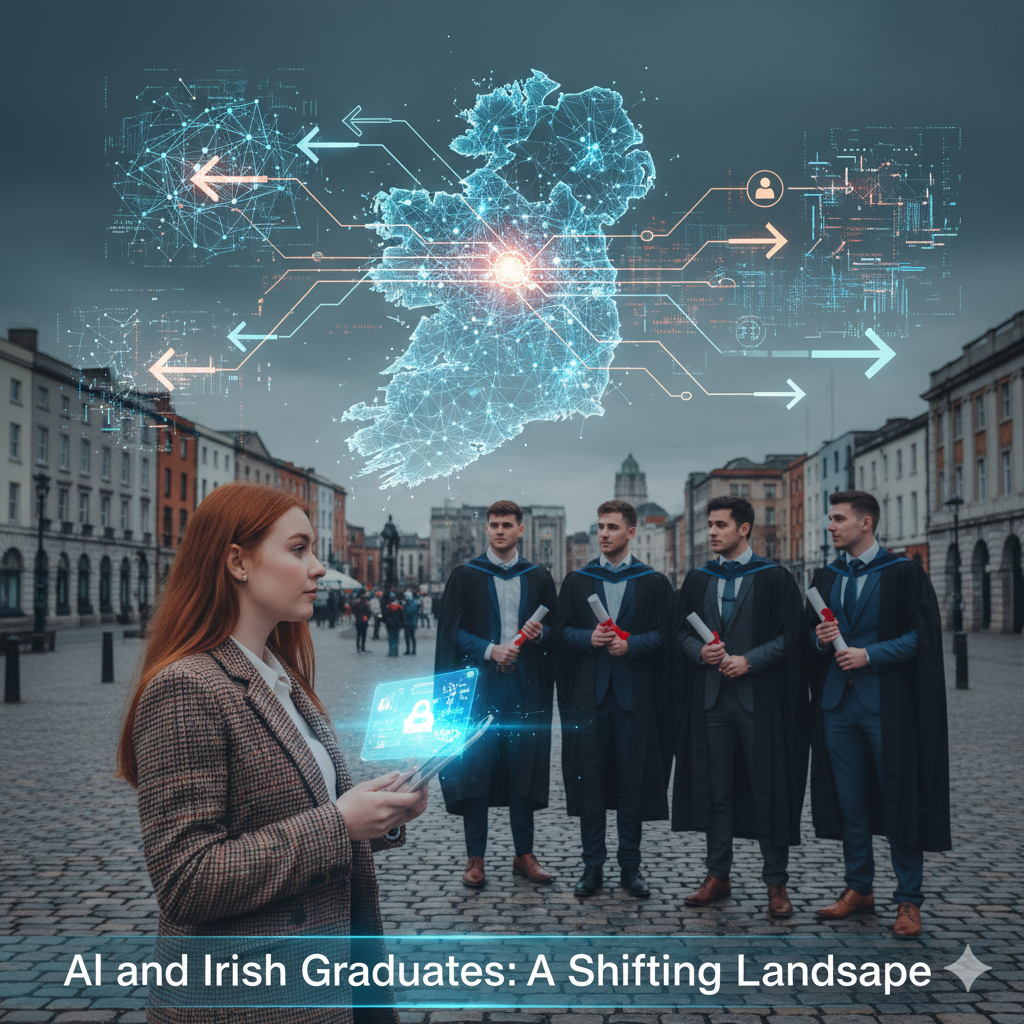
How is AI affecting jobs for graduates in Ireland?


A diverse group of recent graduates in caps and gowns stands in an urban street, looking towards a prominent female figure in a business blazer. Behind them, a glowing, networked digital map of Ireland hovers in the sky, interconnected with arrows representing data flow and opportunities. The scene symbolizes AI's impact on Irish graduate jobs. Generated by Nano Banana.
As AI reshapes the global job market, Irish graduates navigate a new landscape of opportunities and challenges. This image captures the intersection of traditional academic achievement with the digital transformation, illustrating how artificial intelligence is influencing career paths across Ireland. Image generated by Nano Banana.

Source

The Irish Times

Summary

Irish graduates are facing a shifting job market due to AI and automation, but the impact is more nuanced than dramatic headlines suggest. While graduate hiring — especially in accountancy and related fields — is already being affected, broader forces (offshoring, economic conditions) also play a big part. Experts say AI is more reshaping tasks than replacing entire jobs: automating routine tasks, meaning graduates must adapt by emphasising creativity, human judgement, decision-making and transparency. Those who succeed will be ones who treat career development as lifelong learning, stay technically literate, and stand out in how they communicate, think, and add value beyond what a machine can do.

Key Points

  • Graduate roles in fields like accountancy are being reduced, partly due to AI/automation.
  • Media coverage tends toward exaggeration; many effects are emerging but not yet fully realised.
  • Tasks that require creativity, human interaction, or decision-making are harder for AI to replicate; these are where graduates can differentiate themselves.
  • Familiarity with AI tools and continuous learning are becoming essential parts of employability.
  • Graduates who write well, show personality, judgement, and can work with newer technologies have an advantage.

Keywords

URL

https://www.irishtimes.com/ireland/education/2025/09/20/how-is-ai-affecting-jobs-for-graduates-in-ireland/

Summary generated by ChatGPT 5