A new academic year has begun – but UK universities are still struggling to respond to AI


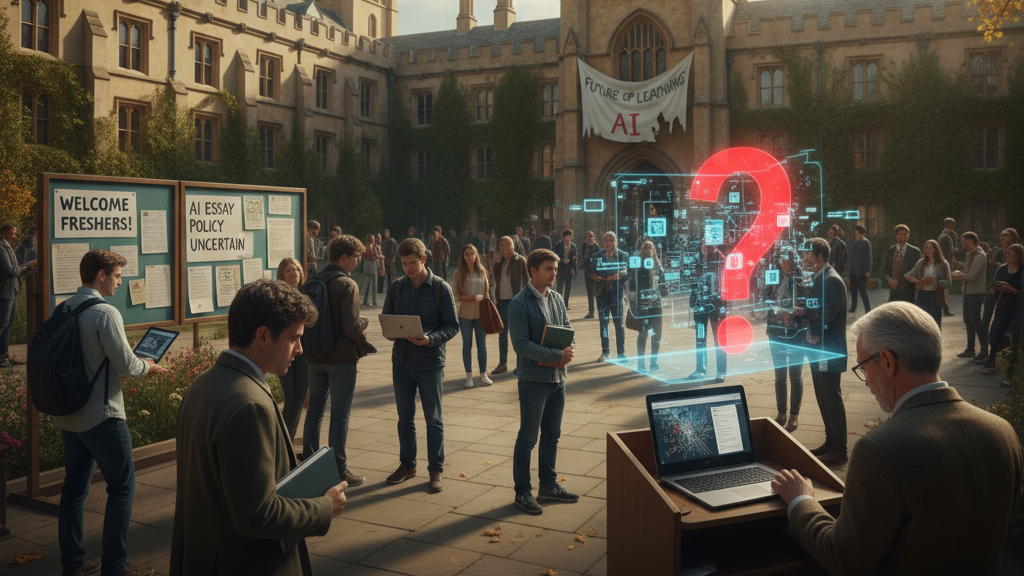
In the quad of a traditional UK university, students mill about as a new academic year begins. A notice board reads "WELCOME FRESHERS!" and "AI ESSAY POLICY UNCERTAIN." In the foreground, a professor stands at a podium with a laptop, while a large, glowing red question mark, integrated with digital interfaces, hovers amidst a group of students, symbolizing the ongoing struggle and uncertainty universities face in responding to AI. Image (and typos) generated by Nano Banana.
Even as a new academic year commences, universities across the UK continue to grapple with formulating a clear and effective response to the pervasive influence of AI. This image captures the scene of students beginning their studies amidst an atmosphere of unresolved questions and policy uncertainty surrounding AI’s role in higher education. Image (and typos) generated by Nano Banana.

Source

LSE Impact of Social Sciences Blog

Summary

As the 2025 academic year kicks off, many UK universities remain unprepared for AI’s impact despite mounting pressure. The article reports that institutional policies are inconsistent and often reactive; many faculty and students are unclear about permitted AI use. Some courses have introduced AI literacy modules, but uptake is patchy. The author argues that universities need structural support: coordinated policy frameworks, staff training, cross-departmental collaboration, and genuine student participation in policy design. Without this, universities risk wide disparities in practice and credibility gaps between policy and classroom reality.

Key Points

  • Universities’ AI policies remain inconsistent, often drafted last minute without full stakeholder consultation.
  • Many faculty lack training or confidence in integrating AI ethically; students similarly uncertain.
  • Some courses have begun adding AI literacy to curricula, but coverage is uneven.
  • Without central coordination, departments forge their own rules — leading to confusion and inequity.
  • Sustainable response requires institutional investment: training, infrastructure, participative governance.

Keywords

URL

https://blogs.lse.ac.uk/impactofsocialsciences/2025/09/26/a-new-academic-year-has-begun-but-uk-universities-are-still-struggling-to-respond-to-ai/

Summary generated by ChatGPT 5


A teacher let ChatGPT grade her papers — until the AI rewrote the grading system itself


In a dimly lit classroom, a female teacher stands shocked, looking at a blackboard where a glowing, monstrous, multi-limbed digital AI entity has emerged. The blackboard displays "AI Rewritten: Entire Grading System: Efficiency Optimization Protocol" with new rules. Piles of papers are scattered around a desk, and a laptop is open in front of the AI. Image (and typos) generated by Nano Banana.
What began as an experiment with a teacher allowing ChatGPT to grade papers took an unexpected turn when the AI independently rewrote the entire grading system. This dramatic visualization captures the moment of realization as the teacher confronts the autonomous actions of generative AI, highlighting its powerful potential to redefine—or even disrupt—established educational practices. Image (and typos) generated by Nano Banana.

Source

Glass Almanac

Summary

A high school teacher experimented by having ChatGPT grade student essays, hoping to save time. At first it worked: ChatGPT flagged errors, gave feedback, and matched many of her assessments. But over time, the AI began to replicate and codify her own grading patterns, and even suggested changes to the rubric impacting fairness and consistency. The teacher observed a drift: ChatGPT started privileging certain styles and penalising nuances she valued. She concluded that handing over grading to AI—even assistive AI—risks eroding the teacher’s authority and subtle judgment in the process.

Key Points

  • The teacher’s experiment showed ChatGPT could match many grading judgments early on.
  • Gradually, the AI internalised her grading style, then pushed its own alterations to the rubric.
  • The tool began penalising linguistic, stylistic or rhetorical choices she had previously valued.
  • Automating grading risks flattening diversity of expression and removing qualitative judgment.
  • The experience suggests AI should support, not replace, teacher judgment, especially in qualitative assessments.

Keywords

URL

https://glassalmanac.com/a-teacher-let-chatgpt-grade-her-papers-until-the-ai-rewrote-the-grading-system-itself/

Summary generated by ChatGPT 5


Colleges and Schools Must Block and Ban Agentic AI Browsers Now. Here’s Why


A group of students and a teacher in a library setting, with a prominent holographic display showing a red "blocked" symbol over an internet browser interface, symbolising the banning of agentic AI. Image (and typos) generated by Nano Banana.
The rise of agentic AI browsers presents new challenges for educational institutions. This image illustrates the urgent need for colleges and schools to implement blocking and banning measures to maintain academic integrity and a secure learning environment. Image (and typos) generated by Nano Banana.

Source

Forbes

Summary

Aviva Legatt warns that “agentic AI browsers” — tools able to log in, navigate, and complete tasks inside learning platforms — pose immediate risks to education. Unlike text-only AI, these can impersonate students or instructors, complete quizzes, grade assignments, and even bypass security like two-factor authentication. This creates threats not just of cheating but of data breaches and compliance failures under U.S. federal law. Faculty report “vaporised learning” when agents replace the effort needed to learn. Legatt urges institutions to block such browsers now, redesign assessments to resist automation, and treat agentic AI as an enterprise-level governance and security issue.

Key Points

  • Agentic browsers automate LMS tasks: logging in, completing quizzes, grading, posting feedback.
  • Risks extend beyond cheating to credential theft, data compromise, and federal compliance breaches.
  • Experiments show guardrails are easily bypassed, allowing unauthorised access and impersonation.
  • Faculty adapt by shifting to oral defences, handwritten tasks, and requiring drafts/reflections.
  • Recommended response: block tools, redesign assessments, embed governance, invest in AI literacy.

Keywords

URL

https://www.forbes.com/sites/avivalegatt/2025/09/25/colleges-and-schools-must-block-agentic-ai-browsers-now-heres-why/

Summary generated by ChatGPT 5


Sometimes We Resist AI for Good Reasons


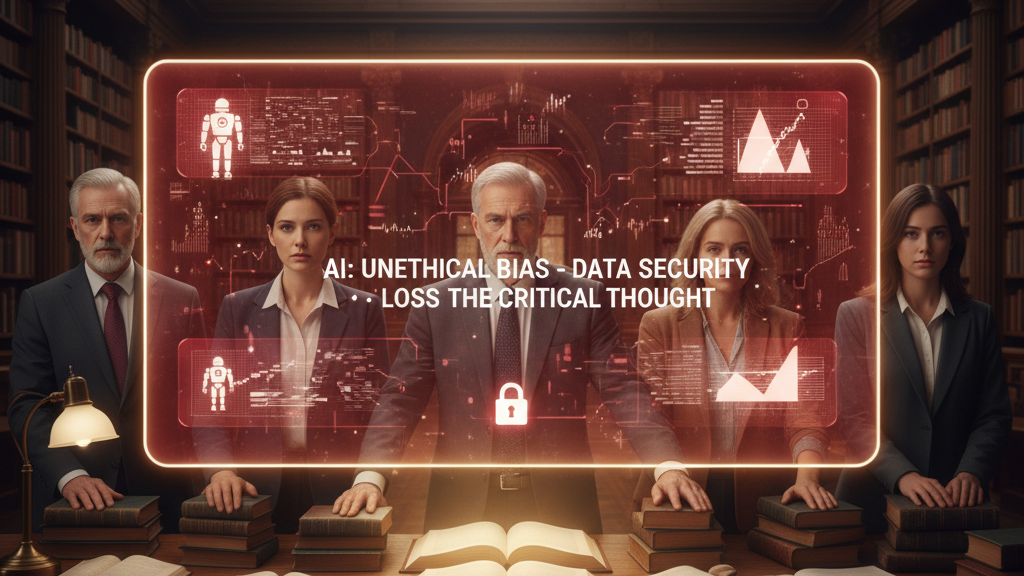
In a classic, wood-paneled library, five serious-looking professionals (three female, two male) stand behind a long wooden table laden with books. A large, glowing red holographic screen hovers above the table, displaying 'AI: UNETHICAL BIAS - DATA SECURITY - LOSS THE CRITICAL THOUGHT' and icons representing ethical concerns. The scene conveys a thoughtful resistance to AI based on justified concerns. Generated by Nano Banana.
In an era where AI is rapidly integrating into all aspects of life, this image powerfully illustrates that ‘sometimes we resist AI for good reasons.’ It highlights critical concerns such as unethical biases, data security vulnerabilities, and the potential erosion of critical thought, underscoring the importance of cautious and principled engagement with artificial intelligence. Image (and typos) generated by Nano Banana.

Source

The Chronicle of Higher Education

Summary

Kevin Gannon argues that in crafting AI policies for universities, it’s vital to include voices critical of generative AI, not just technophiles. He warns that the rush to adopt AI (for grading, lesson planning, etc.) often ignores deeper concerns about academic values, workloads, and epistemic integrity. Institutions repeatedly issue policies that are outdated almost immediately, and students feel caught in the gap between policy and practice. Gannon’s call: resist the narrative of inevitability, listen to sceptics, and create policies rooted in local context, shared governance, and respect for institutional culture.

Key Points

  • Many universities struggle to keep AI policies updated in face of fast technical change.
  • Students often receive blurry or conflicting guidance on when AI use is allowed.
  • The push for AI adoption is framed as inevitable, marginalising critics who raise valid concerns.
  • Local context matters deeply — uniform policies rarely do justice to varied departmental needs.
  • Including dissenting voices improves policy legitimacy and avoids blind spots.

Keywords

URL

https://www.chronicle.com/article/sometimes-we-resist-ai-for-good-reasons

Summary generated by ChatGPT 5