How AI can drive tailored learning


A smiling student wearing futuristic glasses interacts with a holographic display showing a 'Personalized Learning Path' with graphs and DNA-like structures. In the background, other students are engaged in a modern classroom setting, and a screen displays 'Cognitive Adaptation' with a brain icon. The image illustrates AI's role in individualized education. Generated by Nano Banana.
AI is revolutionising education by creating personalised learning paths that adapt to each student’s unique needs and pace. This image depicts a student engaging with an AI-driven interface, highlighting how technology can foster individualised growth and a more effective learning experience in modern classrooms. Image generated by Nano Banana.

Source

Times Higher Education

Summary

In this piece, Andreas Rausch argues that generative AI (GenAI) should be integrated into business and higher education in ways that promote tailored learning without losing the human touch. He emphasises that AI can enhance problem-solving skills, adapt content to individual student needs, and help instructors personalise feedback. But Rausch warns that over-reliance on AI risks eroding essential skills such as creativity, ethical judgement, and interpersonal communication. The article calls for balance: using AI to support learning, not replace human instructors, and designing AI-augmented pedagogy that preserves reflective, human elements while enhancing flexibility and engagement.

Key Points

  • GenAI can help personalise content and feedback, making learning more adaptive to individual progress.
  • Focus on enhancing business students’ problem-solving skills rather than automating them away.
  • There is a risk that AI use, if unmanaged, may diminish human qualities like ethical judgement, reflection, and creativity.
  • Teachers’ role becomes even more important: guiding students through AI outputs, maintaining human connection in learning.
  • Institutional implementation should be thoughtful: adequate training, governance, and ensuring AI is a tool—not a crutch.

Keywords

URL

https://www.timeshighereducation.com/campus/how-ai-can-drive-tailored-learning

Summary generated by ChatGPT 5
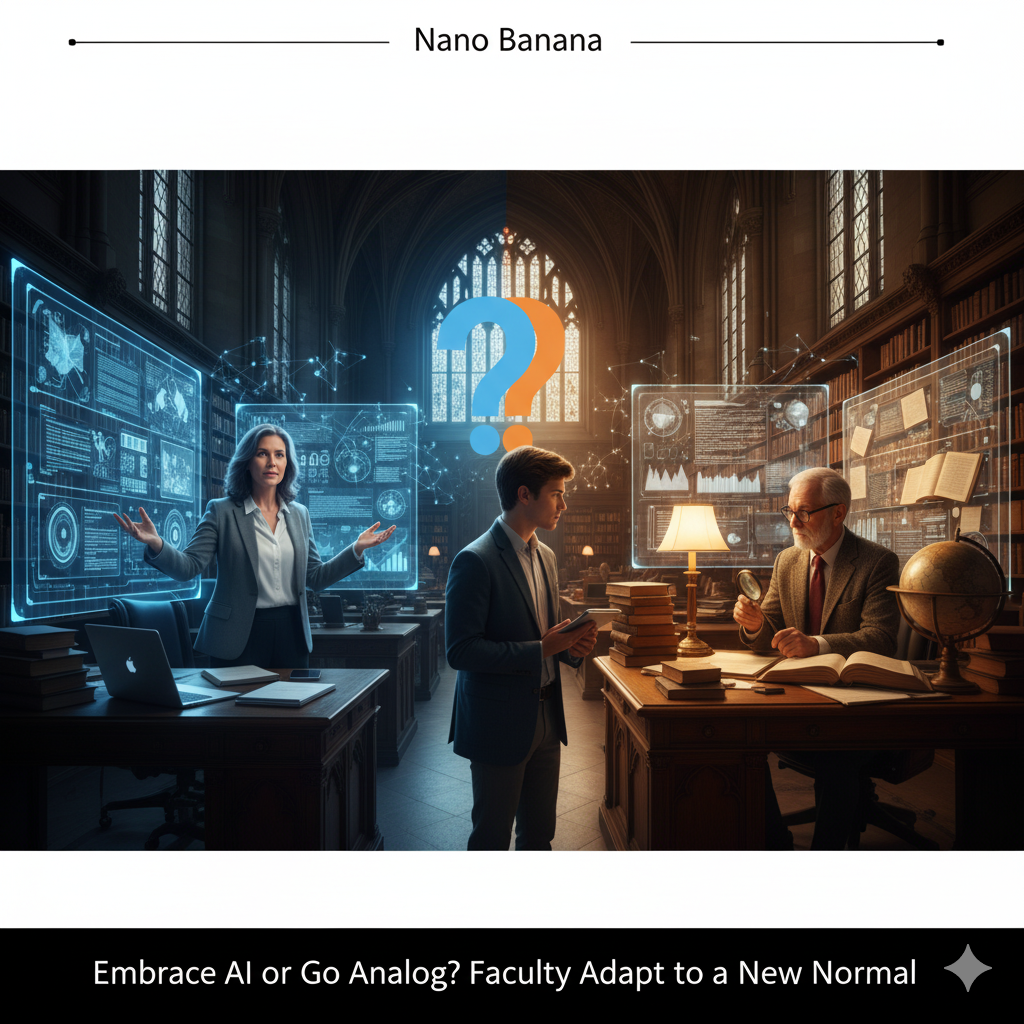

Embrace AI or Go Analog? Harvard Faculty Adapt to a New Normal


In a grand, traditional library setting, a female faculty member gestures towards a large glowing screen displaying AI data on the left, while a male faculty member examines a physical book with a magnifying glass on the right. Between them, a hovering question mark split in blue and orange signifies the choice between AI and traditional methods. The scene represents academics adapting to new technologies. Generated by Nano Banana.
As artificial intelligence becomes increasingly integrated into education, faculty in esteemed institutions face a pivotal choice: embrace the analytical power of AI or champion traditional analogue learning. This image captures the dynamic tension and adaptation required as educators navigate this new normal. Image generated by Nano Banana.

Source

The Harvard Crimson

Summary

AI is now a widespread presence in Harvard classrooms, and faculty are increasingly accepting it as part of teaching rather than trying to ignore it. Around 80% of surveyed faculty reported seeing coursework they believed was AI-generated. Yet most aren’t confident in spotting it. In response, different pedagogical strategies are emerging: some instructors encourage responsible AI use (e.g. tutor chatbots, AI homework), others “AI-proof” their classes via in-person exams. Harvard’s Bok Center is providing support with AI-specific tools and workshops. While concerns persist (cheating, undermined learning), many believe that adjusting to AI and preparing students for its reality is the more sustainable path.

Key Points

  • Nearly 80% of Harvard faculty have seen student work they believe used AI.
  • Only ~14% of faculty feel very confident distinguishing AI-generated content.
  • Faculty responses vary: some embrace AI (homework/assistant tools), others shift to in-person exams to reduce risks.
  • The Bok Center helps instructors design AI-resilient assignments, tutor chatbots, and offers pedagogical support.
  • Some faculty worry that AI use might degrade deep learning, but many accept that AI is here to stay and practices must evolve.

Keywords

URL

https://www.thecrimson.com/article/2025/9/19/AI-Shapes-Classroom-Embrace/

Summary generated by ChatGPT 5


How AI could radically change schools by 2050


A futuristic classroom in a circular building with large windows overlooking a green city skyline. Students, wearing sleek uniforms and glasses, sit at round tables interacting with holographic projections of planets and data. A glowing blue humanoid AI figure stands at the front, seemingly teaching. The scene depicts a 'Global AI-Integrated Curriculum, 2050 AD,' showcasing radical educational changes. Generated by Nano Banana.
Envisioning the classroom of tomorrow, this image illustrates how AI could fundamentally transform education by 2050. From holographic learning environments to AI-driven instructors and personalized interactive experiences, schools may offer a radically integrated curriculum, preparing students for an ever-evolving world. Image generated by Nano Banana.

Source

Harvard Gazette

Summary

Harvard thinkers Howard Gardner and Anthea Roberts envision a future in which AI reshapes education so fundamentally that many standard practices seem archaic by 2050. After a few years learning the basics (reading, writing, arithmetic, plus some coding), students may be guided more by coaches than lecturers. Gardner suggests that AI may render “disciplined”, “synthesising,” and “creative” kinds of cognitive work optional for humans, while human responsibility is likely to centre on ethics, respect, and interpersonal judgement. Roberts foresees graduates becoming directors of ensembles of AI, needing strong judgement and facility with AI tools. Critical concerns include preserving human agency, avoiding over-reliance, and ensuring deep thinking remains central.

Key Points

  • The current model of uniform schooling & assessment will seem outdated; education may move toward coaching and personalised paths.
  • After basics, humans may offload many cognitive tasks (discipline, synthesis, creativity) to AI, leaving ethics and humanity as core roles.
  • Students will need training not just in tools but strong faculties of judgement, editing, and leading AI systems.
  • Risk that AI could erode critical reasoning if educational design lets it replace thinking rather than support it.
  • The shift raises policy, pedagogical, and moral questions: how to assess, how long school should last, what trust & responsibility in AI-augmented education looks like.

Keywords

URL

https://news.harvard.edu/gazette/story/2025/09/how-ai-could-radically-change-schools-by-2050/

Summary generated by ChatGPT 5