Social media is teaching children how to use AI. How can teachers keep up?


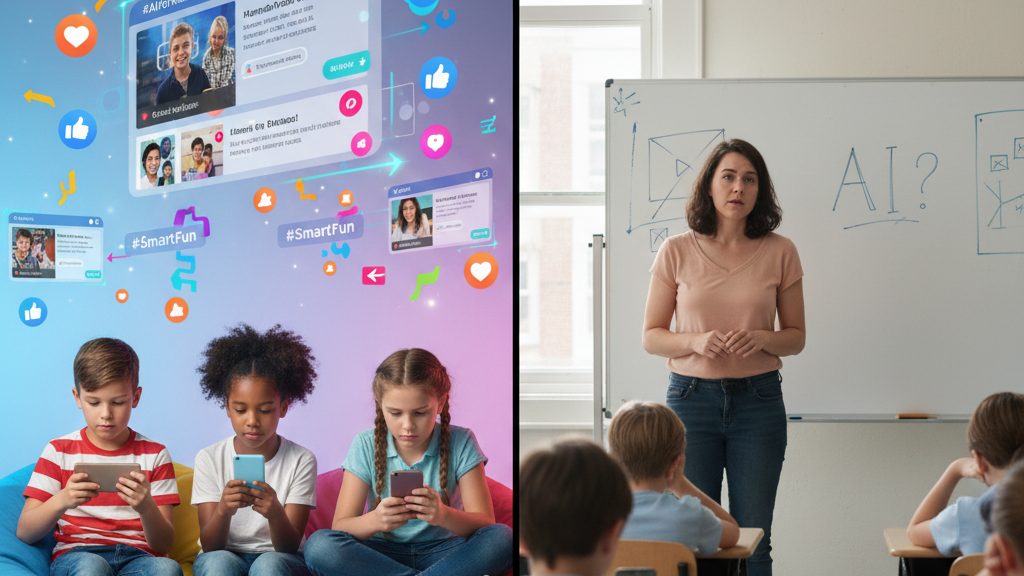
A split image contrasting two scenes. On the left, three young children are engrossed in tablets and smartphones, surrounded by vibrant social media interfaces featuring AI-related content and hashtags like "#AIforkids." On the right, a teacher stands in a traditional classroom looking somewhat perplexed at a whiteboard with "AI?" written on it, while students sit at desks, symbolizing the challenge for educators to keep pace with children's informal AI learning. Image (and typos) generated by Nano Banana.
While children are rapidly learning about AI through pervasive social media platforms, educators face the challenge of integrating this knowledge into formal learning environments. This image highlights the growing disconnect between how children are acquiring AI literacy informally and the efforts teachers must make to bridge this gap and keep classroom instruction relevant and engaging. Image (and typos) generated by Nano Banana.

Source

The Conversation

Summary

Students are learning to use AI mainly through TikTok, Discord, and peer networks, while teachers rely on informal exchanges and LinkedIn. This creates quick but uneven knowledge transfer that often skips deeper issues such as bias, equity, and ethics. A Canadian pilot project showed that structured teacher education transforms enthusiasm into critical AI literacy, giving educators both vocabulary and judgment to integrate AI responsibly. The article stresses that without institutional clarity and professional development, AI adoption risks reinforcing inequity and mistrust.

Key Points

  • Informal learning (TikTok, Discord, staff rooms) drives AI uptake but lacks critical depth.
  • Teacher candidates benefit from structured AI education, gaining language and tools to discuss ethics and bias.
  • Institutional AI policies are fragmented, leaving instructors without support and creating confusion.
  • Equity and bias are central concerns; multilingual learners may be disadvantaged by uncritical AI use.
  • Embedding AI literacy in teacher education and learning communities is critical to move from casual adoption to critical engagement.

Keywords

URL

https://theconversation.com/social-media-is-teaching-children-how-to-use-ai-how-can-teachers-keep-up-264727

Summary generated by ChatGPT 5


Harvard Professors Are Adapting To AI. It’s Time Students Do the Same.


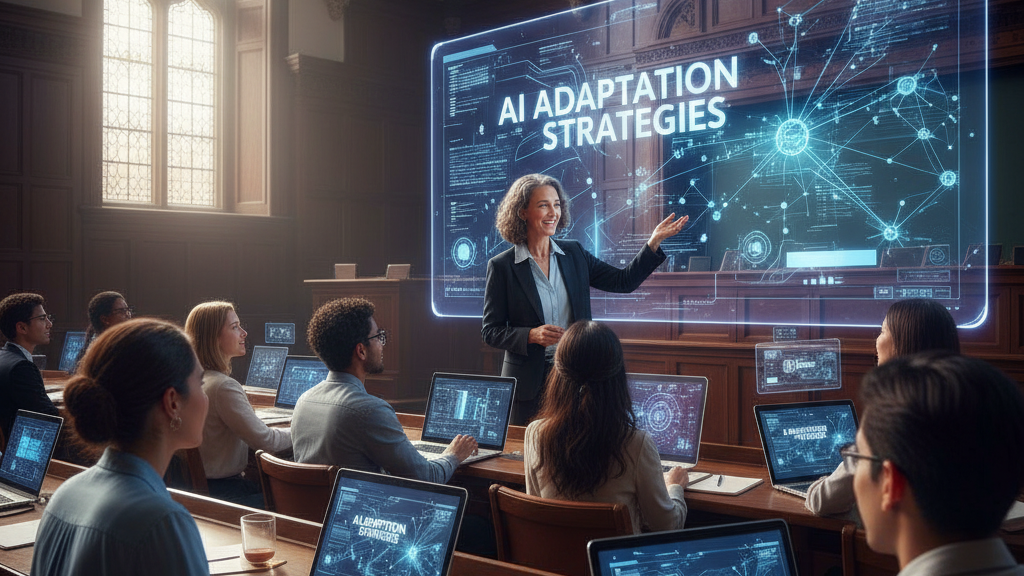
In a collegiate lecture hall, a female professor stands at the front, gesturing towards a large transparent screen displaying "AI ADAPTATION STRATEGIES" and a network of connected digital nodes. Students are seated at wooden desks with laptops, many showing similar AI-related content, actively engaged in learning about AI. Image (and typos) generated by Nano Banana.
As institutions like Harvard embrace and adapt to the integration of AI, the educational landscape is shifting rapidly. This image depicts a professor leading a class on “AI Adaptation Strategies,” underscoring the vital need for students to also acquire the skills and mindset necessary to effectively navigate and utilise artificial intelligence in their academic and future professional lives. Image (and typos) generated by Nano Banana.

Source

The Harvard Crimson

Summary

Harvard professors are moving away from blanket bans on AI and shifting toward nuanced, transparent policies that balance academic integrity with practical realities. Assignments are being redesigned to reduce misuse, and students are urged to treat AI as a tool for learning rather than a shortcut. Success depends on both institutional frameworks and student responsibility.

Key Points

  • 80% of faculty suspect or know AI is used in assignments.
  • Shift from total bans to clearer, nuanced policies.
  • AI often used as shortcut, undermining learning.
  • New assessments: oral exams, group work, AI-use disclosures.
  • Framework success depends on student buy-in.

Keywords

URL

https://www.thecrimson.com/article/2025/9/10/previn-harvard-ai-polocies/

Summary generated by ChatGPT 5