Faculty innovate with, and avoid, AI in the classroom


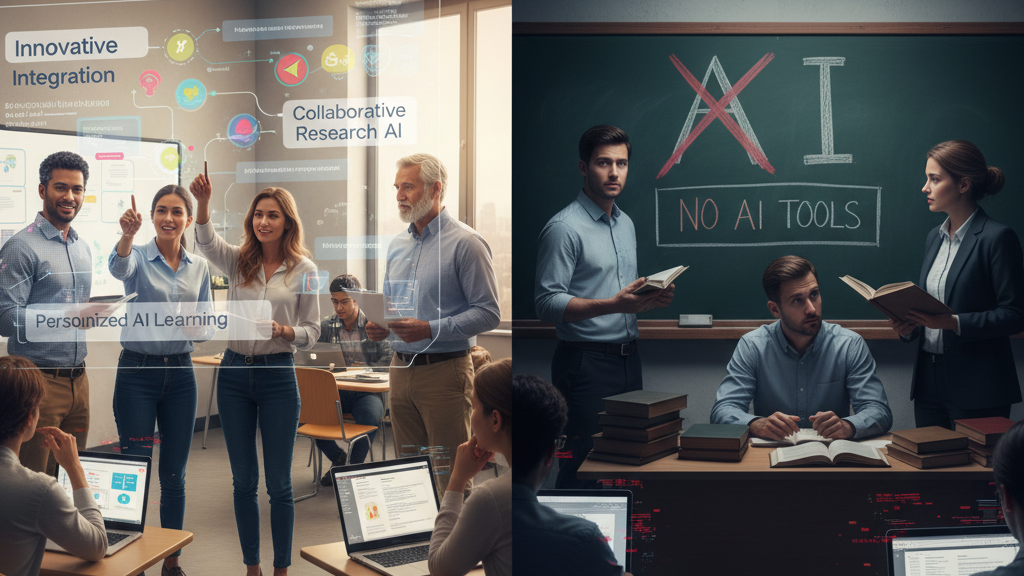
A split image contrasting two distinct classroom approaches to AI. On the left, a bright, modern classroom shows faculty and students collaboratively engaging with holographic displays and laptops, demonstrating "Innovative Integration" and "Collaborative Research AI." On the right, a darker, traditional classroom features a blackboard with a large red 'X' over "AI" and "NO AI TOOLS" written below it, with faculty and students avoiding technology, symbolizing resistance to AI. Image (and typos) generated by Nano Banana.
The academic world is currently experiencing a bifurcated response to artificial intelligence: while some faculty are enthusiastically innovating with AI to transform learning, others are deliberately avoiding its integration, advocating for traditional methods. This image vividly illustrates these contrasting approaches within university classrooms, highlighting the ongoing debate and diverse strategies faculty are employing regarding AI. Image (and typos) generated by Nano Banana.

Source

Cornell Chronicle

Summary

Cornell faculty are experimenting with hybrid approaches to AI: some integrate generative AI into coursework, others push back by returning to in-person, pencil-and-paper assessments. In nutrition and disease classes, AI is used to simulate patient case studies, generating unpredictable errors that prompt students to think critically. In parallel, some professors now include short “job interview” chats or oral questions to verify understanding. A campus survey found 70% of students use GenAI weekly or more, but only 44% of faculty do. Cornell is responding via workshops, a GenAI education working group, and guidelines to preserve academic integrity while embracing AI’s pedagogical potentials.

Key Points

  • AI is used to generate case studies, simulate patients, debate AI arguments, and help faculty draft content.
  • Some faculty moved back to paper exams, in-class assessments, or short oral checks (“job interviews”) to guard learning.
  • A campus survey showed 70% of students use GenAI weekly, vs. 44% of faculty.
  • Cornell’s GenAI working group develops policies, workshops, and academic integrity guidelines around AI use.
  • The approach is not binary acceptance or rejection, but navigating where AI can support without eroding students’ reasoning and agency.

Keywords

URL

https://news.cornell.edu/stories/2025/10/faculty-innovate-and-avoid-ai-classroom

Summary generated by ChatGPT 5


6 Smart Ways I Use AI for Learning (Without Becoming Lazy)


A multi-panel image illustrating smart ways to use AI for learning. The top panel shows a large screen displaying six distinct AI applications: "Personalized Tutor," "Concept Explainer," "Creative Brainstormer," "Language Partner," "Language Partner," and "Feedback Coach." The bottom two panels show individuals actively engaging with these AI tools on their laptops in study environments, utilizing holographic interfaces for tasks like personalized tutoring and receiving feedback, all without appearing lazy. Image (and typos) generated by Nano Banana.
This image showcases six intelligent and active ways individuals can leverage AI for enhanced learning without succumbing to intellectual laziness. From personalized tutoring and concept explanation to creative brainstorming and language practice, these methods highlight how AI can be a powerful tool to augment, rather than replace, human effort in the pursuit of knowledge and skill development. Image (and typos) generated by Nano Banana.

Source

PCMag UK

Summary

Brian Westover explains how AI can enhance learning when used as an active partner, not a shortcut. Drawing on studies from MIT and Microsoft, he warns that offloading critical thinking to AI weakens understanding. Instead, Westover outlines six practical ways to use AI as a learning aid—digitising handwritten notes, organising study materials, creating flashcards, simplifying complex topics, engaging in Socratic dialogue, and practising the Feynman technique. These methods turn AI into a reflection tool that reinforces comprehension, memory, and independent reasoning rather than replacing them.

Key Points

  • AI note-taking should complement—not replace—handwriting, which improves retention and understanding.
  • Use AI to digitise notes, compile key concepts, and create flashcards for spaced repetition learning.
  • Simplify complex topics via prompts such as “Explain like I’m 5” or “In simple English”.
  • Apply Socratic dialogue and Feynman techniques to build reasoning, self-explanation, and mastery.
  • Treat AI as a study partner to deepen thinking, not as a shortcut for completing tasks.

Keywords

URL

https://uk.pcmag.com/ai/160379/6-smart-ways-i-use-ai-for-learning-without-becoming-lazy

Summary generated by ChatGPT 5


AI in the classroom is hard to detect — time to bring back oral tests


In a modern classroom or meeting room, students are seated around a table, some with laptops. Two individuals are engaged in an oral discussion, facing each other. Behind them, a large screen displays lines of code that appear to be pixelating and disappearing, symbolizing the difficulty in detecting AI. Image (and typos) generated by Nano Banana.
As the stealth of AI-generated content in written assignments increases, educators are exploring alternative assessment methods. This image highlights a return to oral examinations, where direct interaction can provide a more accurate measure of a student’s understanding and original thought, bypassing the challenges of AI detection software. Image (and typos) generated by Nano Banana.

Source

The Conversation

Summary

Because AI-written texts are relatively easy to present convincingly, detecting AI use in student work is becoming increasingly difficult. The article argues that oral assessments (discussions, interrogations, viva voce) expose a student’s reasoning in ways AI can’t mimic. Voice, hesitation, follow-up questioning and depth of thought are far harder for AI to fake in real time. The authors suggest reintroducing or strengthening oral exams and conversational assessments as a countermeasure to maintain academic integrity and ensure authentic student understanding.

Key Points

  • AI tools produce polished text, but they fail when asked to defend their reasoning under questioning.
  • Oral tests can force students to show understanding, not just output.
  • Real-time dialogue gives instructors more confidence about authenticity than text alone.
  • Reintroduction of oral assessment may help bridge the integrity gap in AI-era classrooms.
  • The method isn’t perfect, but it is a practical and historically grounded safeguard.

Keywords

URL

https://theconversation.com/ai-in-the-classroom-is-hard-to-detect-time-to-bring-back-oral-tests-265955

Summary generated by ChatGPT 5


OpenAI Releases List of Work Tasks ChatGPT Can Already Replace


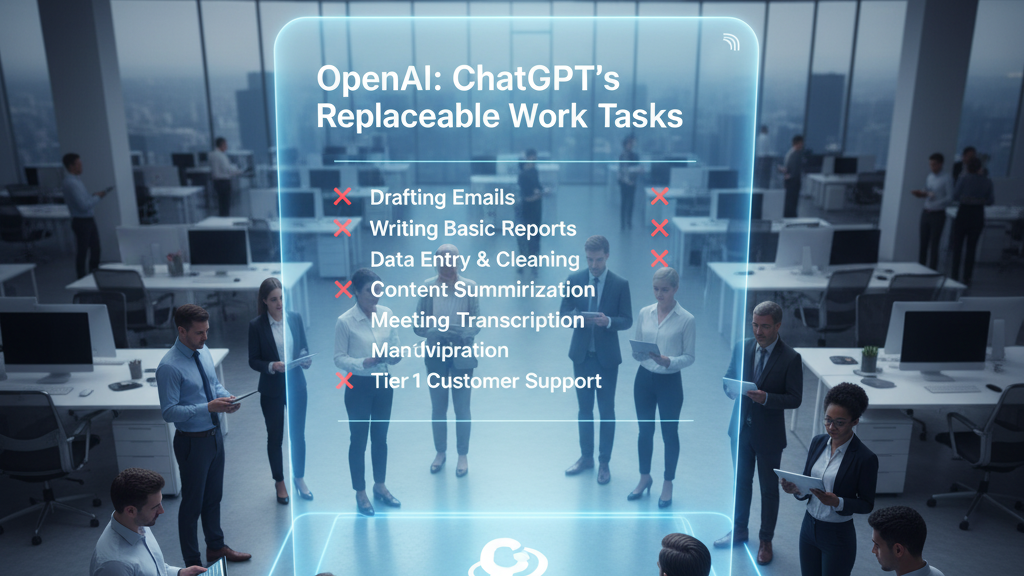
In a sleek, modern open-plan office, a group of professionals stands around a glowing holographic display that projects "OpenAI: ChatGPT's Replaceable Work Tasks." A list of tasks like "Drafting Emails," "Writing Basic Reports," and "Data Entry & Cleaning" is visible, with checkmarks or X's next to them, indicating tasks ChatGPT can handle. Some individuals are holding tablets, observing the display, while others are in the background. Image (and typos) generated by Nano Banana.
OpenAI has released a significant list detailing numerous work tasks that its advanced AI, ChatGPT, is already capable of performing or even replacing. This image illustrates professionals observing these capabilities, highlighting the transformative impact AI is having on the modern workforce and prompting discussions about job roles and efficiency. Image (and typos) generated by Nano Banana.

Source

Futurism

Summary

OpenAI published a new evaluation, GDPval, assessing how well its models perform “economically valuable” tasks across 44 occupations. The results suggest that current frontier models are approaching the quality of expert work in many domains. Examples include legal briefs, marketing analyses, technical documentation, medical image assessments, and sales brochures. While AI might not replace entire jobs, it can outperform humans in well-specified tasks. OpenAI emphasises that models currently handle repetitive, clearly defined tasks better than nuanced judgment work. GPT-5-High matched or surpassed expert deliverables in ~40% of evaluated cases. Critics warn of hallucinations, overconfidence, and the risk of overestimating AI’s real-world reach.

Key Points

  • GDPval tests 44 occupations on real-world tasks to benchmark AI against experts.
  • GPT-5-High achieved parity or better than expert work in ~40% of tasks.
  • Tasks include analytics, document drafting, medical imaging, and sales collateral.
  • AI models perform best on repetitive, narrow tasks; struggle on ambiguous, poorly defined ones.
  • OpenAI positions this not as job replacement but augmentation—yet raises deeper questions about labour, oversight, and trust.

Keywords

URL

https://futurism.com/future-society/openai-work-tasks-chatgpt-can-already-replace

Summary generated by ChatGPT 5


Students Who Lack Academic Confidence More Likely to Use AI


In a modern university library setting, a young female student with a concerned expression is intently focused on her laptop. A glowing holographic interface floats above her keyboard, displaying "ESSAY ASSIST," "RESEARCH BOT," and "CONFIDENCE BOOST!" with an encouraging smiley face. In the background, other students are also working on laptops. Image (and typos) generated by Nano Banana.
Research suggests a correlation between a lack of academic confidence in students and an increased likelihood of turning to AI tools for assistance. This image depicts a student utilising an AI interface offering “confidence boost” and “essay assist,” illustrating how AI can become a crutch for those feeling insecure about their abilities in the academic environment. Image (and typos) generated by Nano Banana.

Source

Inside Higher Ed

Summary

A survey by Inside Higher Ed and Generation Lab finds that 85 % of students claim they’ve used generative AI for coursework in the past year. Among the habits observed, students with lower self-perceived academic competence or low confidence are more likely to lean on AI tools, especially when unsure or reluctant to ask peers or instructors for help. The study distinguishes between instrumental help-seeking (clarification, explanations) and executive help-seeking (using AI to complete work). Students who trust AI more are also more likely to use it. The authors argue that universities need clearer AI policies and stronger support structures so that students don’t feel forced into overreliance.

Key Points

  • 85 % of surveyed students reported using generative AI for coursework in the past year.
  • Students with lower academic confidence or discomfort asking peers tend to rely more on AI.
  • AI use splits into two modes: instrumental (asking questions, clarifying) vs executive (using the AI to generate or complete work).
  • Trust in AI correlates with higher usage, even controlling for other variables.
  • Many students call for clear, standardised institutional policies on AI use to reduce ambiguity.

Keywords

URL

https://www.insidehighered.com/news/student-success/academic-life/2025/09/30/students-who-lack-academic-confidence-more-likely-use

Summary generated by ChatGPT 5