AI Is Robbing Students of Critical Thinking, Professor Says


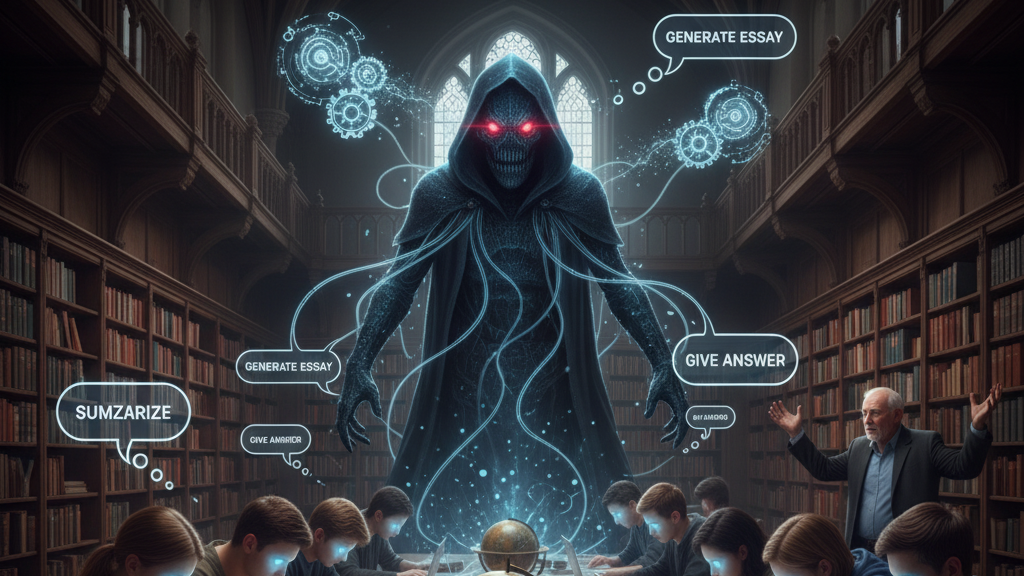
In a grand, traditional university library, a menacing, cloaked digital entity with glowing red eyes representing AI looms over a group of students seated at a long table, all intensely focused on laptops with glowing blue faces. Thought bubbles emanate from the AI, offering to "GENERATE ESSAY," "SUMMARIZE," and "GIVE ANSWER." In the background, a visibly frustrated professor gestures emphatically, observing the scene. Image (and typos) generated by Nano Banana.
A prominent professor warns that the widespread use of AI is actively depriving students of opportunities to develop critical thinking skills. This image dramatically visualizes AI as a looming, pervasive force in the academic lives of students, offering quick solutions that may bypass the deeper cognitive processes essential for genuine intellectual growth and independent thought. Image (and typos) generated by Nano Banana.

Source

Business Insider

Summary

Kimberley Hardcastle, assistant professor of business and marketing at Northumbria University, warns that generative AI is not just facilitating plagiarism—it’s encouraging students to outsource their thinking. Based on Anthropic data, about 39 % of student-AI interactions involved creating or polishing academic texts and another 33 % requested direct solutions. Hardcastle argues this is shifting the locus of intellectual authority toward Big Tech, making it harder for students to engage with ambiguity, weigh evidence, or claim ownership of ideas. She urges institutions to focus less on policing misuse, and more on pedagogies that preserve critical thinking and epistemic agency.

Key Points

  • 39.3 % of student-AI chats were about composing or revising assignments; 33.5 % requested direct solutions.
  • AI output often is accepted uncritically because it presents polished, authoritative language.
  • The danger: students come to trust AI explanations over their own reasoned judgement.
  • Hardcastle views this as part of a larger shift: tech companies increasingly influence how “knowledge” is framed and delivered.
  • She suggests the response should emphasise pedagogy: design modes of teaching that foreground critical thinking over output policing.

Keywords

URL

https://www.businessinsider.com/ai-chatgpt-robbing-students-of-critical-thinking-professor-says-2025-9

Summary generated by ChatGPT 5


How to test GenAI’s impact on learning


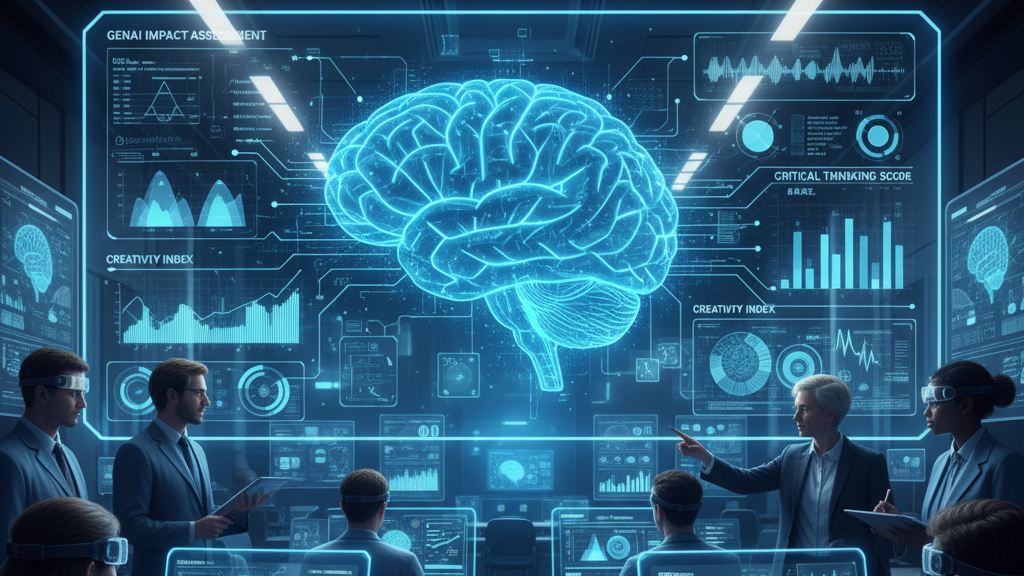
 In a futuristic classroom or lab, a large holographic screen prominently displays a glowing human brain at its center, surrounded by various metrics like "GENAI IMPACT ASSESSMENT," "CREATIVITY INDEX," and "CRITICAL THINKING SCORE." Several individuals, some wearing VR/AR headsets, are engaged with individual holographic desks showing similar data, actively analyzing GenAI's effects on learning. Image (and typos) generated by Nano Banana.
As generative AI becomes more prevalent, understanding its true impact on student learning is paramount. This image envisions a sophisticated approach to assessing GenAI’s influence, utilising advanced metrics and holographic displays to quantify and analyse its effects on creativity, critical thinking, and overall educational outcomes. Image (and typos) generated by Nano Banana.

Source

Times Higher Education

Summary

Thibault Schrepel argues against speculation and for empirical classroom experiments to measure how generative AI truly affects student learning. He outlines simple, scalable experimental designs—e.g. groups forbidden from AI, groups using it without guidance, groups trained in prompting and critique—to compare outcomes in recall, writing quality, and reasoning. Schrepel also suggests activities like having students build AI research assistants, comparing human and AI summaries, and using AI as a Socratic tutor. He emphasises that AI won’t uniformly help or hurt; its impact depends on how it’s used, taught, and assessed.

Key Points

  • Use controlled classroom experiments with different levels of AI access/training to reveal real effects.
  • Recall or rote learning may not change much; AI’s effects show more in reasoning, argumentation and writing quality.
  • Activities like comparing AI vs human summaries or having AI play the role of interlocutor can highlight strengths and limitations.
  • Prompting, critique, and metacognitive reflection are central to converting AI from crutch to tool.
  • Banning AI outright is less useful than enabling pedagogical experimentation and shared insight across faculty.

Keywords

URL

https://www.timeshighereducation.com/campus/how-test-genais-impact-learning

Summary generated by ChatGPT 5


Universities give up using software to detect AI in students’ work


In a university meeting room, a holographic display shows a broken padlock icon, symbolizing the failure or abandonment of AI detection software. Professionals are seated around a conference table, some looking at laptops. Image (and typos) generated by Nano Banana.
Universities are re-evaluating their strategies for academic integrity as many are moving away from relying on software to detect AI-generated content in student assignments. This shift reflects growing complexities and challenges in accurately identifying AI’s role in students’ work. Image (and typos) generated by Nano Banana.

Source

RNZ

Summary

Several New Zealand universities, including Massey, Auckland, and Victoria, have abandoned AI-detection software in student assessments, citing unreliability and inconsistency. Massey University’s move followed a major online exam monitoring failure in 2024, after which academics reported that detection results were often misused to accuse students. Research shows detection tools are easy to fool, leading institutions to shift towards alternative strategies: secured in-person assessments, oral defences, and checking document version histories. Universities stress they are not giving up on integrity but adapting to a changing environment by embedding AI literacy and focusing on preventative measures rather than flawed detection.

Key Points

  • Massey, Auckland, and Victoria universities no longer use AI detection software due to poor reliability.
  • Detection tools were inconsistent, with some staff misusing results to accuse students.
  • Alternative checks include document history tracking, professional judgement, and oral exams.
  • Universities focus on secured assessments (e.g. labs, studios, exams) rather than online monitoring.
  • Shift aims to prioritise AI literacy, ethics, and learning-centred approaches over surveillance.

Keywords

URL

https://www.rnz.co.nz/news/national/574517/universities-give-up-using-software-to-detect-ai-in-students-work

Summary generated by ChatGPT 5


How AI is reshaping education – from teachers to students


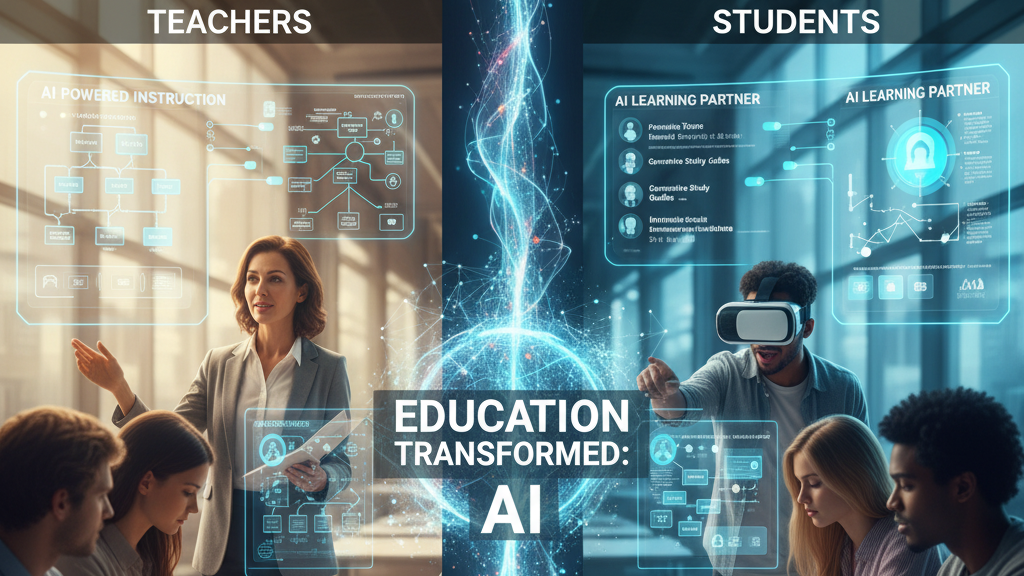
A split image depicting the impact of AI on education. On the left, a female teacher stands in front of a holographic 'AI POWERED INSTRUCTION' diagram, addressing a group of students. On the right, students are engaged with 'AI LEARNING PARTNER' interfaces, one wearing a VR headset. A central glowing orb with 'EDUCATION TRANSFORMED: AI' connects both sides, symbolizing the pervasive change AI brings to both teaching and learning. Generated by Nano Banana.
From empowering educators with intelligent instruction tools to providing students with personalised AI learning partners, artificial intelligence is fundamentally reshaping every facet of education. This image illustrates the transformative journey, highlighting how AI is creating new dynamics in classrooms and preparing both teachers and learners for a future redefined by technology. Image (and typos) generated by Nano Banana.

Source

TribLIVE

Summary

In this article, educators in a Pennsylvania school district discuss how AI is being woven into teaching practice and student learning—not by replacing teachers, but amplifying their capacity. AI tools like Magic School help teachers personalise lesson plans, adjust reading levels, reduce repetitive tasks, and monitor student use. A “traffic light” system is used to label assignments by allowed level of AI. New teachers are required to learn AI tools; students begin learning about AI ethically from early grades. The district emphasises that AI should not replace human work but free teachers to focus more on interpersonal and high-order thinking.

Key Points

  • Magic School is used to adapt assignments by subject, grade, and reading level, giving teachers flexibility.
  • Teachers are being trained and supported in AI adoption via workshops, pilot programs, and guided experiments.
  • A colour-coded “traffic light” system distinguishes when AI is allowed (green), allowed for some parts (yellow), or disallowed (red).
  • Starting in early grades, students are taught what AI is and how to use it ethically; higher grades incorporate more active use.
  • The goal: reduce workload on teachers for repetitive tasks so they can devote more energy to student interaction and complex thinking.

Keywords

URL

https://triblive.com/local/regional/heres-how-ai-is-reshaping-education-from-teachers-to-students/

Summary generated by ChatGPT 5


AI and human learning


Four professionals (three female, one male) are seated around a modern round table in a library setting. From the center of the table, two intertwining beams of light, one blue (labeled 'AI ASSISTANCE') and one orange (labeled 'HUMAN COGNITION'), rise upwards, filled with icons representing data, brains, books, and scientific symbols. The beams symbolize the synergistic relationship between AI and human learning. Generated by Nano Banana.
Exploring the dynamic interplay between artificial intelligence and human cognition, this image visualises a future where AI acts as a powerful assistant, enhancing and amplifying our natural learning capabilities. It underscores a collaborative relationship, where technology and human intellect intertwine to unlock new depths of understanding and innovation. Image (and typos) generated by Nano Banana.

Source

Dawn

Summary

The article examines how Large Language Models and chatbots are reshaping learning in schools and universities. While AI boosts productivity in basic tasks (summarisation, drafting), it fails to deliver on more complex, multi-step reasoning. The author warns that overreliance on AI risks stunting skills like reading, writing, reasoning, and sustaining depth of thought. Learning is not just about output; it’s a process that tests and builds internal faculties. AI’s inherent hallucination problem adds further risk. The piece argues for institutional safeguards and restrictions on AI use in foundational learning stages.

Key Points

  • AI improves efficiency in simple tasks, but shows no clear gains in complex, multi-stage reasoning.
  • Learning as process is key: reading and writing actively shapes thinking, which AI can’t substitute.
  • Overuse of AI could lead to deskilling: students risk losing internal cognitive capacity.
  • The hallucination risk (AI generating false content) undermines trust in AI outputs.
  • Institutions need to assign boundaries to AI use, particularly where literacy and foundational skills are at stake.

Keywords

URL

https://www.dawn.com/news/1945405

Summary generated by ChatGPT 5