AI is redefining university research: here’s how


A group of five diverse researchers in a futuristic lab are gathered around a glowing, circular interactive table. Bright neon lines of blue, green, and orange emanate from the table, connecting to large wall-mounted screens displaying complex data, molecular structures, and charts related to various scientific fields. A large window overlooks a modern city skyline, symbolizing advanced research in an urban university setting. Generated by Nano Banana.
AI is fundamentally reshaping the landscape of university research, offering unprecedented capabilities for data analysis, simulation, and discovery. This image envisions a collaborative, high-tech research environment where AI tools empower scholars to explore complex problems across disciplines, accelerating breakthroughs and pushing the boundaries of knowledge. Image generated by Nano Banana.

Source

Tech Radar

Summary

AI is accelerating many parts of academic research: mining large datasets, speeding hypothesis generation, automating literature reviews, and helping with data visualization. While these tools alleviate time‑heavy, repetitive tasks, there are rising concerns about over‑reliance: loss of critical thinking, ethical issues (authorship, bias), accuracy, and what AI means for researcher agency. Academia must adopt clear policies, build researcher familiarity with AI, and ensure integrity and oversight so that AI complements rather than replaces human scholarship.

Key Points

  • AI tools automate tedious research tasks (data mining, lit reviews, visualization).
  • Hypothesis generation at scale enables new discoveries.
  • Risks: loss of critical thinking, plagiarism, errors, ethical/authorship issues.
  • Helps non-native speakers, assists with referencing and peer review, but needs oversight.
  • Responsible use requires frameworks, training, and ethical guidelines.

Keywords

URL

https://www.techradar.com/ai-platforms-assistants/ai-is-redefining-university-research-heres-how

Summary generated by ChatGPT 5
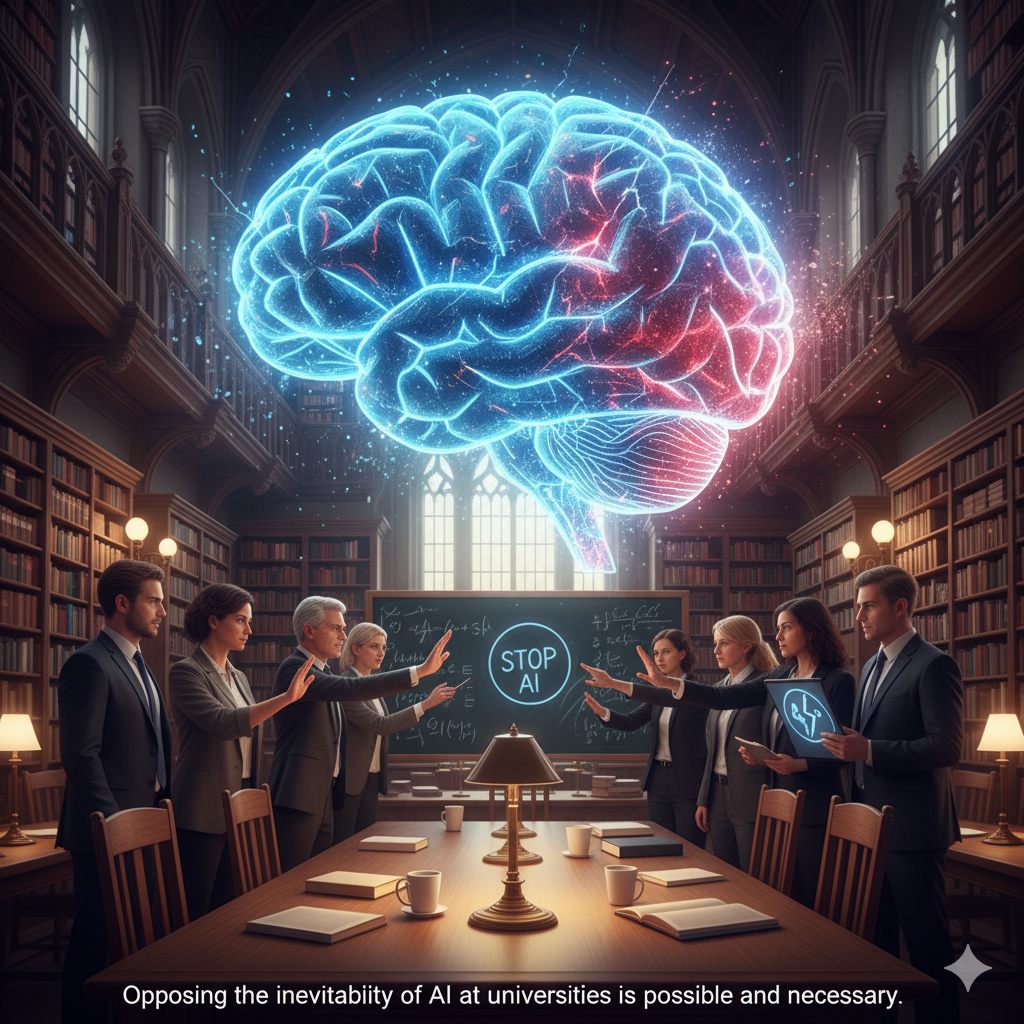

Opposing the inevitability of AI at universities is possible and necessary


In a grand, traditional university library setting, a group of professionals and academics stand around a conference table, actively pushing back with their hands raised towards a large, glowing holographic brain that represents AI. The brain is split with blue (calm) and red (active/threatening) elements, and a "STOP AI" sign is visible on a blackboard in the background. Image (and typos) generated by Nano Banana.
While the integration of AI into universities often feels unstoppable, this image visualizes the argument that actively opposing its unchecked inevitability is not only possible but crucial. It suggests that a proactive stance is necessary to guide the future of AI in academia rather than passively accepting its full integration. Image (and typos) generated by Nano Banana.

Source

Radboud University

Summary

Researchers from Radboud University argue that AI’s spread in academia is being framed as inevitable, but pushback is both possible and essential. They warn that uncritical adoption—especially when backed or funded by industry—threatens academic freedom, distorts research priorities, risks deskilling students, and contributes to misinformation and environmental harm. The paper urges universities to reassert their values: have transparent debates, maintain independence from industry influence, preserve consent, and retain human judgement as central to education and research.

Key Points

  • AI adoption in universities is often assumed to be inevitable, but this is a narrative device not a necessity.
  • Industry funding of AI research risks conflicts of interest and distorting knowledge.
  • Uncritical AI use risks deskilling students (critical thinking, writing).
  • Universities adopting AI redefine what counts as knowledge and who defines it.
  • Call for transparency, debate, consent, independence, and retaining human judgment.

Keywords

URL

https://www.ru.nl/en/research/research-news/opposing-the-inevitability-of-ai-at-universities-is-possible-and-necessary

Summary generated by ChatGPT 5


‘It’s a monster’: How generative AI is forcing university professors to rethink learning


In a dimly lit, traditional university lecture hall, a monstrous, multi-limbed, glowing blue digital creature with glowing red eyes looms large behind a professor at a podium. Around tables in the foreground, other professors in academic robes express concern and confusion, some pointing at the creature, while a blackboard in the background reads "RETHINK CURRICULUM" and "HUMAN PROMPT." Image (and typos) generated by Nano Banana.
Described by some as a “monster,” generative AI is fundamentally challenging established educational paradigms. This image dramatically illustrates the immense, even intimidating, presence of AI in academia, compelling university professors to urgently rethink and innovate their approaches to learning and curriculum design. Image (and typos) generated by Nano Banana.

Source

The Irish Times

Summary

Professors in Ireland are rethinking what learning and assessment mean as generative AI becomes widespread. With students using tools like ChatGPT for brainstorming, summarisation, and essay writing, faculty are concerned not just about plagiarism but about diminished reflection, reading, and originality. Responses include replacing take‑home essays with in‑class/open‑book work, designing reflective and relational assignments, and rebuilding community in learning. Faculty warn education is becoming transactional, focused on grades over growth, and AI use may hollow out critical thinking unless institutions redesign pedagogy and policies.

Key Points

  • Widespread AI use by students undermines traditional essays and originality.
  • Professors replace take‑home essays with in‑class/open‑book assessments.
  • Assignments now stress reflection, relational thinking, vulnerability — areas AI struggles with.
  • Students under pressure turn to AI instrumentally, prioritising grades over growth.
  • Institutions face resource challenges in redesigning assessments and policies.

Keywords

URL

https://www.irishtimes.com/ireland/education/2025/09/09/its-a-monster-how-generative-ai-is-forcing-university-professors-to-rethink-learning/

Summary generated by ChatGPT 5


AI Defeats the Purpose of a Humanities Education


In a grand, traditional university library, a massive, monolithic black AI construct with glowing blue circuit patterns and red text displaying "HUMANITIES INTEGRITY: 0%" is violently crashing into a long wooden conference table, scattering books and ancient busts. A group of somber-faced academics in robes stands around, observing the destruction with concern. Image (and typos) generated by Nano Banana.
This image powerfully visualises the concern that AI’s capabilities might fundamentally undermine the core purpose of a humanities education. The crashing digital monolith symbolises AI’s disruptive force, threatening to erode the value of human critical thought, interpretation, and creativity that humanities disciplines aim to cultivate. Image (and typos) generated by Nano Banana.

Source

The Harvard Crimson

Summary

The authors argue that generative AI tools fundamentally conflict with what a humanities education aims to do: teach students how to think, read, write, and argue as humans do, rather than delegating those tasks to machines. They claim AI can polish writing but misses the point of learning through struggle, critique, and revision. The piece calls for banning generative AI in humanities courses, saying that even mild uses still sidestep essential intellectual growth. Imperfect, difficult writing is better for learning than polished AI‑assisted work.

Key Points

  • AI polishing undermines the learning process of struggle and critique.
  • Imperfect essays without AI are more educational.
  • Inconsistent policies across faculty cause confusion.
  • Humanities should preserve authentic human expression and critical thinking.
  • Banning AI helps preserve rigor and humanistic values.

Keywords

URL

https://www.thecrimson.com/article/2025/9/9/chiocco-farrell-harvard-ai/

Summary generated by ChatGPT 5


How task design transforms AI interactions in the classroom


In a bright, modern classroom with large windows overlooking a green campus, a female teacher stands at the front, gesturing towards a large interactive screen. The screen displays "Task Design & AI Interactions," showing comparisons between "Traditional Tasks" and "Transformed AI Tasks" with visual examples. Numerous students are seated at collaborative desks, working on laptops, with some holographic chat bubbles floating around them, indicating AI interaction. Image (and typos) generated by Nano Banana.
The way educators design tasks is becoming a critical factor in shaping effective AI interactions within the classroom. This image illustrates a dynamic learning environment where thoughtful task design guides students in leveraging AI for enhanced learning outcomes, moving beyond traditional methods to truly transform educational engagement. Image (and typos) generated by Nano Banana.

Source

Psychology Today

Summary

The article argues that the way educators frame and structure tasks determines whether AI becomes a thinking crutch or a scaffold for deeper learning. A classroom debate scenario showed how teams assigned different roles—AI user, content evaluator, information gatherer—could distribute cognitive load and enhance engagement. Prompts that ask the AI to “explain your reasoning” nudged students to interrogate output. But without scaffolding, some teams admitted to overreliance and skipping higher-order thinking. Well-designed tasks promoting interaction, reflection, and collaborative interpretation help AI remain a support, not a substitute.

Key Points

  • Role assignment (AI user, evaluator, gatherer) helps distribute cognitive responsibility.
  • Prompt framing (e.g. “explain your reasoning”) can push AI away from surface responses.
  • Debate structure (real-time questioning) adds social accountability and forces adaptation.
  • Without support, some students fall into dependency, skipping critical thought.
  • The design of tasks—interaction, reflection, scaffolding—is central to ensuring AI enhances rather than replaces human thinking.

Keywords

URL

https://www.psychologytoday.com/ie/blog/in-one-lifespan/202509/how-task-design-transforms-ai-interactions-in-the-classroom

Summary generated by ChatGPT 5