OpenAI’s newly launched Sora 2 makes AI’s environmental impact impossible to ignore


A dark, dystopian cityscape at night is dominated by towering data centers and skyscrapers, one of which prominently displays "OPENAI SORA 2" in glowing blue. Massive plumes of black and fiery red smoke billow from multiple buildings, symbolizing extreme environmental impact. A crowd of people looks on, while a holographic graph in the foreground shows "GLOBAL ENERGY CONSUMPTION: CRITICAL" and "CO2 EMISSIONS: EXTREME," with an icon of a distressed Earth. Image (and typos) generated by Nano Banana.
The recent launch of OpenAI’s Sora 2, a highly advanced AI model, unequivocally brings the environmental impact of artificial intelligence to the forefront, making it impossible to overlook. This dramatic image visually represents the significant energy consumption and CO2 emissions associated with powerful AI systems, urging a critical examination of the ecological footprint of cutting-edge technological advancements. Image (and typos) generated by Nano Banana.

Source

The Conversation

Summary

Robert Diab argues that the release of OpenAI’s Sora 2—a text-to-video model capable of generating ultra-realistic footage—has reignited urgent debate about AI’s environmental costs. While Sora 2’s creative potential is striking, its vast energy and water demands highlight the ecological footprint of large-scale AI. Data centres already consume around 1.5 % of global electricity, projected to double by 2030, with AI accounting for much of that growth. Competing narratives frame AI as either an ecological threat or a manageable risk, but Diab calls for transparency, regulation, and responsible scaling to ensure technological progress does not deepen environmental strain.

Key Points

  • Sora 2 showcases AI’s creative power but underscores its huge energy demands.
  • AI training and usage are accelerating global electricity and water consumption.
  • The “Jevons paradox” means efficiency gains can still drive higher total energy use.
  • Experts urge standardised, transparent reporting of AI’s environmental footprint.
  • Policymakers must balance innovation with sustainable data-centre expansion.

Keywords

URL

https://theconversation.com/openais-newly-launched-sora-2-makes-ais-environmental-impact-impossible-to-ignore-266867

Summary generated by ChatGPT 5


Schools Urged to Use AI in Education with Caution


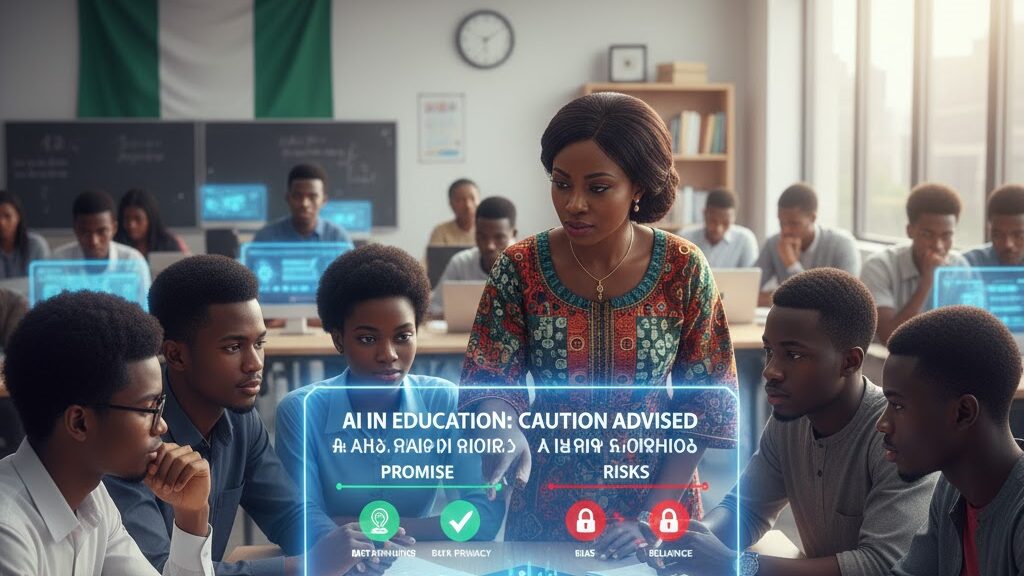
In a modern Nigerian classroom, a female teacher in traditional attire stands over a group of attentive students gathered around a table with laptops. A glowing holographic interface displays "AI IN EDUCATION: CAUTION ADVISED," with sections for "PROMISE" (showing benefits like efficiency) and "RISKS" (highlighting concerns such as bias, data privacy, and reliance) with corresponding checkmarks and X-marks. The Nigerian flag is visible in the background. Image (and typos) generated by Nano Banana.
Amidst the global integration of AI into education, Nigerian schools are being urged to proceed with caution. This image depicts a teacher guiding students through the nuanced landscape of AI, highlighting both its promising applications and significant risks like inherent biases, data privacy concerns, and over-reliance, advocating for a balanced and responsible approach to adopting AI technologies in the classroom. Image (and typos) generated by Nano Banana.

Source

Punch (Nigeria)

Summary

At the “Artificial Intelligence: Turning Disruption into Advantage” forum in Lagos, educators and technologists encouraged Nigerian schools to embrace AI while maintaining a balance between innovation and critical thinking. Speakers highlighted that AI can enhance learning efficiency and prepare students for future careers but warned against over-reliance that weakens analytical skills. John Todd of Charterhouse Lagos urged educators to teach responsible use, stressing the need for ethics and discernment. Eric Oliver of AidTrace added that Africa should invest in local infrastructure to process its own technology resources, reducing dependence on foreign supply chains and strengthening regional economies.

Key Points

  • Educators urged cautious but proactive adoption of AI in classrooms.
  • Over-reliance on AI risks undermining students’ independent thinking skills.
  • Responsible use requires ethics, discernment, and understanding of AI’s limits.
  • African nations should develop local tech infrastructure to capture more value.
  • The forum promoted AI as a tool for empowerment rather than replacement.

Keywords

URL

https://punchng.com/schools-urged-to-use-ai-with-caution/

Summary generated by ChatGPT 5