AI is smart, just don’t ask it to speak the Irish language


In a warm, traditional Irish pub setting, four friends are seated around a wooden table, laughing and enjoying pints of Guinness, with a fireplace in the background. Above their table, a holographic AI interface glows, displaying "An Fáistinseoir AI" (The Oracle AI) at the top, but prominently featuring a red error message: "Error: Irish Language Not Supported." An older gentleman is visible in the background. Image (and typos) generated by Nano Banana.
While AI demonstrates remarkable intelligence across many domains, its capabilities can be surprisingly limited when it comes to lesser-resourced languages. This image playfully highlights a common challenge: asking AI to engage with the Irish language often reveals its current shortcomings, underscoring the need for more inclusive linguistic development in AI. Image, cultural stereotypes, (and typos) generated by Nano Banana

Source

The Irish Times

Summary

The article highlights how advanced chatbots struggle badly with the Irish language (Gaeilge)—a stark reminder of persistent gaps in AI systems. While AI tools handle common European languages with ease, asking them to converse or translate into Irish produces jumbled pronunciation, random spelling, misinterpretation, or bizarre outputs. The author sees this as symptomatic: AI models often neglect smaller or less commercially profitable languages. For minority and indigenous languages, ensuring AI support is not optional but crucial for cultural preservation, representation, and equitable digital inclusion.

Key Points

  • Chatbots like ChatGPT and Google’s Gemini performed very poorly when asked to speak in Irish: pronunciation errors, mis-translations, confusion with Scots Gaelic.
  • The mismatch highlights that AI models are biased toward well-resourced languages and neglect minority ones.
  • AI’s “knowledge” is constrained by available training data—less data means poorer performance.
  • For languages like Irish, this has real stakes: cultural expression, educational access, digital equity.
  • Improving AI support for Irish (and other underrepresented languages) requires intentional investment and training on local, high-quality data.

Keywords

URL

https://www.irishtimes.com/business/2025/10/02/ai-is-smart-just-dont-ask-it-to-speak-the-irish-language/

Summary generated by ChatGPT 5


Harvard Business School Uses AI to Evaluate Students’ Work, Dean Says


In a sophisticated university lecture hall, reminiscent of Harvard, a female speaker stands at a podium, gesturing towards a large interactive screen. The screen prominently displays "AI EVALUATION SYSTEM" along with various complex charts, graphs, and data points, indicating detailed assessment metrics. An audience of students in business attire are seated at tiered desks, working on laptops. Image (and typos) generated by Nano Banana.
Harvard Business School is at the forefront of integrating artificial intelligence into academic assessments, with its Dean confirming the use of AI to evaluate students’ work. This image illustrates a high-tech academic environment where advanced AI evaluation systems are being employed, signifying a significant shift in how student performance is analyzed and graded in prestigious institutions. Image (and typos) generated by Nano Banana.

Source

The Harvard Crimson

Summary

Dean Srikant M. Datar revealed that Harvard Business School (HBS) is actively using AI tools to evaluate student assignments and provide rapid feedback, such as on spreadsheets. At Boston AI Week, he explained that HBS faculty are integrating AI into teaching and research, including through Foundry, a platform connecting entrepreneurs with HBS content. Administrators emphasised that AI supplements, not replaces, classroom learning—supporting tasks like condensing student feedback into actionable insights and offering 24/7 support. HBS leaders frame AI as part of an ongoing digital transformation, stressing the importance of adaptability and a “30 percent rule” for AI literacy.

Key Points

  • HBS uses AI to evaluate coursework and give students rapid feedback.
  • The Foundry platform leverages AI to connect entrepreneurs globally with HBS resources.
  • AI tools condense student feedback for faculty, improving teaching design.
  • Administrators stress AI complements, not replaces, the classroom experience.
  • HBS promotes the “30 percent rule”: basic literacy is enough to work with AI effectively.

Keywords

URL

https://www.thecrimson.com/article/2025/10/2/hbs-dean-ai-use/

Summary generated by ChatGPT 5


Artificial intelligence guidelines for teachers and students ‘notably absent’, report finds


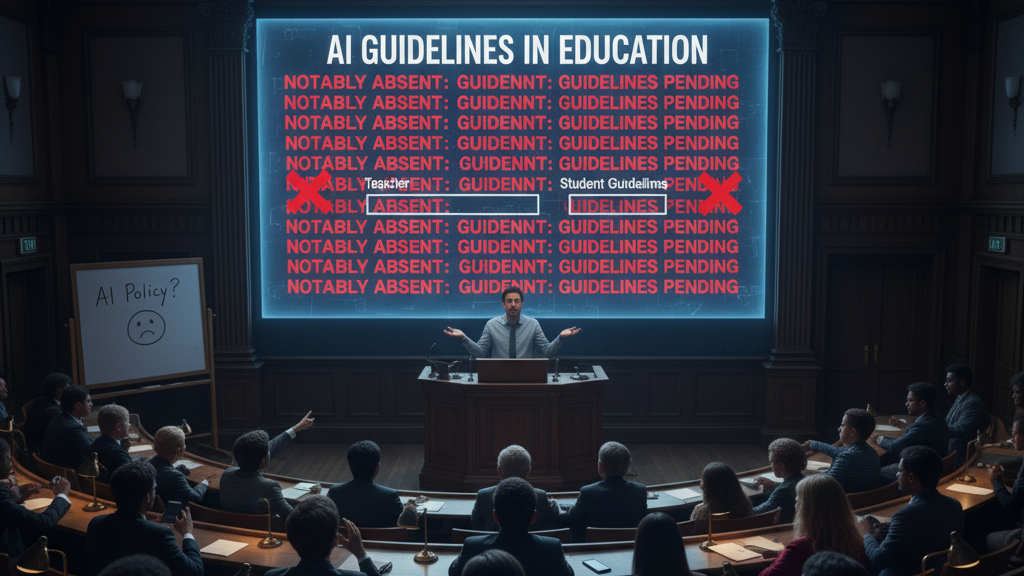
In a dimly lit, traditional lecture hall, a frustrated speaker stands at a podium addressing an audience. Behind him, a large screen prominently displays "AI GUIDELINES IN EDUCATION" with repeating red text emphasizing "NOTABLY ABSENT: GUIDELINES PENDING" and crossed-out sections for "Teacher Guidelines" and "Student Guidelines." A whiteboard to the side has a hand-drawn sad face next to "AI Policy?". Image (and typos) generated by Nano Banana.
A recent report has highlighted a significant void in modern education: the “notable absence” of clear artificial intelligence guidelines for both teachers and students. This image captures the frustration and confusion surrounding this lack of direction, underscoring the urgent need for comprehensive policies to navigate the integration of AI responsibly within academic settings. Image (and typos) generated by Nano Banana.

Source

Irish Examiner

Summary

A new report by ESRI (Economic and Social Research Institute) highlights a significant policy gap: Irish secondary schools largely lack up-to-date acceptable use policies (AUPs) that address AI. Among 51 large schools surveyed, only six had current policies, and none included detailed guidance on AI’s use in teaching or learning. The Department of Education says it’s finalising AI guidance to address risks, opportunities, and responsible use. The absence of clear, central policy leaves individual schools and teachers making ad hoc decisions.

Key Points

  • Only 6 of 51 schools had updated acceptable use policies that could construe AI governance.
  • AI-specific guidelines are “notably absent” in existing school policies.
  • Schools are left to decide individually how (or whether) to integrate AI in learning without shared framework.
  • The Department of Education expects to issue formal guidance imminently, supported by resources via the AI Hub and Oide TiE.
  • Policymaking lag is highlighted as a disconnect between fast technology change and slow institutional response.

Keywords

URL

https://www.irishexaminer.com/news/arid-41715942.html

Summary generated by ChatGPT 5


Teachers Share More Ways to Engage AI in the Classroom


In a modern, technology-rich classroom, a diverse group of students works on laptops at individual desks. A female teacher stands at the front, gesturing towards a large interactive screen that displays "ENGAGING AI IN THE CLASSROOM: NEW STRATEGIES," along with various visual examples of AI tools and learning scenarios. Other teachers are visible on side screens, illustrating collaborative strategies. Image (and typos) generated by Nano Banana.
Educators are continuously innovating and discovering new methods to effectively integrate AI into classroom learning. This image showcases a vibrant educational setting where teachers are actively sharing and implementing a range of strategies to engage AI, transforming teaching methodologies and enriching student experiences. Image (and typos) generated by Nano Banana.

Source

Education Week (Opinion)

Summary

In this opinion blog, several K-12 English teachers describe practical strategies they use to integrate AI as a learning tool rather than letting it replace student thinking. They treat AI as a brainstorming assistant, prompt critic, or discussion partner rather than writer. Techniques include prompting AI to argue counterpoints, using it to surface alternative interpretations in literature, and setting roles (AI user, evaluator, synthesiser) in group tasks. Districts are also forming AI steering committees, piloting tools, and developing consistent guidelines to guide equitable, transparent adoption.

Key Points

  • AI is used as brainstorming / idea generation support, but students still revise and contextualise its output.
  • Teachers use AI in debate, persuasive writing, literary analysis, historical inquiry, science discussions, and Socratic questioning to deepen engagement.
  • Role assignments (AI user, evaluator, gatherer) help distribute responsibilities and prevent overreliance.
  • Districts should establish AI steering committees, pilot thoughtfully, and build shared understanding and policies.
  • AI should be scaffolded, not standalone; teachers emphasise transparency, critical review, and prompting skills.

Keywords

URL

https://www.edweek.org/technology/opinion-teachers-share-more-ways-to-engage-ai-in-the-classroom/2025/10

Summary generated by ChatGPT 5


Research, curriculum and grading: new data sheds light on how professors are using AI


In a bright, modern classroom, students are actively engaged at individual desks with laptops. At the front, two female professors and one male professor are presenting to the class, while a large interactive screen displays "INNOVATIVE AI CHATBOT USE CASES." The screen shows four panels detailing applications such as "Personalized Tutoring," "Collaborative Research," "Creative Writing & Feedback," and "Language Practice." Image (and typos) generated by Nano Banana.
University professors are increasingly discovering and implementing creative ways to leverage AI chatbots to enhance learning in the classroom. This image illustrates a dynamic educational environment where various innovative use cases for AI chatbots are being explored, from personalised tutoring to collaborative research, transforming traditional teaching and learning methodologies. Image (and typos) generated by Nano Banana.

Source

NPR

Summary

Professors across U.S. universities are increasingly using AI chatbots like Gemini and Claude for curriculum design, grading support, and administrative work. A Georgia State professor described using AI to brainstorm assignments and draft rubrics, while Anthropic’s analysis of 74,000 higher-ed conversations with Claude found 57% related to curriculum planning and 13% to research. Some professors even create interactive simulations. Others use AI to automate emails, budgets, and recommendations. But concerns remain: faculty warn that AI-grading risks hollowing out the student–teacher relationship, while scholars argue universities lack clear guidance, leaving professors to “fend for themselves.”

Key Points

  • National survey: ~40% of administrators and 30% of instructors now use AI weekly or daily, up from 2–4% in 2023.
  • 57% of higher-ed AI conversations focus on curriculum development; 13% on research.
  • Professors use AI to design interactive simulations, draft rubrics, manage budgets, and write recommendations.
  • 7% of analysed use involved grading, though faculty report AI is least effective here.
  • Concerns: risk of “AI-grading AI-written papers,” weakening educational purpose; calls for stronger guidance.

Keywords

URL

https://www.npr.org/2025/10/02/nx-s1-5550365/college-professors-ai-classroom

Summary generated by ChatGPT 5