AI Won’t Replace Teachers—but Teachers Who Use AI Will Change Teaching


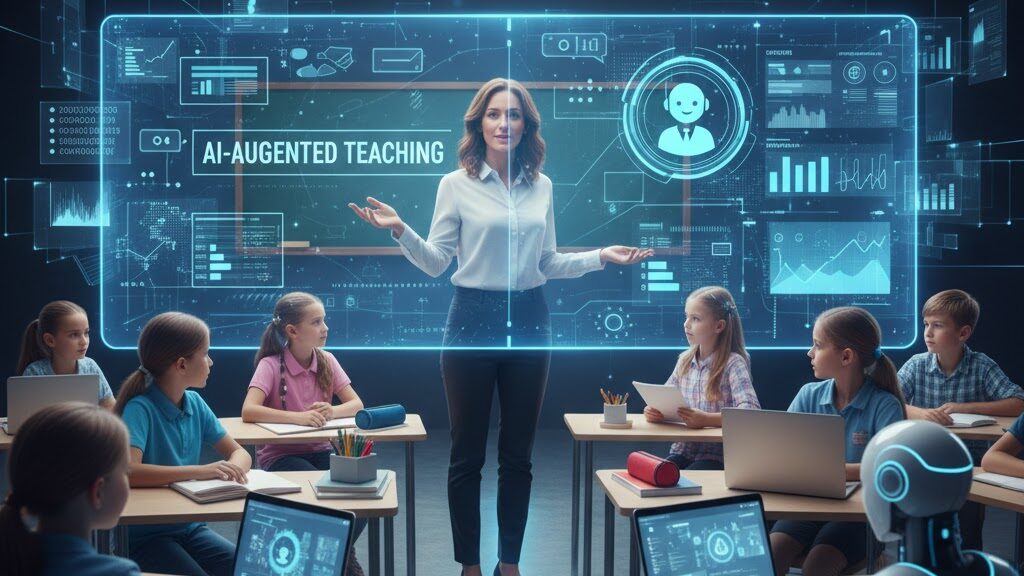
A female teacher stands confidently at the front of a modern classroom, gesturing towards a large, glowing holographic screen behind her that displays "AI-AUGMENTED TEACHING" along with various educational data, student profiles, and analytical charts. Rows of elementary school students are seated at desks, each engaged with a laptop. In the foreground to the right, a sleek, white humanoid robot is also seated at a desk, looking towards the teacher, symbolizing AI as a supportive tool rather than a replacement. The classroom is neat and well-lit. Image (and typos) generated by Nano Banana.
While the fear of AI replacing educators is prevalent, the reality is more nuanced: AI is set to empower teachers. This image illustrates how educators who embrace and integrate AI tools will fundamentally transform teaching methodologies, enhancing learning experiences rather than being superseded by technology. Image (and typos) generated by Nano Banana.

Source

Education Week

Summary

Ingrid Guerra-López argues that artificial intelligence will not replace teachers but will transform how they teach, provided educators engage with the technology thoughtfully and ethically. While AI can automate lesson planning, grading, and data organisation, Guerra-López emphasises that these efficiencies should enhance—not replace—teachers’ human judgment, empathy, and creativity. Drawing on research from RAND and the National Center for Education Statistics, she notes that teachers spend nearly ten hours a week on planning and administrative work—time AI could help recover for more meaningful teaching. However, without proper preparation and professional development, AI risks becoming another underused classroom innovation. Guerra-López calls for investment in AI literacy within teacher training and ongoing professional learning communities to ensure technology integration supports instructional quality and student engagement.

Key Points

  • AI can streamline routine teaching tasks, freeing time for deeper instructional work.
  • Educators remain essential for providing human connection, judgment, and mentorship.
  • Teacher-preparation programmes must include AI training and reflective practice.
  • Schools should create professional learning networks to support responsible AI use.
  • The goal is not to outsource thinking to AI but to use it as a scaffold for learning.
  • Failing to adapt risks both inefficiency and missed opportunities for innovation.

Keywords

URL

https://www.edweek.org/technology/opinion-ai-wont-replace-teachers-but-teachers-who-use-ai-will-change-teaching/2025/10

Summary generated by ChatGPT 5


Australian teachers are some of the highest users of AI in classrooms around the world – new survey


In a bright, modern classroom with large windows, students are actively working on laptops at individual desks. At the front, two female and two male teachers stand, gesturing towards large holographic screens that proudly announce "AI INTEGRATION SURVEY: AUSTRALIA LEADS!" and display "GLOBAL AI USE IN EDUCATION" with a prominent "82%," highlighting Australia's high adoption rate of AI in classrooms. Image (and typos) generated by Nano Banana.
A new global survey reveals that Australian teachers are among the leading adopters of artificial intelligence in classrooms worldwide, pioneering its integration into daily teaching practices. This image celebrates Australia’s significant role in transforming educational environments into hubs of AI-augmented learning, showcasing educators actively embracing technology to enhance student engagement and outcomes. Image (and typos) generated by Nano Banana.

Source

The Conversation

Summary

According to the OECD’s 2024 Teaching and Learning International Survey (TALIS), Australian teachers rank among the world’s highest users of artificial intelligence in education, with 66 % of lower secondary teachers reporting AI use—well above the OECD average of 36 %. Most use AI for lesson planning and content learning, though fewer apply it for grading or analysing student data due to privacy and ethical concerns. The survey also highlights serious teacher stress, with Australia ranking third-highest in reported workplace stress and first in frequent stress incidents. Despite satisfaction with academic preparation, teachers feel undertrained in behaviour management, signalling the need for systemic support alongside technological adoption.

Key Points

  • 66 % of Australian teachers use AI, placing them fourth globally.
  • AI is mostly used for planning and learning, not assessment or data analysis.
  • Australian teachers report some of the highest stress levels in the OECD.
  • Only half felt adequately trained in managing student behaviour.
  • The report calls for policies balancing teacher wellbeing with technological progress.

Keywords

URL

https://theconversation.com/australian-teachers-are-some-of-the-highest-users-of-ai-in-classrooms-around-the-world-new-survey-266894

Summary generated by ChatGPT 5


2025 Horizon Action Plan: Building Skills and Literacy for Teaching with GenAI


Source

Jenay Robert, EDUCAUSE (2025)

Summary

This collection of essays explores how artificial intelligence—particularly generative AI (GenAI)—is reshaping the university sector across teaching, research, and administration. Contributors, including Dame Wendy Hall, Vinton Cerf, Rose Luckin, and others, argue that AI represents a profound structural shift rather than a passing technological wave. The report emphasises that universities must respond strategically, ethically, and holistically: developing AI literacy among staff and students, redesigning assessment, and embedding responsible innovation into governance and institutional strategy.

AI is portrayed as both a disruptive and creative force. It automates administrative processes, accelerates research, and transforms strategy-making, while simultaneously challenging ideas of authorship, assessment, and academic integrity. Luckin and others call for universities to foster uniquely human capacities—critical thinking, creativity, emotional intelligence, and metacognition—so that AI augments rather than replaces human intellect. Across the essays, there is strong consensus that AI literacy, ethical governance, and institutional agility are vital if universities are to remain credible and relevant in the AI era.

Key Points

  • GenAI is reshaping all aspects of higher education teaching and learning.
  • AI literacy must be built into curricula, staff training, and institutional culture.
  • Faculty should use GenAI to enhance creativity and connection, not replace teaching.
  • Clear, flexible policies are needed for responsible and ethical AI use.
  • Institutions must prioritise equity, inclusion, and closing digital divides.
  • Ongoing professional development in AI is essential for staff and administrators.
  • Collaboration across institutions and with industry accelerates responsible adoption.
  • Assessment and pedagogy must evolve to reflect AI’s role in learning.
  • GenAI governance should balance innovation with accountability and transparency.
  • Shared toolkits and global practice networks can scale learning and implementation.

Conclusion

The Action Plan positions GenAI as both a challenge and a catalyst for renewal in higher education. Institutions that foster literacy, ethics, and innovation will not only adapt but thrive. Teaching with AI is framed as a collective, values-led enterprise—one that keeps human connection, creativity, and critical thinking at the centre of the learning experience.

Keywords

URL

https://library.educause.edu/resources/2025/9/2025-educause-horizon-action-plan-building-skills-and-literacy-for-teaching-with-genai

Summary generated by ChatGPT 5