Why Even Basic A.I. Use Is So Bad for Students


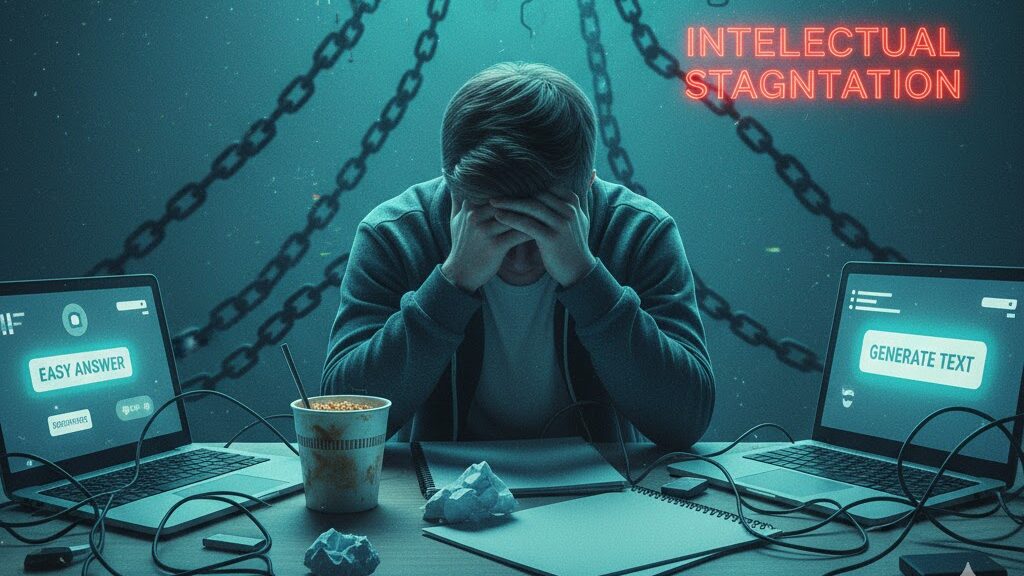
ALT Text: A distressed student sits at a desk with their head in their hands, surrounded by laptops displaying AI interfaces. Labeled "INTELLECTUAL STAGNATION." Image (and typos) generated by Nano Banana.
The weight of intellectual stagnation: How reliance on AI can hinder genuine learning and critical thinking in students. Image (and typos) generated by Nano Banana.

Source

The New York Times

Summary

Anastasia Berg, a philosophy professor at the University of California, Irvine, contends that even minimal reliance on AI tools threatens students’ cognitive development and linguistic competence. Drawing on her experience of widespread AI use in a moral philosophy course, Berg argues that generative AI erodes the foundational processes of reading, reasoning, and self-expression that underpin higher learning and democratic citizenship. While past technologies reshaped cognition, she claims AI uniquely undermines the human capacity for thought itself by outsourcing linguistic effort. Berg calls for renewed emphasis on tech-free learning environments to protect students’ intellectual autonomy and critical literacy.

Key Points

  • Over half of Berg’s students used AI to complete philosophy exams.
  • AI shortcuts inhibit linguistic and conceptual growth central to thinking.
  • Even “harmless” uses, like summarising, weaken cognitive engagement.
  • Cognitive decline could threaten democratic participation and self-rule.
  • Universities should create tech-free spaces to rebuild reading and writing skills.

Keywords

URL

https://www.nytimes.com/2025/10/29/opinion/ai-students-thinking-school-reading.html

Summary generated by ChatGPT 5


The Case Against AI Disclosure Statements


A large tablet displaying an "AI Disclosure Statement" document with a prominent red "X" over it sits on a wooden desk in a courtroom setting. A gavel lies next to the tablet, and a judge's bench with scales of justice is visible in the background. Image (and typos) generated by Nano Banana.
Challenging transparency: A visual argument against mandatory AI disclosure statements, set against the backdrop of legal scrutiny. Image (and typos) generated by Nano Banana.

Source

Inside Higher Ed

Summary

Julie McCown, an associate professor of English at Southern Utah University, argues that mandatory AI disclosure statements in higher education are counterproductive. Initially designed to promote transparency and responsible use, these statements have instead reinforced a culture of guilt, distrust, and surveillance. McCown contends that disclosure requirements stigmatise ethical AI use and inhibit open dialogue between students and educators. Rather than policing AI use, she advocates normalising it within learning environments, rethinking assessment design, and fostering trust. Transparency, she suggests, emerges from safety and shared experimentation, not coercion.

Key Points

  • Mandatory AI disclosure creates a culture of confession and distrust.
  • Research shows disclosure reduces perceived trustworthiness regardless of context.
  • Anti-AI bias drives use underground and suppresses AI literacy.
  • Assignments should focus on quality and integrity of writing, not AI detection.
  • Normalising AI through reflective practice and open discussion builds genuine transparency.

Keywords

URL

https://www.insidehighered.com/opinion/views/2025/10/28/case-against-ai-disclosure-statements-opinion

Summary generated by ChatGPT 5


Homework Is Facing an Existential Crisis: Has AI Made It Pointless?


A split image contrasting traditional homework with AI-influenced study. The left side shows a frustrated teenage boy sitting at a cluttered desk under a lamp, struggling with a textbook and papers, with a large red 'X' overlaid on him, signifying the traditional struggle. The background features a messy bulletin board and bookshelves. The right side shows the same boy relaxed in a modern, blue-lit setting, calmly using a tablet. Above his tablet, a friendly, glowing holographic AI tutor figure appears, surrounded by flowing data, equations, and digital interfaces, representing effortless, AI-assisted learning. Image (and typos) generated by Nano Banana.
As AI revolutionizes learning, traditional homework faces an existential crisis. This image dramatically contrasts the classic struggle with assignments against the ease of AI-assisted learning, raising a fundamental question: has artificial intelligence rendered conventional homework pointless, or simply redefined its purpose? Image (and typos) generated by Nano Banana.

Source

Los Angeles Times

Summary

Howard Blume explores how the rise of artificial intelligence is forcing educators to reconsider the value of homework. According to the College Board, 84 per cent of U.S. high school students now use AI for schoolwork, leading some teachers to abandon homework entirely while others redesign tasks to make AI misuse harder. Educators such as Alyssa Bolden in Inglewood now require handwritten essays to limit AI reliance, while others emphasise in-class mastery over at-home repetition. Experts warn that poorly designed homework, amplified by AI, risks undermining learning and widening inequality. Yet research suggests students still benefit from meaningful, creative assignments that foster independence, time management, and deeper understanding. The article concludes that AI hasn’t made homework obsolete—it has exposed the need for better, more purposeful learning design.

Key Points

  • 84 per cent of U.S. high school students use AI for schoolwork, up from 79 per cent earlier in 2025.
  • Teachers are divided: some have scrapped homework, while others are redesigning it to resist AI shortcuts.
  • AI challenges traditional measures of academic effort and authenticity.
  • Experts urge teachers to create engaging, meaningful assignments that deepen understanding.
  • Poorly designed homework can increase stress and widen learning gaps, particularly across socioeconomic lines.
  • The consensus: students don’t need more homework—they need better homework.

Keywords

URL

https://www.latimes.com/california/story/2025-10-25/homework-useless-existential-crisis-ai

Summary generated by ChatGPT 5


Why Students Shouldn’t Use AI, Even Though It’s OK for Teachers


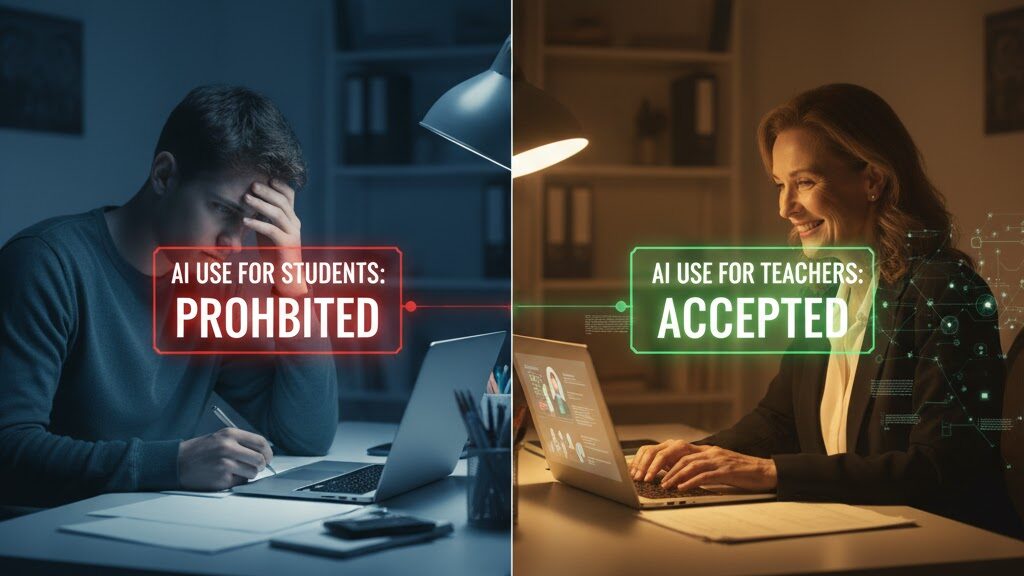
A split image showing a frustrated male student on the left, with text "AI USE FOR STUDENTS: PROHIBITED," and a smiling female teacher on the right, with text "AI USE FOR TEACHERS: ACCEPTED." Both are working on laptops in a contrasting light. Image (and typos) generated by Nano Banana.
The double standard: Exploring why AI use might be acceptable for educators yet detrimental for students’ learning and development. Image (and typos) generated by Nano Banana.

Source

Edutopia

Summary

History and journalism teacher David Cutler argues that while generative AI can meaningfully enhance teachers’ feedback and efficiency, students should not use it unsupervised. Teachers possess the critical judgment to evaluate AI outputs, but students risk bypassing essential cognitive processes and genuine understanding. Cutler likens premature AI use to handing a calculator to someone who hasn’t learned basic arithmetic. He instead promotes structured, transparent use—AI for non-assessed learning or teacher moderation—while continuing to teach critical thinking and writing through in-class work. His stance reflects both ethical caution and pragmatic optimism about AI’s potential to support, not supplant, human learning.

Key Points

  • Teachers can use AI to improve feedback, fairness, and grading efficiency.
  • Students lack the maturity and foundational skills for unsupervised AI use.
  • In-class writing fosters integrity, ownership, and authentic reasoning.
  • Transparent teacher use models responsible AI practice.
  • Slow, deliberate adoption best protects student learning and trust.

Keywords

URL

https://www.edutopia.org/article/why-students-should-not-use-ai/

Summary generated by ChatGPT 5


My Students Use AI. So What?


A confident female teacher stands at the center of a modern classroom, holding up a tablet that displays a world map, symbolizing global connection. She looks directly at the viewer with a slight smile. Around her, a diverse group of college-aged students are seated at collaborative tables, actively working on laptops that show glowing digital interfaces. Above the entire scene, a large, vibrant word cloud hovers, with prominent words like "CREATIVITY," "INNOVATION," "COLLABORATION," "CRITICAL THINKING," and "PROBLEM-SOLVING," all associated with AI and learning. The words are illuminated with a soft, energetic glow. Image (and typos) generated by Nano Banana.
In a world where AI is ubiquitous, some educators are embracing its presence in the classroom. This image captures the perspective of a teacher who views AI not as a threat, but as an integral tool that can foster creativity, innovation, and critical thinking, challenging traditional views on technology in education. Image (and typos) generated by Nano Banana.

Source

The Atlantic

Summary

John McWhorter, a linguist and professor at Columbia University, argues that fears about artificial intelligence destroying academic integrity are exaggerated. He contends that educators should adapt rather than resist, acknowledging that AI has become part of how students read, write, and think. While traditional essay writing once served as a key training ground for argumentation, AI now performs that function efficiently, prompting teachers to develop more relevant forms of assessment. McWhorter urges educators to replace formulaic essays with classroom discussions, personal reflections, and creative applications that AI cannot replicate. Grammar and stylistic rules, he suggests, should no longer dominate education; instead, AI can handle mechanical precision, freeing students to focus on reasoning and ideas. For McWhorter, the goal is not to preserve outdated academic rituals but to help students learn to think more deeply in a changed world.

Key Points

  • The author challenges alarmist narratives about AI eroding higher education.
  • AI has replaced traditional essay writing as a mechanical exercise but not genuine thought.
  • Teachers should create assessments that require personal insight and classroom engagement.
  • Grammar and stylistic conventions are becoming obsolete as AI handles technical writing.
  • AI allows students to focus on creativity, reasoning, and synthesis rather than busywork.
  • The shift mirrors earlier transitions in media—from print to digital—without diminishing intellect.

Keywords

URL

https://www.theatlantic.com/ideas/archive/2025/10/ai-college-crisis-overblown/684642/

Summary generated by ChatGPT 5