How the French Philosopher Jean Baudrillard Predicted Today’s AI 30 Years Before ChatGPT


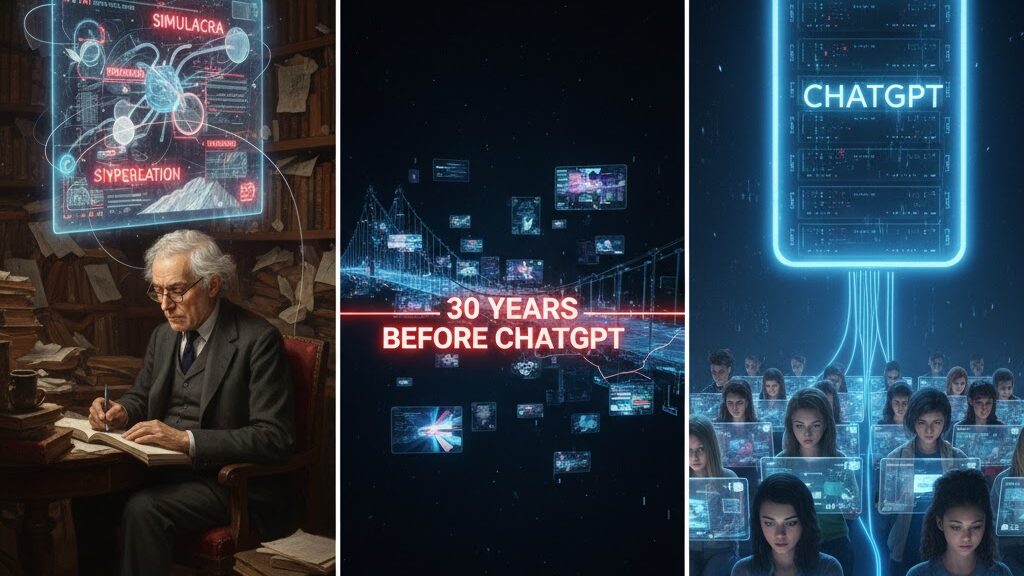
A stylized, sepia-toned image of French philosopher Jean Baudrillard seated in a classic setting, holding a book, with a faint, modern, glowing digital projection of AI code and chat bubbles superimposed subtly in the background and foreground, merging the past and the hyperreal present. Image (and typos) generated by Nano Banana.
Philosophy meets the future: Examining the enduring relevance of Jean Baudrillard’s concepts of the hyperreal and simulacra, and how they eerily foreshadow the rise and impact of modern generative AI. Image (and typos) generated by Nano Banana.

Source

The Conversation

Summary

Bran Nicol argues that Jean Baudrillard’s cultural theory anticipated the logic and impact of today’s AI decades before its emergence. Through concepts such as simulacra, hyperreality and the disappearance of the real, Baudrillard foresaw a world in which screens, networks and digital proxies would replace direct human experience. He framed AI as a cognitive prosthetic: a device that simulates thought while encouraging humans to outsource thinking itself. Nicol highlights Baudrillard’s belief that such reliance risks eroding human autonomy and “exorcising” our humanness, not through machine domination but through our willingness to surrender judgement. Contemporary developments—AI actors, algorithmic companions and blurred boundaries between human and machine—demonstrate the uncanny accuracy of his predictions.

Key Points

  • Baudrillard predicted smartphone culture, hyperreality and AI-mediated life decades early.
  • He viewed AI as a prosthetic that produces the appearance of thought, not thought itself.
  • Outsourcing cognition risks diminishing human autonomy and “disappearing” the real.
  • Modern AI phenomena—deepfakes, AI influencers, chatbots—align with his theories.
  • He believed only human pleasure and embodied experience distinguished us from machines.

Keywords

URL

https://theconversation.com/how-the-french-philosopher-jean-baudrillard-predicted-todays-ai-30-years-before-chatgpt-267372

Summary generated by ChatGPT 5


How Generative AI Could Change How We Think and Speak


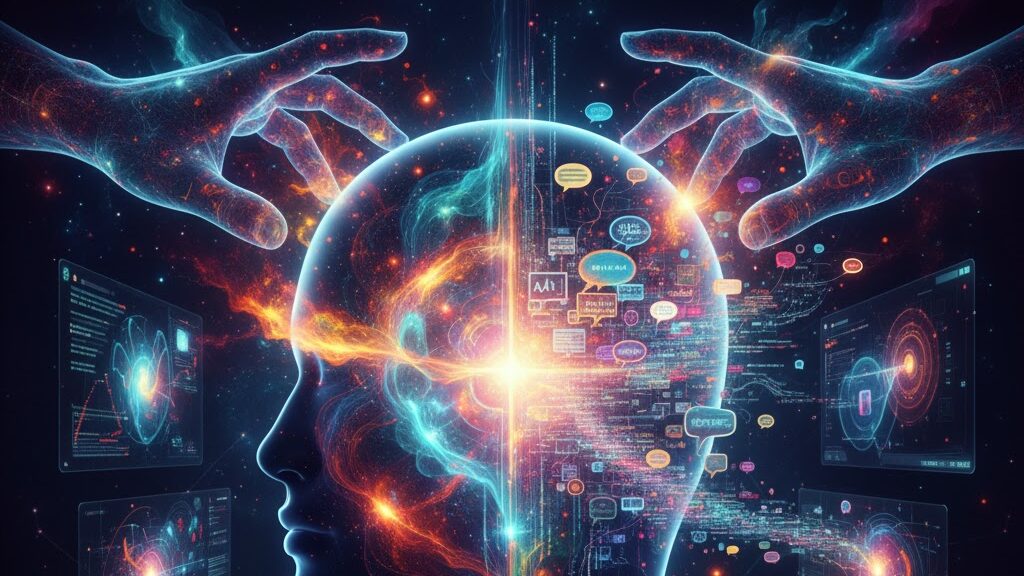
A glowing, ethereal blue silhouette of a human head and shoulders against a dark, starry background. Within the head, vibrant cosmic energy and swirling light converge, symbolizing thought and consciousness. From the head, streams of complex code, abstract data visualizations, and various speech bubbles with different languages and concepts flow outward, representing language and communication. Above the head, two pairs of translucent, glowing hands reach down, seemingly interacting with or guiding the processes. On either side, futuristic holographic interfaces display intricate data and neural networks. Image (and typos) generated by Nano Banana.
Generative AI is not just changing how we create, but how we fundamentally process information and express ourselves. Explore the profound ways this transformative technology could reshape human thought patterns and linguistic communication in the years to come. Image (and typos) generated by Nano Banana.

Source

The Conversation

Summary

Antonio Cerella examines how generative AI may reshape the cognitive and linguistic habits that underpin human thought. Drawing on psychology, neuroscience, and linguistics, he argues that over-reliance on AI tools risks weakening creativity, critical thinking, and language mastery. Just as GPS technology has diminished spatial memory, constant AI-assisted writing and problem-solving could erode our ability to form and express original ideas. Cerella warns that when language becomes pre-packaged through AI systems, the connection between speech and thought deteriorates, fostering a “culture of immediacy” driven by emotion rather than understanding. Yet for those with mature linguistic awareness, AI can still serve as a creative partner—if used reflectively and not as a substitute for thought.

Key Points

  • Overuse of AI may dull critical thinking and creative language use.
  • Psychological research shows that technological reliance can reconfigure the brain.
  • AI-generated language risks weakening the link between thought and expression.
  • The loss of linguistic agency could erode democratic discourse and imagination.
  • Conscious, reflective engagement with language can preserve creativity and autonomy.

Keywords

URL

https://theconversation.com/how-generative-ai-could-change-how-we-think-and-speak-267118

Summary generated by ChatGPT 5