AI: Are we empowering students – or outsourcing the skills we aim to cultivate?


A stark split image contrasting two outcomes of AI in education, divided by a jagged white lightning bolt. The left side shows a diverse group of three enthusiastic students working collaboratively on laptops, with one student raising their hands in excitement. Above them, a vibrant, glowing display of keywords like "CRITICAL THINKING," "CREATIVITY," and "COLLABORATION" emanates, surrounded by data and positive learning metrics. The right side shows a lone, somewhat disengaged male student working on a laptop, with a large, menacing robotic hand hovering above him. The robot hand has glowing red lights and is connected to a screen filled with complex, auto-generated data, symbolizing the automation of tasks and potential loss of human skills. Image (and typos) generated by Nano Banana.
The rise of AI in education presents a crucial dichotomy: are we using it to truly empower students and cultivate essential skills, or are we inadvertently outsourcing those very abilities to algorithms? This image visually explores the two potential paths for AI’s integration into learning, urging a thoughtful approach to its implementation. Image (and typos) generated by Nano Banana.

Source

The Irish Times

Summary

Jean Noonan reflects on the dual role of artificial intelligence in higher education—its capacity to empower learning and its risk of eroding fundamental human skills. As AI becomes embedded in teaching, research, and assessment, universities must balance innovation with integrity. AI literacy, she argues, extends beyond technical skills to include ethics, empathy, and critical reasoning. While AI enhances accessibility and personalised learning, over-reliance may weaken originality and authorship. Noonan calls for assessment redesigns that integrate AI responsibly, enabling students to learn with AI rather than be replaced by it. Collaboration between academia, industry, and policymakers is essential to ensure education cultivates judgment, creativity, and moral awareness. Echoing Orwell’s warning in 1984, she concludes that AI should enhance, not diminish, the intellectual and linguistic richness that defines human learning.

Key Points

  • AI literacy must combine technical understanding with ethics, empathy, and reflection.
  • Universities are rapidly adopting AI but risk outsourcing creativity and independent thought.
  • Over-reliance on AI tools can blur authorship and weaken critical engagement.
  • Assessment design should promote ethical AI use and active, independent learning.
  • Collaboration between universities and industry can align innovation with responsible practice.
  • Education must ensure AI empowers rather than replaces essential human skills.

Keywords

URL

https://www.irishtimes.com/ireland/education/2025/10/29/ai-are-we-empowering-students-or-outsourcing-the-skills-we-aim-to-cultivate/

Summary generated by ChatGPT 5


Their Professors Caught Them Cheating. They Used A.I. to Apologize.


A distressed university student in a dimly lit room is staring intently at a laptop screen, which displays an AI chat interface generating a formal apology letter to their professor for a late submission. Image (and typos) generated by Nano Banana.
The irony of a digital dilemma: Students caught using AI to cheat are now turning to the same technology to craft their apologies. Image (and typos) generated by Nano Banana.

Source

The New York Times

Summary

At the University of Illinois Urbana–Champaign, over 100 students in an introductory data science course were caught using artificial intelligence both to cheat on attendance and to generate apology emails after being discovered. Professors Karle Flanagan and Wade Fagen-Ulmschneider identified the misuse through digital tracking tools and later used the incident to discuss academic integrity with their class. The identical AI-written apologies became a viral example of AI misuse in education. While the university confirmed no disciplinary action would be taken, the case underscores the lack of clear institutional policy on AI use and the growing tension between student temptation and ethical academic practice.

Key Points

  • Over 100 Illinois students used AI to fake attendance and write identical apologies.
  • Professors exposed the incident publicly to promote lessons on academic integrity.
  • No formal sanctions were applied as the syllabus lacked explicit AI-use rules.
  • The case reflects universities’ struggle to define ethical AI boundaries.
  • Highlights the normalisation and risks of generative AI in student behaviour.

Keywords

URL

https://www.nytimes.com/2025/10/29/us/university-illinois-students-cheating-ai.html

Summary generated by ChatGPT 5


The Case Against AI Disclosure Statements


A large tablet displaying an "AI Disclosure Statement" document with a prominent red "X" over it sits on a wooden desk in a courtroom setting. A gavel lies next to the tablet, and a judge's bench with scales of justice is visible in the background. Image (and typos) generated by Nano Banana.
Challenging transparency: A visual argument against mandatory AI disclosure statements, set against the backdrop of legal scrutiny. Image (and typos) generated by Nano Banana.

Source

Inside Higher Ed

Summary

Julie McCown, an associate professor of English at Southern Utah University, argues that mandatory AI disclosure statements in higher education are counterproductive. Initially designed to promote transparency and responsible use, these statements have instead reinforced a culture of guilt, distrust, and surveillance. McCown contends that disclosure requirements stigmatise ethical AI use and inhibit open dialogue between students and educators. Rather than policing AI use, she advocates normalising it within learning environments, rethinking assessment design, and fostering trust. Transparency, she suggests, emerges from safety and shared experimentation, not coercion.

Key Points

  • Mandatory AI disclosure creates a culture of confession and distrust.
  • Research shows disclosure reduces perceived trustworthiness regardless of context.
  • Anti-AI bias drives use underground and suppresses AI literacy.
  • Assignments should focus on quality and integrity of writing, not AI detection.
  • Normalising AI through reflective practice and open discussion builds genuine transparency.

Keywords

URL

https://www.insidehighered.com/opinion/views/2025/10/28/case-against-ai-disclosure-statements-opinion

Summary generated by ChatGPT 5


Homework Is Facing an Existential Crisis: Has AI Made It Pointless?


A split image contrasting traditional homework with AI-influenced study. The left side shows a frustrated teenage boy sitting at a cluttered desk under a lamp, struggling with a textbook and papers, with a large red 'X' overlaid on him, signifying the traditional struggle. The background features a messy bulletin board and bookshelves. The right side shows the same boy relaxed in a modern, blue-lit setting, calmly using a tablet. Above his tablet, a friendly, glowing holographic AI tutor figure appears, surrounded by flowing data, equations, and digital interfaces, representing effortless, AI-assisted learning. Image (and typos) generated by Nano Banana.
As AI revolutionizes learning, traditional homework faces an existential crisis. This image dramatically contrasts the classic struggle with assignments against the ease of AI-assisted learning, raising a fundamental question: has artificial intelligence rendered conventional homework pointless, or simply redefined its purpose? Image (and typos) generated by Nano Banana.

Source

Los Angeles Times

Summary

Howard Blume explores how the rise of artificial intelligence is forcing educators to reconsider the value of homework. According to the College Board, 84 per cent of U.S. high school students now use AI for schoolwork, leading some teachers to abandon homework entirely while others redesign tasks to make AI misuse harder. Educators such as Alyssa Bolden in Inglewood now require handwritten essays to limit AI reliance, while others emphasise in-class mastery over at-home repetition. Experts warn that poorly designed homework, amplified by AI, risks undermining learning and widening inequality. Yet research suggests students still benefit from meaningful, creative assignments that foster independence, time management, and deeper understanding. The article concludes that AI hasn’t made homework obsolete—it has exposed the need for better, more purposeful learning design.

Key Points

  • 84 per cent of U.S. high school students use AI for schoolwork, up from 79 per cent earlier in 2025.
  • Teachers are divided: some have scrapped homework, while others are redesigning it to resist AI shortcuts.
  • AI challenges traditional measures of academic effort and authenticity.
  • Experts urge teachers to create engaging, meaningful assignments that deepen understanding.
  • Poorly designed homework can increase stress and widen learning gaps, particularly across socioeconomic lines.
  • The consensus: students don’t need more homework—they need better homework.

Keywords

URL

https://www.latimes.com/california/story/2025-10-25/homework-useless-existential-crisis-ai

Summary generated by ChatGPT 5


Why Students Shouldn’t Use AI, Even Though It’s OK for Teachers


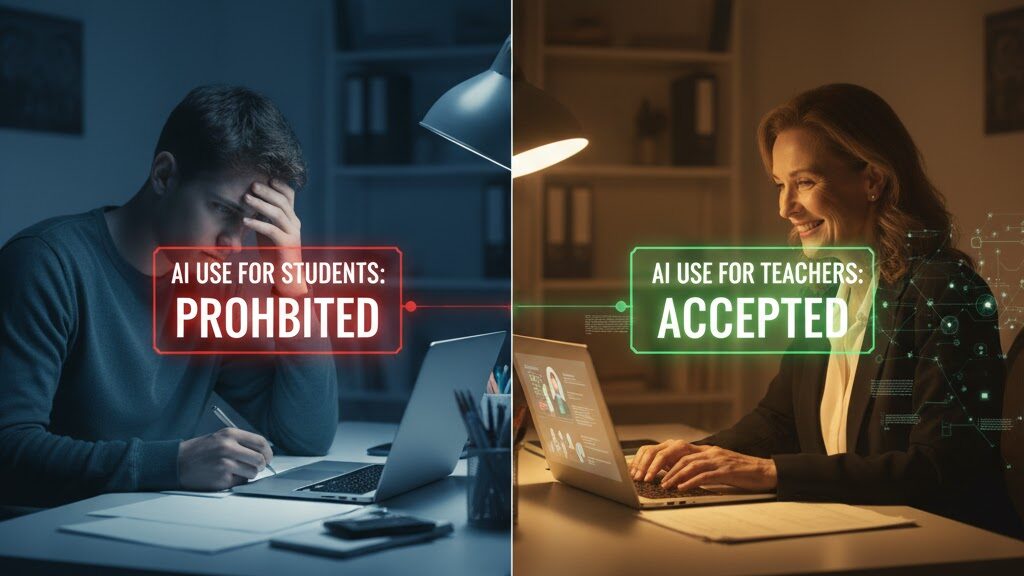
A split image showing a frustrated male student on the left, with text "AI USE FOR STUDENTS: PROHIBITED," and a smiling female teacher on the right, with text "AI USE FOR TEACHERS: ACCEPTED." Both are working on laptops in a contrasting light. Image (and typos) generated by Nano Banana.
The double standard: Exploring why AI use might be acceptable for educators yet detrimental for students’ learning and development. Image (and typos) generated by Nano Banana.

Source

Edutopia

Summary

History and journalism teacher David Cutler argues that while generative AI can meaningfully enhance teachers’ feedback and efficiency, students should not use it unsupervised. Teachers possess the critical judgment to evaluate AI outputs, but students risk bypassing essential cognitive processes and genuine understanding. Cutler likens premature AI use to handing a calculator to someone who hasn’t learned basic arithmetic. He instead promotes structured, transparent use—AI for non-assessed learning or teacher moderation—while continuing to teach critical thinking and writing through in-class work. His stance reflects both ethical caution and pragmatic optimism about AI’s potential to support, not supplant, human learning.

Key Points

  • Teachers can use AI to improve feedback, fairness, and grading efficiency.
  • Students lack the maturity and foundational skills for unsupervised AI use.
  • In-class writing fosters integrity, ownership, and authentic reasoning.
  • Transparent teacher use models responsible AI practice.
  • Slow, deliberate adoption best protects student learning and trust.

Keywords

URL

https://www.edutopia.org/article/why-students-should-not-use-ai/

Summary generated by ChatGPT 5