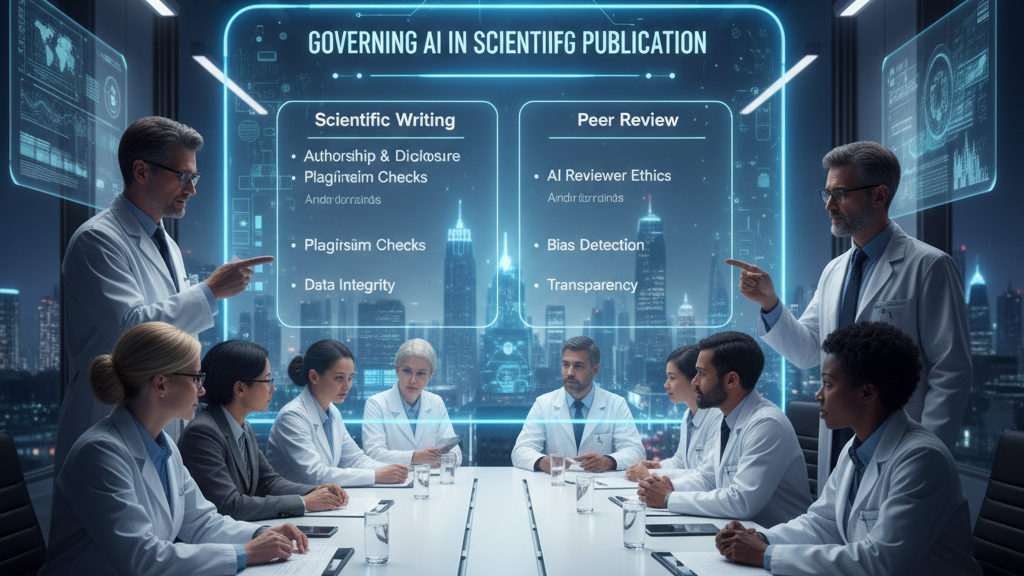
As AI’s role in academic research rapidly expands, establishing clear guidelines for its use in scientific writing and peer review has become an urgent imperative. This image depicts a panel of experts discussing these crucial regulations, emphasizing the need to set ethical frameworks to maintain integrity, transparency, and fairness in the scientific publication process. Image (and typos) generated by Nano Banana.
Source
Times Higher Education
Summary
George Chalhoub argues that as AI becomes more entrenched in research and publication, the academic community urgently needs clear, enforceable guidelines for its use in scientific writing and peer review. He cites evidence of undeclared AI involvement in manuscripts and reviews, hidden prompts, and inflated submission volume. To maintain credibility, journals must require authors and reviewers to disclose AI use, forbid AI as a co-author, and ensure human oversight. Chalhoub frames AI as a tool—not a decision-maker—and insists that accountability, transparency, and common standards must guard against erosion of trust in the scientific record.
Key Points
Significant prevalence of AI content: e.g. 13.5 % of 2024 abstracts bore signs of LLM use, with some fields reaching 40 %.
Up to ~17 % of peer review sentences may already be generated by AI, per studies of review corpora.
Some authors embed hidden prompts (e.g. white-text instructions) to influence AI-powered reviewing tools.
Core requirements: disclosure of AI use (tools, versions, roles), human responsibility for verification, no listing of AI as author.
Journals should adopt policies involving audits, sanctions for misuse, and shared frameworks via organisations like COPE and STM.
This image envisions an engaging online AI class at Arizona State University, titled “The Agentic Self,” exploring the intricacies of autonomous AI. It showcases a dynamic virtual classroom where students connect from various locations, delving into cutting-edge concepts of AI’s self-governing capabilities and its implications for the future. Image (and typos) generated by Nano Banana.
Source
Phoenix Business Journal
Summary
Arizona State University announced that Black Eyed Peas performer and entrepreneur will.i.am will join the faculty as a professor of practice to teach a course on artificial intelligence. Starting spring 2026, he will lead “The Agentic Self”, a 15-week class exploring how AI can serve as a creative and educational partner. The class will run through ASU’s GAME School and connect to will.i.am’s FYI.AI platform. University officials emphasise the collaboration as part of ASU’s mission to innovate teaching and help students gain fluency in emerging technologies.
Key Points
will.i.am joins ASU as professor of practice to teach AI.
Course title: “The Agentic Self”, scheduled for spring 2026.
Students will explore AI as tool, collaborator, and creative partner.
Class is hosted by ASU’s GAME School and linked to FYI.AI platform.
Move underscores ASU’s strategy of blending tech, industry expertise, and higher education innovation.
This collection of essays explores how artificial intelligence—particularly generative AI (GenAI)—is reshaping the university sector across teaching, research, and administration. Contributors, including Dame Wendy Hall, Vinton Cerf, Rose Luckin, and others, argue that AI represents a profound structural shift rather than a passing technological wave. The report emphasises that universities must respond strategically, ethically, and holistically: developing AI literacy among staff and students, redesigning assessment, and embedding responsible innovation into governance and institutional strategy.
AI is portrayed as both a disruptive and creative force. It automates administrative processes, accelerates research, and transforms strategy-making, while simultaneously challenging ideas of authorship, assessment, and academic integrity. Luckin and others call for universities to foster uniquely human capacities—critical thinking, creativity, emotional intelligence, and metacognition—so that AI augments rather than replaces human intellect. Across the essays, there is strong consensus that AI literacy, ethical governance, and institutional agility are vital if universities are to remain credible and relevant in the AI era.
Key Points
GenAI is reshaping all aspects of higher education teaching and learning.
AI literacy must be built into curricula, staff training, and institutional culture.
Faculty should use GenAI to enhance creativity and connection, not replace teaching.
Clear, flexible policies are needed for responsible and ethical AI use.
Institutions must prioritise equity, inclusion, and closing digital divides.
Ongoing professional development in AI is essential for staff and administrators.
Collaboration across institutions and with industry accelerates responsible adoption.
Assessment and pedagogy must evolve to reflect AI’s role in learning.
GenAI governance should balance innovation with accountability and transparency.
Shared toolkits and global practice networks can scale learning and implementation.
Conclusion
The Action Plan positions GenAI as both a challenge and a catalyst for renewal in higher education. Institutions that foster literacy, ethics, and innovation will not only adapt but thrive. Teaching with AI is framed as a collective, values-led enterprise—one that keeps human connection, creativity, and critical thinking at the centre of the learning experience.
by Jim O’Mahony, SFHEA – Munster Technological University
Estimated reading time: 5 minutes
The true test of a professor’s intelligence: finding the lost remote control. Image generated by Nano Banana
I remember as a 7-year-old having to hop off the couch at home to change the TV channel. Shortly afterwards, a futuristic-looking device called a remote control was placed in my hand, and since then I have chosen its wizardry over my own physical ability to operate the TV. Why wouldn’t I? It’s reliable, instant, multifunctional, compliant and most importantly… less effort.
The Seduction of Less Effort
Less effort……….as humans, we’re biologically wired for it. Our bodies will always choose energy saving over energy-consuming, whether that’s a physical instance or a cognitive one. It’s an evolutionary aid to conserve energy.
Now, my life hasn’t been impaired by the introduction of a remote control, but imagine for a minute if that remote control replaced my thinking as a 7-year-old rather than my ability to operate a TV. Sounds fanciful, but in reality, this is exactly the world in which our students are now living in.
Within their grasp is a seductive all-knowing technological advancement called Gen AI, with the ability to replace thinking, reflection, metacognition, creativity, evaluative judgement, interpersonal relationships and other richly valued attributes that make us uniquely human.
Now, don’t get me wrong, I’m a staunch flag bearer for this new age of Gen AI and can see the unlimited potential it holds for enhanced learning. Who knows? Someday, it may even solve Bloom’s 2 sigma problem through its promise of personalised learning?
Guardrails for a New Age
However, I also realise that as the adults in the room, we have a very narrow window to put sufficient guardrails in place for our students around its use, and urgent considered governance is needed from University executives.
Gen AI literacy isn’t the most glamorous term (it may not even be the most appropriate term), but it encapsulates what our priority as educators should be. Learn what these tools are, how they work, what are the limitations, problems, challenges, pitfalls, etc, and how can we use them positively within our professional practice to support rather than replace learning?
Isn’t that what we all strive for? To have the right digital tools matched with the best pedagogical practices so that our students enter the workforce as well-rounded, fully prepared graduates – a workforce by the way, that is rapidly changing, with more than 71% of employers routinely adopting Gen AI 12 months ago (we can only imagine what it is now).
Shouldn’t our teaching practices change then, to reflect the new Gen AI-rich graduate attributes required by employers? Surely, the answer is YES… or is it? There is no easy answer – and perhaps no right answer. Maybe we’ve been presented with a wicked problem – an unsolvable situation where some crusade to resist AI, and others introduce policies to ‘ban the banning’ of AI! Confused anyone?
Rethinking Assessment in a GenAI World
I believe a common-sense approach is best and would have us reimagine our educational programmes with valid, secure and authentic assessments that reward learning both with and without the use of Gen AI.
Achieving this is far from easy, but as a starting point, consider a recent paper from Deakin University, which advocates for structural changes to assessment design along with clearly communicated instructions to students around Gen AI use.
To facilitate a more discursive approach regarding reimagined assessment protocols, some universities are adopting ‘traffic light systems’ such as the AI Assessment scale, which, although not perfect (or the whole solution), at least promotes open and transparent dialogue with students about assessment integrity – and that’s never a bad thing.
The challenge will come from those academics who resist the adoption of Gen AI in education. Whether their reasons relate to privacy, environmental issues, ethics, inherent bias, AGI, autonomous AI or cognitive offloading concerns (all well-intentioned and entirely valid by the way), Higher Ed debates and decision making around this topic in the coming months will be robust and energetic.
Accommodating the fearful or ‘traditionalist educators’ who feel unprepared or unwilling to road-test Gen AI should be a key part of any educational strategy or initiative. Their voices should be heard and their opinions considered – but in return, they also need to understand how Gen AI works.
From Resistance to Fluency
Within each department, faculty, staffroom, T&L department – even among the rows of your students, you will find early adopters and digital champions who are a little further along this dimly lit path to Gen AI enlightenment. Seek them out, have coffee with them, reflect on their wisdom and commit to trialling at least one new Gen AI tool or application each week – here’s a list of 100 to get you started. Slowly build your confidence, take an open course, learn about AI fluency, and benefit from the expertise of others.
I’m not encouraging you to be an AI evangelist, but improving your knowledge and general AI capabilities will make you better able to make more informed decisions for you and your students.
Now, did anyone see where I left the remote control?
Jim O’Mahony
University Professor | Biotechnologist | Teaching & Learning Specialist Munster Technological University
I am a passionate and enthusiastic University lecturer with over 20 years experience of designing, delivering and assessing undergraduate and postgraduate programmes. My primary focus as an academic is to empower students to achieve their full potential through innovative educational strategies and carefully designed curricula. I embrace the strategic and well-intentioned use of digital tools as part of my learning ethos, and I have been an early adopter and enthusiastic advocate of Artificial Intelligence (AI) as an educational tool.