A History Professor Says AI Did Not Break College; It Exposed How Broken It Already Was


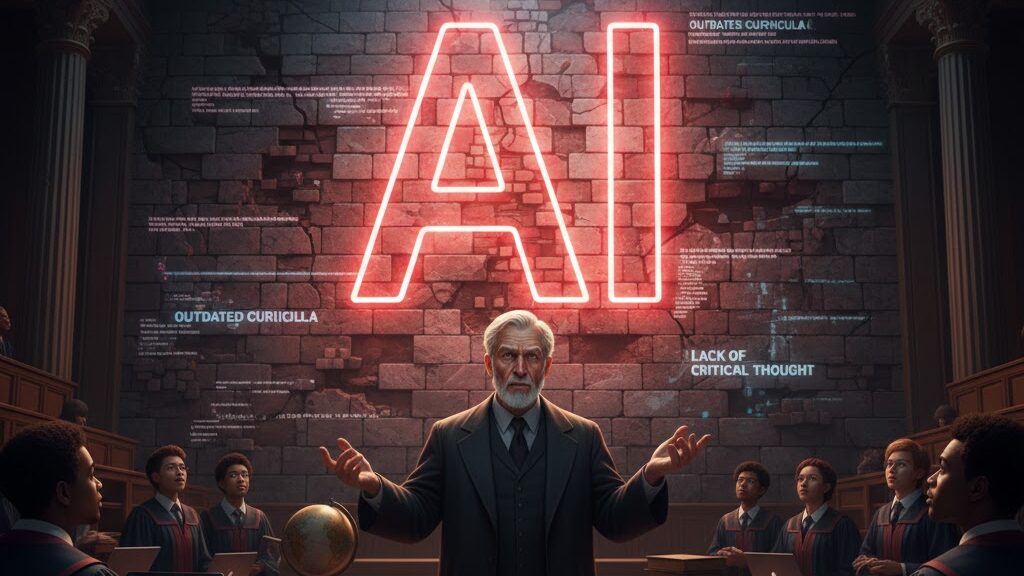
A dramatic, conceptual image showing a crumbling, old-fashioned column (representing "Traditional College Structure") with cracks widening as digital light and AI code seep into the fissures, emphasizing that AI revealed existing weaknesses rather than caused the damage. Image (and typos) generated by Nano Banana.
Unmasking the flaws: A history professor’s perspective suggesting that AI merely shone a light on the structural vulnerabilities and existing problems within higher education, rather than being the sole source of disruption. Image (and typos) generated by Nano Banana.

Source

Business Insider

Summary

This article features a U.S. history professor who argues that generative AI did not cause the crisis currently unfolding in higher education but instead revealed long-standing structural flaws. According to the professor, AI has exposed weaknesses in assessment design, unclear expectations placed on students and unsustainable workloads carried by academic staff. The sudden visibility of AI-generated essays and assignments has forced institutions to confront the limitations of traditional assessment models that rely heavily on polished written output rather than demonstrated cognitive processes. The professor notes that AI has unintentionally highlighted inequities in student preparation, inconsistencies in grading norms and the mismatch between institutional rhetoric and actual resourcing. Rather than attempting to suppress AI, the article argues that higher education should treat this moment as an opportunity to redesign curricula, diversify assessments and rethink the broader purpose of university education. The piece positions AI as a catalyst for long-overdue reform, emphasising that genuine improvement will require institutions to invest in pedagogical redesign, staff support and clearer communication around learning outcomes.

Key Points

  • AI highlighted systemic weaknesses already present in higher education
  • Exposed flaws in assessment design and grading expectations
  • Revealed pressures on overworked teaching staff
  • Suggests AI could drive constructive reform
  • Encourages rethinking pedagogy and institutional priorities

Keywords

URL

https://www.businessinsider.com/ai-didnt-break-college-it-exposed-broken-system-professor-2025-11

Summary generated by ChatGPT 5.1

Schools Urged to Use AI in Education with Caution


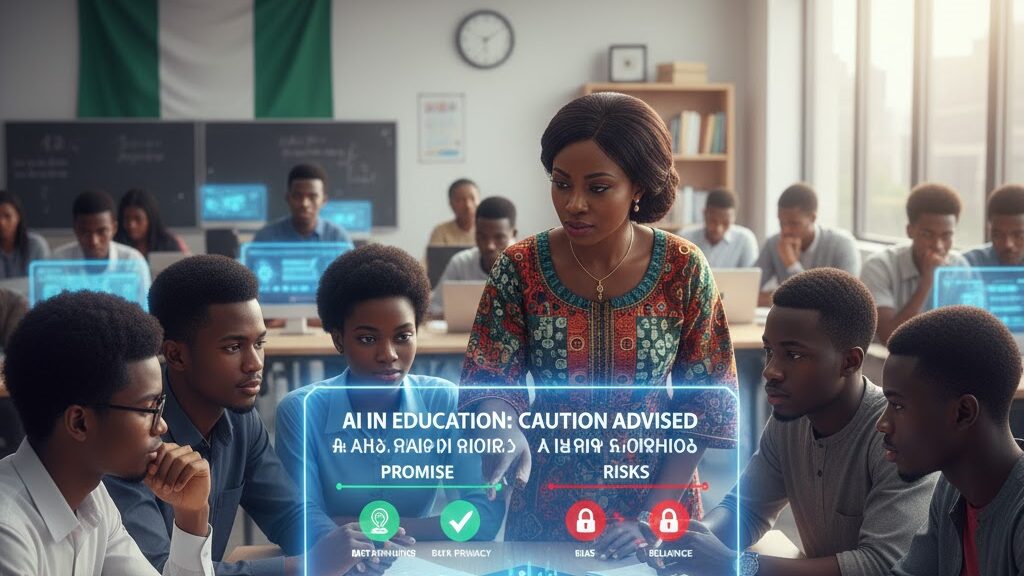
In a modern Nigerian classroom, a female teacher in traditional attire stands over a group of attentive students gathered around a table with laptops. A glowing holographic interface displays "AI IN EDUCATION: CAUTION ADVISED," with sections for "PROMISE" (showing benefits like efficiency) and "RISKS" (highlighting concerns such as bias, data privacy, and reliance) with corresponding checkmarks and X-marks. The Nigerian flag is visible in the background. Image (and typos) generated by Nano Banana.
Amidst the global integration of AI into education, Nigerian schools are being urged to proceed with caution. This image depicts a teacher guiding students through the nuanced landscape of AI, highlighting both its promising applications and significant risks like inherent biases, data privacy concerns, and over-reliance, advocating for a balanced and responsible approach to adopting AI technologies in the classroom. Image (and typos) generated by Nano Banana.

Source

Punch (Nigeria)

Summary

At the “Artificial Intelligence: Turning Disruption into Advantage” forum in Lagos, educators and technologists encouraged Nigerian schools to embrace AI while maintaining a balance between innovation and critical thinking. Speakers highlighted that AI can enhance learning efficiency and prepare students for future careers but warned against over-reliance that weakens analytical skills. John Todd of Charterhouse Lagos urged educators to teach responsible use, stressing the need for ethics and discernment. Eric Oliver of AidTrace added that Africa should invest in local infrastructure to process its own technology resources, reducing dependence on foreign supply chains and strengthening regional economies.

Key Points

  • Educators urged cautious but proactive adoption of AI in classrooms.
  • Over-reliance on AI risks undermining students’ independent thinking skills.
  • Responsible use requires ethics, discernment, and understanding of AI’s limits.
  • African nations should develop local tech infrastructure to capture more value.
  • The forum promoted AI as a tool for empowerment rather than replacement.

Keywords

URL

https://punchng.com/schools-urged-to-use-ai-with-caution/

Summary generated by ChatGPT 5


Today’s AI hype has echoes of a devastating technology boom and bust 100 years ago


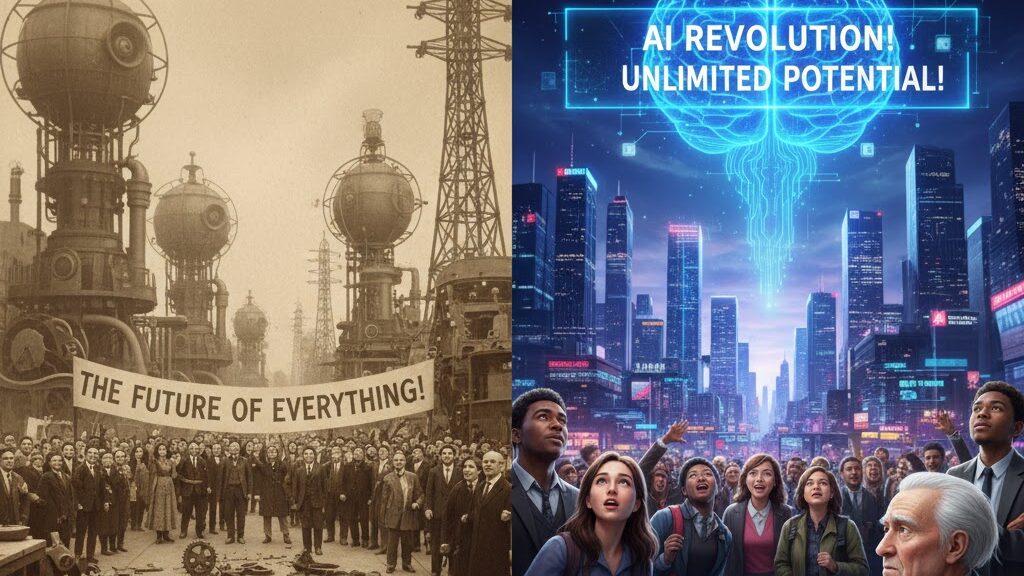
A split image contrasting two eras. On the left, a sepia-toned scene from 100 years ago shows a crowd enthusiastically gathered around industrial machinery and towering power lines, with a banner proclaiming "THE FUTURE OF EVERYTHING!" On the right, a vibrant, futuristic cityscape glows under a digital sky, where a diverse crowd looks up at a holographic brain symbol and text announcing "AI REVOLUTION! UNLIMITED POTENTIAL!". In the foreground, people interact with digital news showing "AI CRASHES" and "TECH LAYOFFS." Image (and typos) generated by Nano Banana.
The intense fervor surrounding today’s AI technology mirrors the intense hype and subsequent devastating bust of a technological revolution a century ago. This side-by-side comparison starkly portrays the recurring cycle of technological innovation and speculation, prompting a cautionary reflection on whether the current AI gold rush could face a similar fate to past booms and busts. Image (and typos) generated by Nano Banana.

Source

The Conversation

Summary

Cameron Shackell draws parallels between today’s AI boom and the electrification craze of the 1920s. Just as electricity fuelled massive innovation, speculation and eventual collapse, AI is showing similar patterns of overinvestment, market concentration and loose regulation. The 1929 stock market crash revealed the dangers of unregulated “high-tech” exuberance, leading to reforms that transformed electricity into stable infrastructure. Shackell warns that AI could follow the same path—booming unsustainably before a painful correction—unless governments implement thoughtful regulation. The question, he suggests, is whether we can integrate AI safely into daily life before a comparable bust forces reform.

Key Points

  • The 1920s electricity boom mirrors today’s AI surge in hype and speculation.
  • Both technologies reshaped industries and drove market concentration.
  • Lack of oversight in the 1920s helped trigger the Great Depression.
  • AI’s rapid expansion faces similarly weak global regulation.
  • The author urges proactive governance to avoid another tech-driven collapse.

Keywords

URL

https://theconversation.com/todays-ai-hype-has-echoes-of-a-devastating-technology-boom-and-bust-100-years-ago-265492

Summary generated by ChatGPT 5