Experts Warn AI Could Reshape Teen Brains


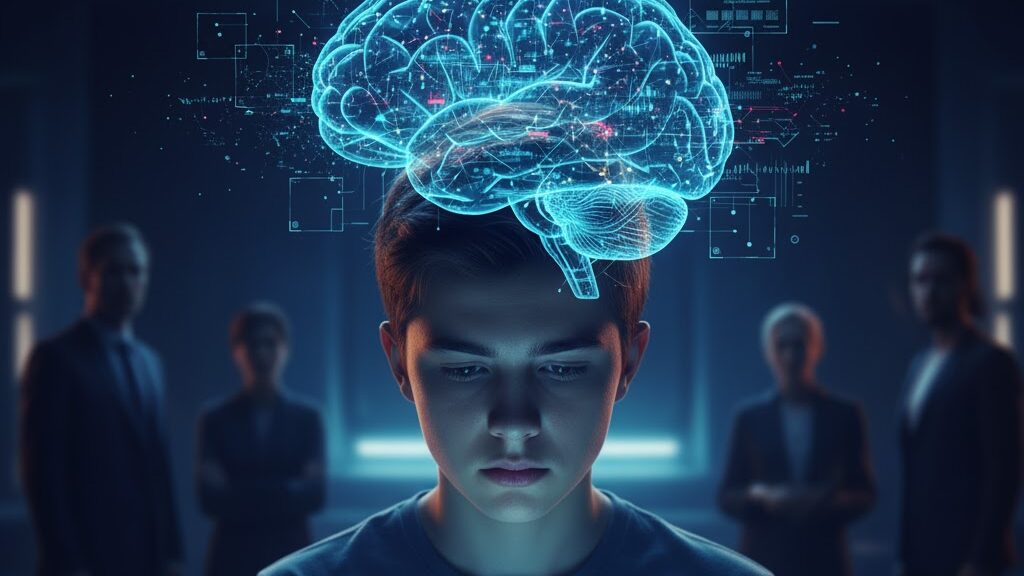
A focused teenage boy looks down at a glowing digital tablet displaying complex data. Above his head, a bright blue, intricate holographic representation of a human brain pulsates with interconnected data points and circuits, symbolizing the impact of technology. In the blurred background, several adult figures in professional attire stand, observing the scene, representing the "experts." Image (and typos) generated by Nano Banana.
As artificial intelligence becomes increasingly integrated into daily life, experts are raising concerns about its potential long-term effects on the developing brains of teenagers. Explore the warnings and discussions surrounding AI’s influence on cognitive development and neural pathways. Image (and typos) generated by Nano Banana.

Source

CNBC

Summary

Ernestine Siu reports growing concern among scientists and regulators that prolonged use of generative AI by children and teenagers could alter brain development and weaken critical thinking skills. A 2025 MIT Media Lab study found that reliance on large language models (LLMs) such as ChatGPT reduced neural connectivity compared with unaided writing tasks, suggesting “cognitive debt” from over-dependence on external support. Researchers warn that early exposure may limit creativity, self-regulation, and critical analysis, while privacy and emotional risks also loom large as children anthropomorphise AI companions. Experts urge limits on generative AI use among young people, stronger parental oversight, and the cultivation of both AI and digital literacy to safeguard cognitive development and wellbeing.

Key Points

  • One in four U.S. teens now use ChatGPT for schoolwork, double the 2023 rate.
  • MIT researchers found reduced brain network activity in users relying on LLMs.
  • Overuse of AI may lead to “cognitive debt” and hinder creativity and ownership of work.
  • Younger users are particularly vulnerable to emotional and privacy risks.
  • Experts recommend age-appropriate AI design, digital literacy training, and parental engagement.

Keywords

URL

https://www.cnbc.com/2025/10/13/experts-warn-ai-llm-chatgpt-gemini-perplexity-claude-grok-copilot-could-reshape-teen-youth-brains.html

Summary generated by ChatGPT 5


How to Teach Critical Thinking When AI Does the Thinking


In a modern classroom overlooking a city skyline, a female teacher engages with a small group of students around a table. A glowing holographic maze labeled "CRITICAL THINKING" emanates from the tabletop, surrounded by various interactive data displays. In the background, other students work on laptops, and a large screen at the front displays "CRITICAL THINKING IN THE AGE OF AI: NAVIGATING THE ALGORITHMIC LANDSCAPE." Image (and typos) generated by Nano Banana.
As artificial intelligence increasingly automates cognitive tasks, educators face the crucial challenge of teaching critical thinking when AI can “do the thinking” for students. This image illustrates a forward-thinking classroom where a teacher guides students through complex, interactive simulations designed to hone their critical thinking skills, transforming AI from a potential crutch into a tool for deeper intellectual engagement and navigating an algorithmic world. Image (and typos) generated by Nano Banana.

Source

Psychology Today

Summary

Timothy Cook explores how the growing use of generative AI is eroding critical thinking and accountability in both education and professional contexts. Citing Deloitte’s $291,000 error-filled AI-generated report, he warns that overreliance on AI leads to “cognitive outsourcing,” where users stop questioning information and lose ownership of their ideas. Educators, he argues, mirror this problem by automating grading and teaching materials while penalising students for doing the same. Cook proposes a “dialogic” approach—using AI as a thinking partner through questioning, critique, and reflection—to restore analytical engagement and model responsible use in classrooms and workplaces alike.

Key Points

  • Deloitte’s AI-generated report highlights the risks of uncritical reliance on ChatGPT.
  • Many educators automate teaching tasks while discouraging students from AI use.
  • Frequent AI users show weakened brain connectivity and reduced ownership of ideas.
  • Dialogic prompting—interrogating AI outputs—fosters deeper reasoning and creativity.
  • Transparent, guided AI use should replace institutional hypocrisy and cognitive outsourcing.

Keywords

URL

https://www.psychologytoday.com/us/blog/the-algorithmic-mind/202510/how-to-teach-critical-thinking-when-ai-does-the-thinking

Summary generated by ChatGPT 5