Pupils Fear AI Is Eroding Their Ability to Study, Research Finds


Four serious-looking teenage students (two boys, two girls) are seated across from each other at a long table in a library setting, each with an open laptop in front of them. Glowing, ethereal representations of open books made of data and digital information hover above their laptops, subtly connecting them to the screens. Their expressions convey concern and perhaps a touch of apprehension as they look directly at the viewer. The background features bookshelves, typical of a library or study area. Image (and typos) generated by Nano Banana.
A new study reveals that students are increasingly concerned about how artificial intelligence might be undermining their foundational study and research abilities. Explore the findings that confirm pupils’ fears about AI’s impact on learning. Image (and typos) generated by Nano Banana.

Source

The Guardian

Summary

A study commissioned by Oxford University Press (OUP) reveals that students across the UK increasingly worry that artificial intelligence is weakening their study habits, creativity, and motivation to learn. The report, Teaching the AI Native Generation, found that 98 per cent of pupils aged 13 to 18 use AI for schoolwork, with 80 per cent relying on it regularly. Many described AI as making tasks “too easy” and limiting their independent thinking. While students recognise its usefulness, they also express concern about overreliance and skill erosion. The findings highlight the urgent need for balanced AI education strategies that promote critical thinking, ethical awareness, and human creativity alongside digital competence.

Key Points

  • 98 per cent of UK secondary pupils use AI for schoolwork, most on a regular basis.
  • Many pupils say AI tools make studying too easy and reduce creativity.
  • Concerns are growing about AI’s impact on independent learning and problem-solving.
  • The study urges educators to develop frameworks for responsible, balanced AI use.
  • OUP calls for schools to integrate AI literacy into teaching while safeguarding learning depth.

Keywords

URL

https://www.theguardian.com/technology/2025/oct/15/pupils-fear-ai-eroding-study-ability-research

Summary generated by ChatGPT 5


Professors Share Their Findings and Thoughts on the Use of AI in Research


Three professors (one woman, two men) sit around a large polished conference table in a modern office with bookshelves in the background. They are engaged in a discussion, with open laptops, notebooks, and coffee cups in front of them. Overlaying the scene are glowing holographic data visualizations and graphs, with the words "AI IN ACADEMIC RESEARCH: FINDINGS & PERSPECTIVES" digitally projected in the center, representing the intersection of human intellect and artificial intelligence. Image (and typos) generated by Nano Banana.
Dive into the evolving landscape of academic research as leading professors share their insights and discoveries on integrating AI tools. Explore the benefits, challenges, and future implications of artificial intelligence in scholarly pursuits. Image (and typos) generated by Nano Banana.

Source

The Cavalier Daily

Summary

At the University of Virginia, faculty across disciplines are exploring how artificial intelligence can accelerate and reshape academic research. Associate Professor Hudson Golino compares AI’s transformative potential to the introduction of electricity in universities, noting its growing use in data analysis and conceptual exploration. Economist Anton Korinek, recently named among Time’s 100 most influential in AI, evaluates where AI adds value—from text synthesis and coding to ideation—while cautioning that tasks like mathematical modelling still require human oversight. Professors Mona Sloane and Renee Cummings stress ethical transparency, inclusivity, and the need for disclosure when using AI in research, arguing that equity and critical reflection must remain at the heart of innovation.

Key Points

  • AI is increasingly used at the University of Virginia for research and analysis across disciplines.
  • Golino highlights AI’s role in improving efficiency but calls for deeper institutional understanding.
  • Korinek finds AI most effective for writing, coding, and text synthesis, less so for abstract modelling.
  • Sloane and Cummings advocate transparency, ethical use, and inclusion in AI-assisted research.
  • Faculty urge a balance between efficiency, equity, and accountability in AI’s integration into academia.

Keywords

URL

https://www.cavalierdaily.com/article/2025/10/professors-share-their-findings-and-thoughts-on-the-use-of-ai-in-research

Summary generated by ChatGPT 5


How to Teach Critical Thinking When AI Does the Thinking


In a modern classroom overlooking a city skyline, a female teacher engages with a small group of students around a table. A glowing holographic maze labeled "CRITICAL THINKING" emanates from the tabletop, surrounded by various interactive data displays. In the background, other students work on laptops, and a large screen at the front displays "CRITICAL THINKING IN THE AGE OF AI: NAVIGATING THE ALGORITHMIC LANDSCAPE." Image (and typos) generated by Nano Banana.
As artificial intelligence increasingly automates cognitive tasks, educators face the crucial challenge of teaching critical thinking when AI can “do the thinking” for students. This image illustrates a forward-thinking classroom where a teacher guides students through complex, interactive simulations designed to hone their critical thinking skills, transforming AI from a potential crutch into a tool for deeper intellectual engagement and navigating an algorithmic world. Image (and typos) generated by Nano Banana.

Source

Psychology Today

Summary

Timothy Cook explores how the growing use of generative AI is eroding critical thinking and accountability in both education and professional contexts. Citing Deloitte’s $291,000 error-filled AI-generated report, he warns that overreliance on AI leads to “cognitive outsourcing,” where users stop questioning information and lose ownership of their ideas. Educators, he argues, mirror this problem by automating grading and teaching materials while penalising students for doing the same. Cook proposes a “dialogic” approach—using AI as a thinking partner through questioning, critique, and reflection—to restore analytical engagement and model responsible use in classrooms and workplaces alike.

Key Points

  • Deloitte’s AI-generated report highlights the risks of uncritical reliance on ChatGPT.
  • Many educators automate teaching tasks while discouraging students from AI use.
  • Frequent AI users show weakened brain connectivity and reduced ownership of ideas.
  • Dialogic prompting—interrogating AI outputs—fosters deeper reasoning and creativity.
  • Transparent, guided AI use should replace institutional hypocrisy and cognitive outsourcing.

Keywords

URL

https://www.psychologytoday.com/us/blog/the-algorithmic-mind/202510/how-to-teach-critical-thinking-when-ai-does-the-thinking

Summary generated by ChatGPT 5


University wrongly accuses students of using artificial intelligence to cheat


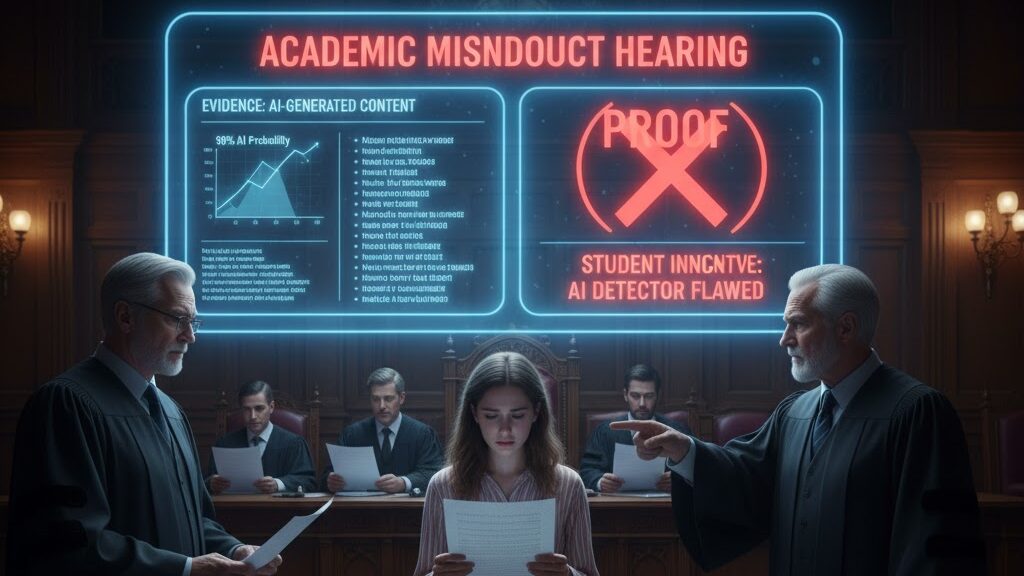
In a solemn academic hearing room, reminiscent of a courtroom, a distressed female student stands before a panel of university officials in robes, holding a document. A large holographic screen above displays "ACADEMIC MISCONDUCT HEARING." On the left, "EVIDENCE: AI-GENERATED CONTENT" shows a graph of AI probability, while on the right, a large red 'X' over "PROOF" is accompanied by text stating "STUDENT INNOCENT: AI DETECTOR FLAWED," highlighting a wrongful accusation. Image (and typos) generated by Nano Banana.
The burgeoning reliance on AI detection software has led to a disturbing trend: universities wrongly accusing students of using artificial intelligence to cheat. This dramatic image captures the devastating moment a student is cleared after an AI detector malfunctioned, highlighting the serious ethical challenges and immense distress caused by flawed technology in academic integrity processes. Image (and typos) generated by Nano Banana.

Source

ABC News (Australia)

Summary

The Australian Catholic University (ACU) has come under fire after wrongly accusing hundreds of students of using AI to cheat on assignments. Internal records showed nearly 6,000 academic misconduct cases in 2024, around 90 % linked to AI use. Many were based solely on Turnitin’s unreliable AI detection tool, later scrapped for inaccuracy. Students said they faced withheld results, job losses and reputational damage while proving their innocence. Academics reported low AI literacy, inconsistent policies and heavy workloads. Experts, including Sydney’s Professor Danny Liu, argue that banning AI is misguided and that universities should instead teach students responsible and transparent use.

Key Points

  • ACU recorded nearly 6,000 misconduct cases, most tied to alleged AI use.
  • Many accusations were based only on Turnitin’s flawed AI detector.
  • Students bore the burden of proof, with long investigation delays.
  • ACU has since abandoned the AI tool and introduced training on ethical AI use.
  • Experts urge universities to move from policing AI to teaching it responsibly.

Keywords

URL

https://www.abc.net.au/news/2025-10-09/artificial-intelligence-cheating-australian-catholic-university/105863524

Summary generated by ChatGPT 5


Leaving Cert changes won’t stand up to AI, says Colm O’Rourke


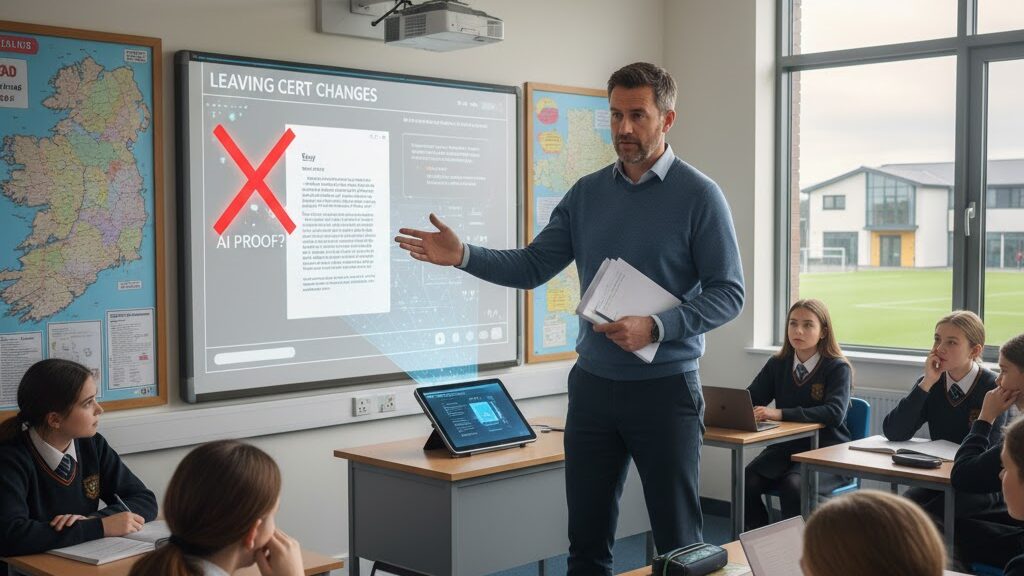
In a modern secondary school classroom, a male teacher stands at the front, holding papers and gesturing towards a large interactive screen. The screen displays "LEAVING CERT CHANGES" with a big red 'X' over a document and the question "AI PROOF?", indicating concerns about the new exam structure's vulnerability to AI. Students in school uniforms are seated at desks, attentively listening. Image (and typos) generated by Nano Banana.
Concerns are mounting that recent changes to the Leaving Certificate examination system may not be robust enough to withstand the challenges posed by artificial intelligence. This image depicts a teacher discussing the new exam structure in a classroom, highlighting anxieties that the updated assessment methods might be susceptible to AI-driven academic dishonesty, compromising the integrity of the crucial final exams. Image (and typos) generated by Nano Banana.

Source

BreakingNews.ie

Summary

Former school principal and columnist Colm O’Rourke has criticised Ireland’s revised Leaving Certificate curriculum, warning that new assessment methods are ill-equipped to withstand the influence of generative AI. The updated curriculum, which allocates 40 % of marks to classroom-based work, was designed to promote continuous assessment but, according to O’Rourke, is now “too easy to cheat.” He argues that the reforms—developed years ago—have already been overtaken by technological change. O’Rourke calls for more in-person, practical, and oral-style assessments to ensure authenticity and to distinguish between genuine learning and AI-assisted shortcuts.

Key Points

  • The new Leaving Cert curriculum allocates 40 % of marks to class-based assessments.
  • O’Rourke warns these assessments are highly vulnerable to AI-assisted cheating.
  • He advocates for oral, practical, and supervised assessment formats instead.
  • The reforms were designed a decade ago and are now outdated by AI’s rapid rise.
  • He argues that genuine knowledge acquisition cannot be replicated by AI tools.

Keywords

URL

https://www.breakingnews.ie/ireland/leaving-cert-changes-wont-stand-up-to-ai-says-colm-orourke-1816115.html

Summary generated by ChatGPT 5