Generic AI cannot capture higher education’s unwritten rules


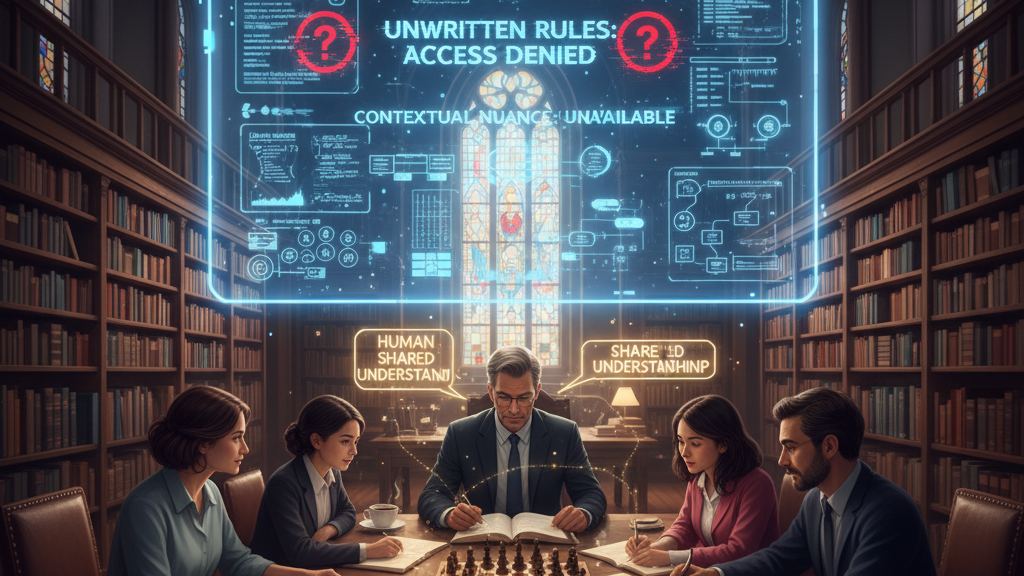
Five academics, dressed in business attire, are seated around a chess board on a wooden table in a traditional library, with books and papers. Above them, a large holographic screen displays 'AI - UNWRITTEN RULES: ACCESS DENIED' and 'CONTEXTUAL NUANCE: UNA'ILABLE', surrounded by data. Two thought bubbles above the central figure read 'HUMAN SHARED UNDERSTAIN' and 'SHARE 'ID UNDERSTANHINP'. The scene symbolizes AI's inability to grasp the subtle, unwritten rules of higher education. Generated by Nano Banana.
While AI excels at processing explicit data, it fundamentally struggles to grasp the nuanced, ‘unwritten rules’ that govern higher education. This image illustrates the critical gap where generic AI falls short in understanding the complex social, cultural, and contextual intricacies that define the true academic experience, highlighting the irreplaceable value of human intuition and shared understanding. Image (and typos) generated by Nano Banana.

Source

Wonkhe

Summary

Kurt Barling argues that universities operate not only through formal policies but via tacit, institution-specific norms—corridor conversations, precedents, traditions—that generic AI cannot perceive or replicate. Deploying off-the-shelf AI tools risks flattening institutional uniqueness, eroding identity and agency. He suggests universities co-design AI tools that reflect their values, embed nuance, preserve institutional memory, and maintain human oversight. Efficiency must not come at the cost of hollowing out culture, or letting external systems dictate how universities function.

Key Points

  • Universities depend heavily on tacit norms and culture—unwritten rules that guide decisions and practices.
  • Generic AI, based on broad datasets, flattens nuance and treats institutions as interchangeable.
  • If universities outsource decision-making to black-box systems, they risk losing identity and governance control.
  • A distributed “human-assistive AI” approach is preferable: systems that suggest, preserve memory, and stay under human supervision.
  • AI adoption must not sacrifice culture and belonging for efficiency; sector collaboration is needed to build tools aligned with institutional values.

Keywords

URL

https://wonkhe.com/blogs/generic-ai-cannot-capture-higher-educations-unwritten-rules/

Summary generated by ChatGPT 5


How generative AI is really changing education – by outsourcing the production of knowledge to Big Tech


A classroom-like setting inside a large server room, where students in white lab coats sit at desks with holographic screens projected from their devices. Above them, a neon sign blue logo glows for 'BIG TECH EDUSYNC' is prominent. The students have blank expressions, connected by wires. The scene criticises the outsourcing of education to technology. Generated by Nano Banana.
The rise of generative AI is fundamentally reshaping education, leading to concerns that the critical process of ‘knowledge production’ is being outsourced to Big Tech companies. This image visualises a future where learning environments are dominated by AI, raising questions about autonomy, critical thinking, and the ultimate source of truth in an AI-driven academic landscape. Image (and typos) generated by Nano Banana.

Source

The Conversation

Summary

This article argues that generative AI is shifting the locus of knowledge production from academic institutions into the hands of Big Tech platforms. As students and educators increasingly rely on AI tools, the power to define what counts as knowledge — what is true, what is cited, what is authoritative — is ceded to private firms. That shift risks marginalising critical thinking, local curricula, and disciplinary expertise. The author calls for reclaiming epistemic authority: universities must define their own ways of knowing, educate students not just in content but in evaluative judgement, and negotiate more equitable relationships with AI platforms so that academic integrity and autonomy aren’t compromised.

Key Points

  • Generative AI tools increasingly mediate how knowledge is accessed, curated and presented—Big Tech becomes a gatekeeper.
  • Reliance on AI may weaken disciplinary expertise and the role of scholars as knowledge producers.
  • Students may accept AI outputs uncritically, transferring trust to algorithmic systems over faculty.
  • To respond, higher education must build student literacy in epistemics (how we know what we know) and insist AI remain assistive, not authoritative.
  • Universities should set policy, technical frameworks, and partnerships that protect research norms, attribution, and diverse knowledge systems.

Keywords

URL

https://theconversation.com/how-generative-ai-is-really-changing-education-by-outsourcing-the-production-of-knowledge-to-big-tech-263160

Summary generated by ChatGPT 5


Study finds ChatGPT-5 is wrong about 1 in 4 times – here’s the reason why


A digital, transparent screen is displaying a large, bold '25%' error rate in red, with a smaller '1 in 4' below it. A glowing blue icon of a brain with a gear inside is shown on the left, while a red icon of a corrupted data symbol is on the right. A researcher in a lab coat is looking at the screen with a concerned expression.  The scene visually represents the unreliability of a generative AI. Generated by Nano Banana.
While generative AI tools like ChatGPT-5 offer powerful capabilities, new research highlights a critical finding: they can be wrong as often as one in four times. This image captures the tension between AI’s potential and its inherent fallibility, underscoring the vital need for human oversight and fact-checking to ensure accuracy and reliability. Image (and typos) generated by Nano Banana.

Source

Tom’s Guide

Summary

A recent OpenAI study finds that ChatGPT-5 produces incorrect answers in roughly 25 % of cases, due largely to the training and evaluation frameworks that penalise uncertainty. Because benchmarks reward confident statements over “I don’t know,” models are biased to give plausible answers even when unsure. More sophisticated reasoning models tend to hallucinate more because they generate more claims. The authors propose shifting evaluation metrics to reward calibrated uncertainty, rather than penalising honesty, to reduce harmful misinformation in critical domains.

Key Points

  • ChatGPT-5 is wrong about one in four responses (~25%).
  • Training and benchmarking systems currently penalise hesitation, nudging models toward confident guesses even when inaccurate.
  • Reasoning-focused models like o3 and o4-mini hallucinate more often—they make more claims, so they have more opportunities to err.
  • The study recommends redesigning AI benchmarks to reward calibrated uncertainty and the ability to defer instead of guessing.
  • For users: treat AI output as tentative and verify especially in high-stakes domains (medicine, law, finance).

Keywords

URL

https://www.tomsguide.com/ai/study-finds-chatgpt-5-is-wrong-about-1-in-4-times-heres-the-reason-why

Summary generated by ChatGPT 5


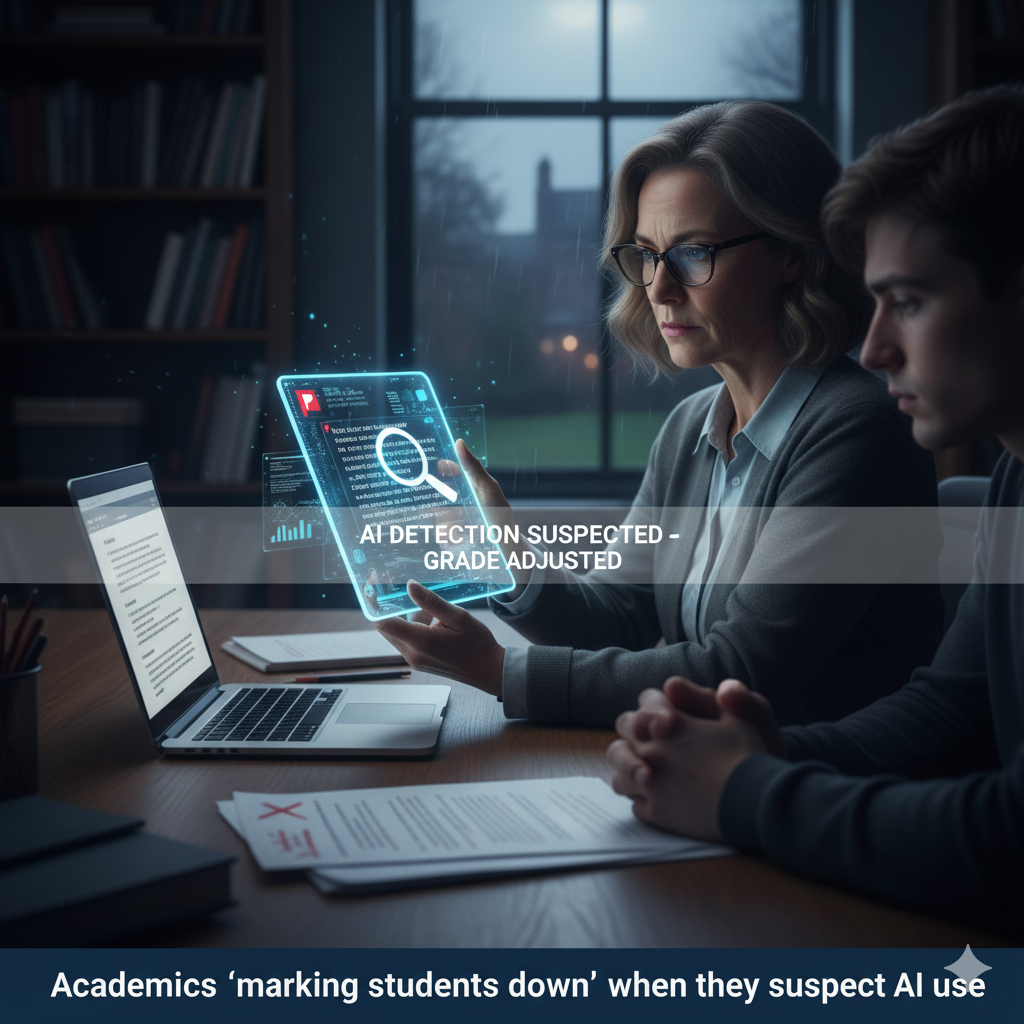
Academics ‘marking students down’ when they suspect AI use


A concerned academic, wearing glasses, sits across from a student, both looking at a transparent tablet displaying 'AI detection suspected - Grade Adjusted' with code and charts. A laptop with an essay is open on the left, and a document with a large red 'X' is on the table, symbolizing suspicion of AI use in academic work. Generated by Nano Banana.
The rise of AI in education presents new challenges for assessment. This image visualizes the tension and scrutiny faced by students as academics grapple with suspected AI use in assignments, leading to difficult conversations and potential grade adjustments. Image generated by Nano Banana.

Source

Times Higher Education

Summary

A recent study of academics in China’s Greater Bay Area reveals that some lecturers are reducing student marks if they suspect AI use, even when the students have declared using it or when institutional policy allows such use. The research, involving 33 academics, highlights that ambiguity around what constitutes legitimate AI use and norms emphasising originality and independence, leads to inconsistent grading. Particularly in the humanities, suspicion of AI can lead to harsher penalties. The lack of explicit expectations communicated to students exacerbates the issue, risking distrust and undermining the credibility of academic grading unless clearer standards are established.

Key Points

  • Academics are sometimes deducting marks based on suspicion of AI use, despite declared or permitted use.
  • The study involved 33 academics, many of whom report tension between policies that permit AI and traditional values of originality and independence.
  • Humanities lecturers are more likely to penalise AI-use suspicion than those in other disciplines.
  • Many institutions lack clear policies; expectations about AI use are often implicit, not explicitly communicated to students.
  • Without clarity, there is a risk of unfair marking, loss of trust between students and staff, and damage to the credibility of academic certifications.

Keywords

URL

https://www.timeshighereducation.com/news/academics-marking-students-down-when-they-suspect-ai-use

Summary generated by ChatGPT 5


How we’ve adapted coursework and essays to guard against AI


In a modern meeting room with large windows overlooking university buildings, a male and female academic are engaged in a discussion across a table. Between them, a glowing holographic shield icon labeled 'AI' is surrounded by other icons representing 'ADAPTED ASSESSMENTS: HUMAN PROOFED', 'ORAL DEFENSE', and 'HANDWRITTEN ASSFSSMENTS'. Other students are seen working on laptops in the background. The scene illustrates strategies for guarding against AI misuse in coursework. Generated by Nano Banana.
As AI tools become commonplace, educational institutions are proactively adapting their coursework and essay assignments to uphold academic integrity. This image visualizes educators implementing new assessment strategies, from human-proofed assignments to oral defenses, designed to ensure students are building their own knowledge and skills, rather than solely relying on AI. Image (and typos) generated by Nano Banana.

Source

Tes

Summary

An international school led by a history teacher rethinks assessment to preserve cognitive engagement in the age of AI. They’ve moved most research and drafting of A-level coursework into lessons (reducing home drafting), track each student’s writing path via Google Docs, require handwritten work at various key stages to discourage copy/paste, and engage students in dialogue about the pitfalls (“hallucinations”) of AI content. The strategy aims not just to prevent cheating, but to reinforce critical thinking, reduce procrastination, and make students more accountable for their own ideas.

Key Points

  • Coursework work (research + drafting) must be done partly in class, enabling oversight and reducing offsite AI use.
  • Monitoring via Google Docs helps detect inconsistencies in tone or sophistication that suggest AI assistance.
  • Handwritten assignments are reintroduced to reduce reliance on AI and minimise temptations to copy-paste.
  • Students are taught about AI’s unreliability (e.g. “hallucinations”) using historical examples of absurd errors (e.g. mixing battles, animals in wrong eras).
  • The reforms have modest benefits: less procrastination, more transparency, though challenges remain when students determined to cheat try to circumvent controls.

Keywords

URL

https://www.tes.com/magazine/analysis/specialist-sector/stopping-ai-cheating-how-our-school-has-adapted-coursework-essay-writing

Summary generated by ChatGPT 5