The Question All Colleges Should Ask Themselves About AI


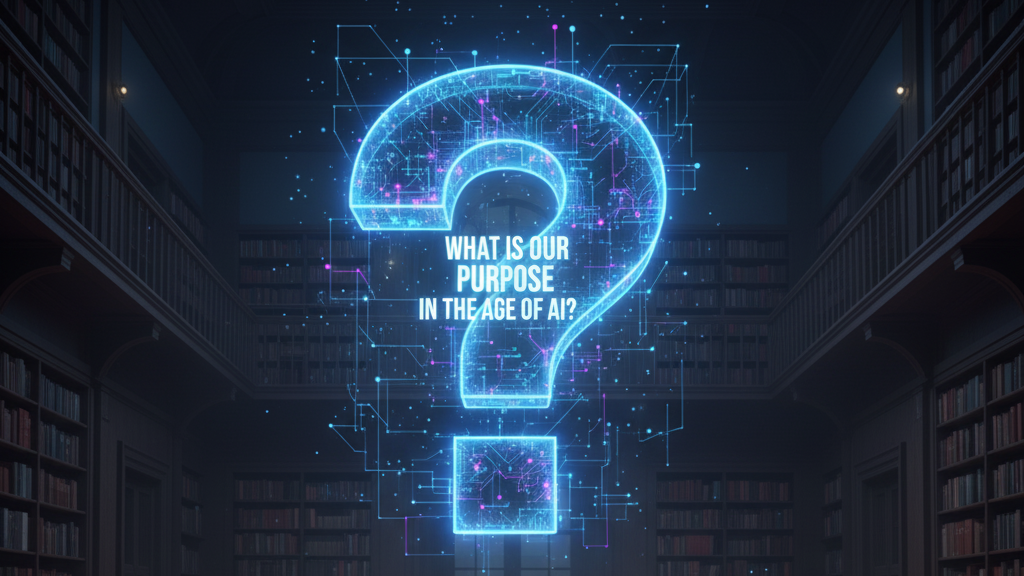
In a grand, traditional university library, a glowing holographic question mark formed from digital circuitry. Inside the question mark, the text reads "WHAT IS OUR PURPOSE IN THE AGE OF AI?". Image (and typos) generated by Nano Banana.
As Artificial Intelligence reshapes industries and societies, colleges and universities are confronted with a fundamental challenge: redefining their core purpose. This image powerfully visualises the critical question that all academic institutions must now address regarding their relevance, value, and role in an increasingly AI-driven world. Image (and typos) generated by Nano Banana.

Source

The Atlantic

Summary

AI is now deeply embedded in college life — often unauthorised — and colleges are struggling with responses. Many institutions fail to enforce coherent, system‑wide policies, risking degradation of learning, peer relationships, and integrity of scholarship. The article suggests radical measures like tech/device bans or stronger honour codes to defend educational values, while teaching responsible AI use where appropriate. Colleges must choose whether to integrate AI or resist it, guided by their core values.

Key Points

  • Unauthorised AI use undermines learning and fairness.
  • Removes opportunities for deep thinking and writing.
  • Institutional goals like originality are compromised by AI’s fabrications and IP issues.
  • Proposals: banning devices, honour codes, strict penalties.
  • Colleges must clarify values and boundaries for AI use.

Keywords

URL

https://www.theatlantic.com/culture/archive/2025/09/ai-colleges-universities-solution/684160/

Summary generated by ChatGPT 5


Social media is teaching children how to use AI. How can teachers keep up?


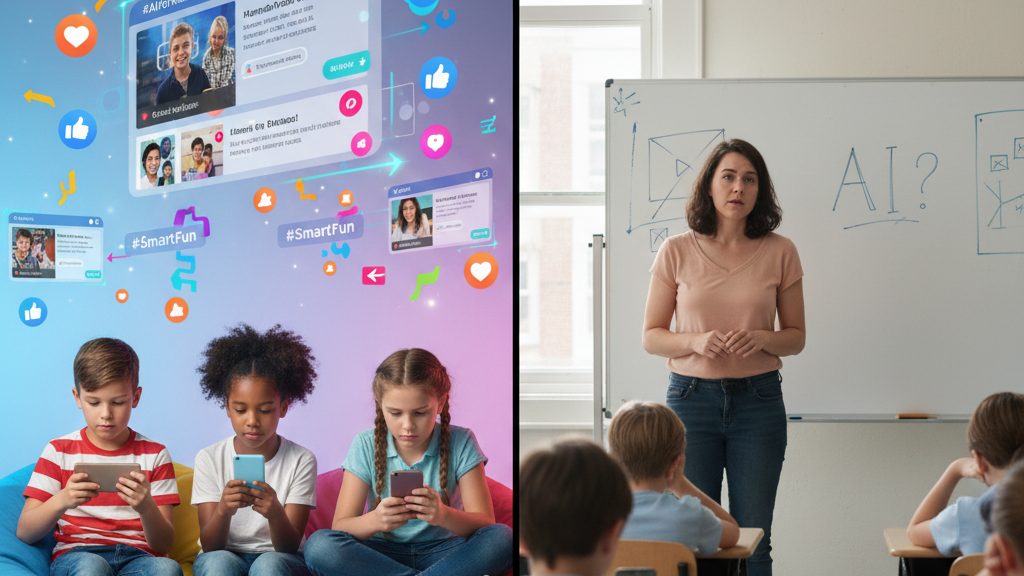
A split image contrasting two scenes. On the left, three young children are engrossed in tablets and smartphones, surrounded by vibrant social media interfaces featuring AI-related content and hashtags like "#AIforkids." On the right, a teacher stands in a traditional classroom looking somewhat perplexed at a whiteboard with "AI?" written on it, while students sit at desks, symbolizing the challenge for educators to keep pace with children's informal AI learning. Image (and typos) generated by Nano Banana.
While children are rapidly learning about AI through pervasive social media platforms, educators face the challenge of integrating this knowledge into formal learning environments. This image highlights the growing disconnect between how children are acquiring AI literacy informally and the efforts teachers must make to bridge this gap and keep classroom instruction relevant and engaging. Image (and typos) generated by Nano Banana.

Source

The Conversation

Summary

Students are learning to use AI mainly through TikTok, Discord, and peer networks, while teachers rely on informal exchanges and LinkedIn. This creates quick but uneven knowledge transfer that often skips deeper issues such as bias, equity, and ethics. A Canadian pilot project showed that structured teacher education transforms enthusiasm into critical AI literacy, giving educators both vocabulary and judgment to integrate AI responsibly. The article stresses that without institutional clarity and professional development, AI adoption risks reinforcing inequity and mistrust.

Key Points

  • Informal learning (TikTok, Discord, staff rooms) drives AI uptake but lacks critical depth.
  • Teacher candidates benefit from structured AI education, gaining language and tools to discuss ethics and bias.
  • Institutional AI policies are fragmented, leaving instructors without support and creating confusion.
  • Equity and bias are central concerns; multilingual learners may be disadvantaged by uncritical AI use.
  • Embedding AI literacy in teacher education and learning communities is critical to move from casual adoption to critical engagement.

Keywords

URL

https://theconversation.com/social-media-is-teaching-children-how-to-use-ai-how-can-teachers-keep-up-264727

Summary generated by ChatGPT 5


Harvard Professors Are Adapting To AI. It’s Time Students Do the Same.


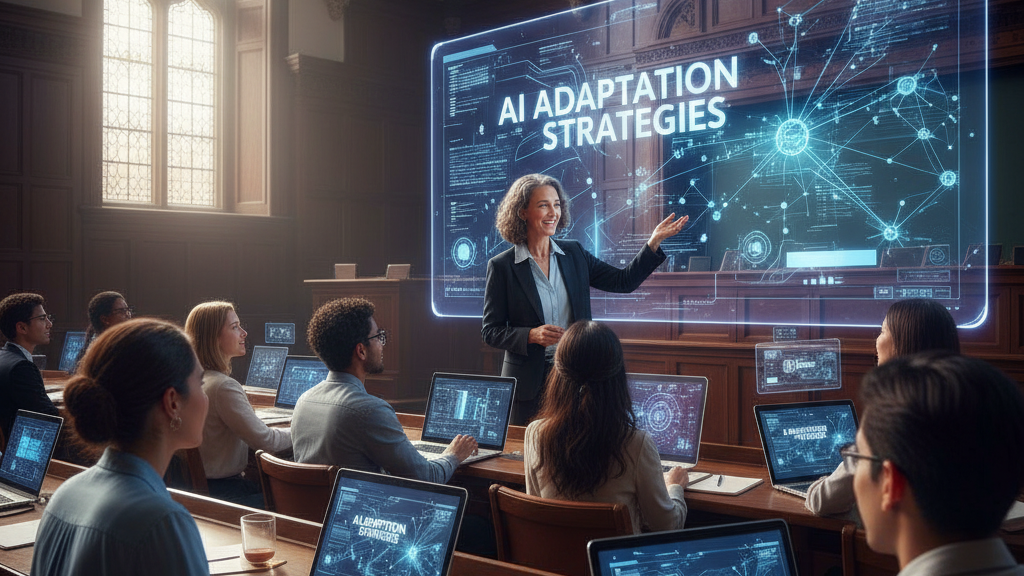
In a collegiate lecture hall, a female professor stands at the front, gesturing towards a large transparent screen displaying "AI ADAPTATION STRATEGIES" and a network of connected digital nodes. Students are seated at wooden desks with laptops, many showing similar AI-related content, actively engaged in learning about AI. Image (and typos) generated by Nano Banana.
As institutions like Harvard embrace and adapt to the integration of AI, the educational landscape is shifting rapidly. This image depicts a professor leading a class on “AI Adaptation Strategies,” underscoring the vital need for students to also acquire the skills and mindset necessary to effectively navigate and utilise artificial intelligence in their academic and future professional lives. Image (and typos) generated by Nano Banana.

Source

The Harvard Crimson

Summary

Harvard professors are moving away from blanket bans on AI and shifting toward nuanced, transparent policies that balance academic integrity with practical realities. Assignments are being redesigned to reduce misuse, and students are urged to treat AI as a tool for learning rather than a shortcut. Success depends on both institutional frameworks and student responsibility.

Key Points

  • 80% of faculty suspect or know AI is used in assignments.
  • Shift from total bans to clearer, nuanced policies.
  • AI often used as shortcut, undermining learning.
  • New assessments: oral exams, group work, AI-use disclosures.
  • Framework success depends on student buy-in.

Keywords

URL

https://www.thecrimson.com/article/2025/9/10/previn-harvard-ai-polocies/

Summary generated by ChatGPT 5


AI Detectors in Education


Source

Associate Professor Mark A. Bassett

Summary

This report critically examines the use of AI text detectors in higher education, questioning their accuracy, fairness, and ethical implications. While institutions often adopt detectors as a visible response to concerns about generative AI in student work, the paper highlights that their statistical metrics (e.g., false positive/negative rates) are largely meaningless in real-world educational contexts. Human- and AI-written text cannot be reliably distinguished, making detector outputs unreliable as evidence. Moreover, reliance on detectors risks reinforcing inequities: students with access to premium AI tools are less likely to be flagged, while others face disproportionate scrutiny.

Bassett argues that AI detectors compromise fairness and transparency in academic integrity processes. Comparisons to metal detectors, smoke alarms, or door locks are dismissed as misleading, since those tools measure objective, physical phenomena with regulated standards, unlike the probabilistic guesswork of AI detectors. The report stresses that detector outputs shift the burden of proof unfairly onto students, often pressuring them into confessions or penalising them based on arbitrary markers like writing style or speed. Instead of doubling down on flawed tools, the focus should be on redesigning assessments, clarifying expectations, and upholding procedural fairness.

Key Points

  • AI detectors appear effective but offer no reliable standard of evidence.
  • Accuracy metrics (TPR, FPR, etc.) are meaningless in practice outside controlled tests.
  • Detectors unfairly target students without addressing systemic integrity issues.
  • Reliance risks inequity: affluent or tech-savvy students can evade detection more easily.
  • Using multiple detectors or comparing student work to AI outputs reinforces bias, not evidence.
  • Analogies to locks, smoke alarms, or metal detectors are misleading and invalid.
  • Procedural fairness demands that institutions—not students—carry the burden of proof.
  • False positives have serious consequences for students, unlike benign fire alarm errors.
  • Deterrence through fear undermines trust and shifts education toward surveillance.
  • Real solutions lie in redesigning assessment practices, not deploying flawed detection tools.

Conclusion

AI detectors are unreliable, unregulated, and ethically problematic as tools for ensuring academic integrity. Rather than treating detector outputs as evidence, institutions should prioritise fairness, transparency, and assessment redesign. Ensuring that students learn and are evaluated equitably requires moving beyond technological quick fixes toward principled, values-based approaches.

Keywords

URL

https://drmarkbassett.com/assets/AI_Detectors_in_education.pdf

Summary generated by ChatGPT 5

How AI Is Changing—Not ‘Killing’—College


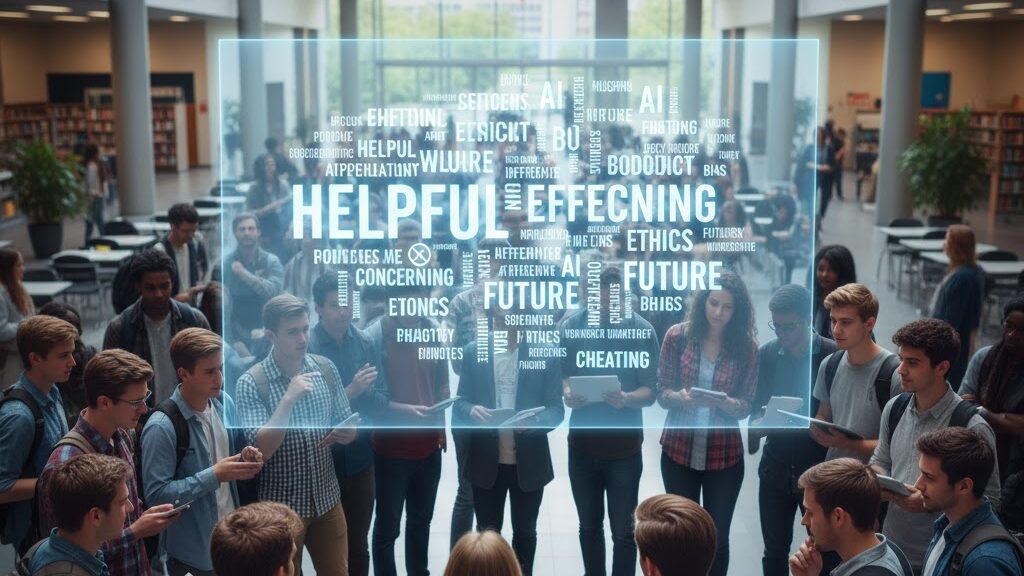
A diverse group of college students is gathered in a modern university library or common area, with some holding tablets or looking at laptops. Above them, a large, glowing word cloud hovers, filled with terms related to artificial intelligence and its impact. Prominent words include "HELPFUL," "FUTURE," "ETHICS," "CHEATING," "BIAS," and "CONCERNING," reflecting a range of student opinions. The overall impression is one of active discussion and varied perspectives on AI. Image (and typos) generated by Nano Banana.
What do the next generation of leaders and innovators think about artificial intelligence? This visual captures the dynamic and often contrasting views of college students on AI’s role in their education, future careers, and daily lives. Image (and typos) generated by Nano Banana.

Source

Inside Higher Ed

Summary

A new Student Voice survey by Inside Higher Ed and Generation Lab captures how U.S. college students are adapting to generative AI in their studies and what they expect from institutions. Of the 1,047 students surveyed, 85 per cent had used AI tools in the past year—mainly for brainstorming, tutoring, and studying—while only a quarter admitted to using them for completing assignments. Most respondents called for universities to provide education on ethical AI use and clearer, standardised policies, rather than policing or banning the technology. Although students are divided about AI’s impact on critical thinking, most agree it can enhance learning if used responsibly. The majority do not view AI as diminishing the value of college; some even see it as increasing it.

Key Points

  • 85 per cent of students have used AI tools for coursework, mainly for brainstorming and study support.
  • 97 per cent want universities to respond to AI’s impact on academic integrity through education, not restriction.
  • Over half say AI has mixed effects on critical thinking; 27 per cent find it enhances learning.
  • Students want institutions to offer professional and ethical AI training, not leave it to individual faculty.
  • Only 18 per cent believe AI reduces the value of college; 23 per cent say it increases it.

Keywords

URL

https://www.insidehighered.com/news/students/academics/2025/08/29/survey-college-students-views-ai

Summary generated by ChatGPT 5