Smarter Classrooms, Real Results: How AI is Rewriting the Rules of Education


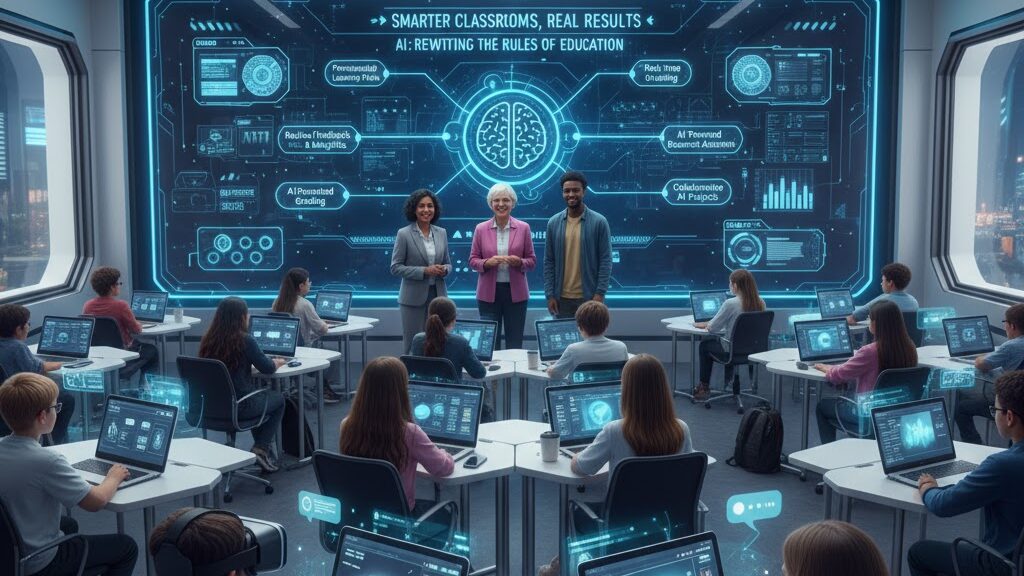
In a sleek, futuristic classroom filled with students using laptops and holographic interfaces, three educators (two female, one male) stand at the front, presenting to the class. A large, interactive screen prominently displays "SMARTER CLASSROOMS, REAL RESULTS: AI IS REWRITING THE RULES OF EDUCATION," featuring a central glowing brain icon surrounded by various AI applications like personalized learning paths, automated grading, and AI-powered assessment. Image (and typos) generated by Nano Banana.
Artificial intelligence is fundamentally “rewriting the rules of education,” ushering in an era of smarter classrooms and demonstrating tangible improvements in learning outcomes. This image envisions a dynamic, technologically advanced educational environment where AI tools enhance every aspect of teaching and learning, from personalised instruction and automated feedback to collaborative projects, ultimately delivering real and measurable results for students. Image (and typos) generated by Nano Banana.

Source

WTOP News

Summary

Will Vitka reports that artificial intelligence is transforming classrooms by saving teachers time, improving accessibility, and offering real-time personalised learning. University of Maryland professor Charles Harry describes AI as a “huge net positive” when used thoughtfully, helping educators create complex, adaptive assignments and enabling students to learn coding and data analysis more quickly. AI tools are also levelling the field for learners with disabilities and multilingual needs. However, privacy, ethical use, and over-reliance remain major concerns. Surveys show one in four teachers believe AI causes more harm than good, underscoring the need for balance between innovation and integrity.

Key Points

  • AI personalises learning and provides real-time academic feedback for students.
  • Educators using AI save up to six hours per week on administrative tasks.
  • Accessibility improves through tools like translation and voice-to-text.
  • Ethical concerns persist around cheating and student data privacy.
  • The global AI-in-education market could reach $90 billion by 2032.

Keywords

URL

https://wtop.com/education/2025/10/smarter-classrooms-real-results-how-ai-is-rewriting-the-rules-of-education/

Summary generated by ChatGPT 5


Schools in Wales ‘excited but wary’ as teacher workloads cut


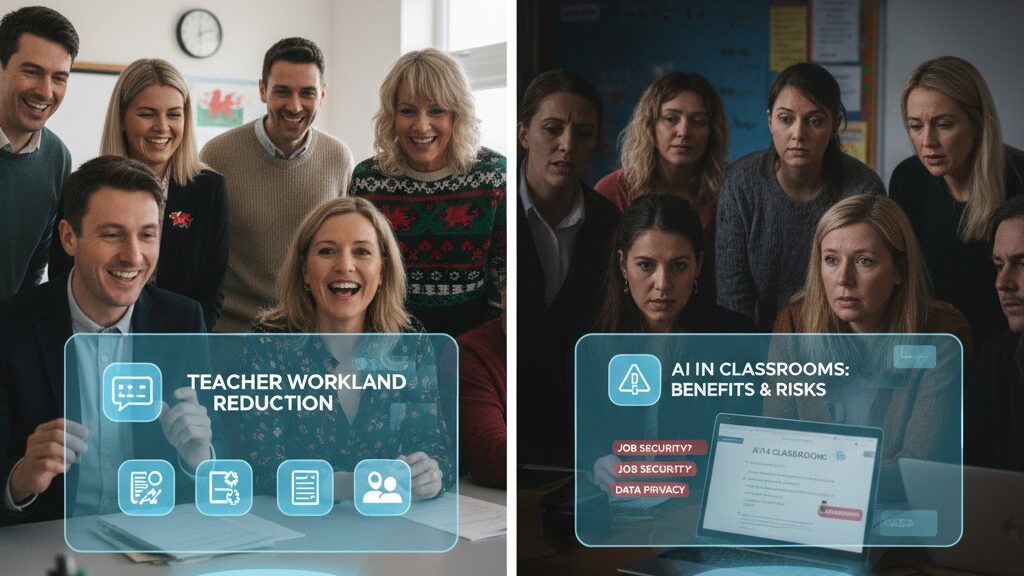
A split image contrasting two emotional responses to AI in Welsh schools. On the left, a group of smiling, happy teachers stands around a table with a glowing holographic display showing "TEACHER WORKLOAD REDUCTION" and icons representing administrative tasks, symbolizing excitement. On the right, a group of wary, concerned teachers huddle around a laptop displaying "AI IN CLASSROOMS: BENEFITS & RISKS," with text highlighting "JOB SECURITY?" and "DATA PRIVACY," reflecting their apprehension. The Welsh flag is visible in the background on the left. Image (and typos) generated by Nano Banana.
As artificial intelligence begins to reduce teacher workloads in schools across Wales, educators are experiencing a mix of excitement for the potential benefits and apprehension about the unseen challenges. This image vividly contrasts the initial relief of reduced administrative burdens with the underlying worries about job security, data privacy, and the broader impact of AI on the educational landscape. Image (and typos) generated by Nano Banana.

Source

BBC News

Summary

A new report by Estyn, Wales’s education watchdog, finds that while artificial intelligence is helping teachers save time and reduce administrative workloads, schools remain cautious about its classroom use. Many Welsh teachers now use AI for lesson planning, report writing and tailoring resources for students with additional needs. However, concerns persist around plagiarism, over-reliance, and data ethics. At Birchgrove Comprehensive School in Swansea, staff are teaching pupils to use AI responsibly, balancing innovation with digital literacy. Estyn and the Welsh government both emphasise the need for national guidance and training to ensure AI enhances learning without undermining skills or safety.

Key Points

  • AI is reducing teacher workloads by automating planning and reporting tasks.
  • Estyn warns that schools need clearer guidance for ethical and safe AI use.
  • Pupils are using AI for revision and learning support, often with teacher oversight.
  • Staff report excitement about AI’s potential but remain wary of bias and misuse.
  • The Welsh government has committed to training and national policy development.

Keywords

URL

https://www.bbc.com/news/articles/c0lkdxpz0dyo

Summary generated by ChatGPT 5