AI in School Affects Pupils’ Ability to Create Original Work, Report Finds


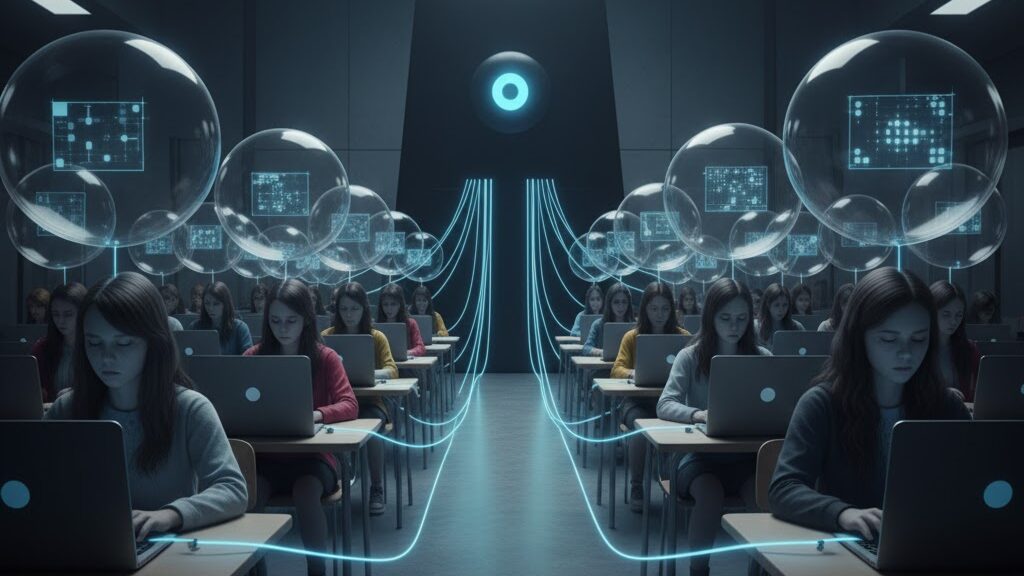
A dimly lit, futuristic classroom with rows of young students, predominantly girls, seated at individual desks, each intensely focused on an open laptop. Above each student's head, a clear, transparent bubble contains glowing digital circuitry and data, symbolizing ideas or creativity. These bubbles are connected by glowing blue lines that lead back to a large, imposing, glowing blue eye or orb on a dark monolith at the front of the classroom, suggesting a central AI influence. The students appear subdued and uniform. Image (and typos) generated by Nano Banana.
A concerning new report indicates that the increasing integration of AI in schools may be diminishing students’ capacity for original thought and creative work. This image visualizes the potential impact, raising questions about how technology might inadvertently hinder the development of essential human skills. Image (and typos) generated by Nano Banana.

Source

The Stage

Summary

A new Oxford University Press report warns that secondary school students in the UK fear artificial intelligence is limiting their creativity and originality. The study found that 80 per cent of pupils aged 13 to 18 use AI regularly for schoolwork, and while 90 per cent said it has helped them develop at least one skill, many expressed concern that it encourages imitation rather than innovation. Sixty per cent reported that AI makes them more likely to copy existing content, while 12 per cent said it hinders creative thinking and writing. Over half also feared AI tools reinforce biased or inaccurate stereotypes. The Writers’ Guild of Great Britain has called on schools and government to protect young people’s creative development and critical independence in the classroom.

Key Points

  • 80 per cent of pupils regularly use AI for schoolwork; only 2 per cent have never used it.
  • 60 per cent say AI encourages imitation and reduces originality.
  • 12 per cent believe AI negatively affects their creative thinking and writing.
  • 51 per cent worry AI tools reinforce bias and untrue stereotypes.
  • The Writers’ Guild urges policies to safeguard creativity and human-centred learning.

Keywords

URL

https://www.thestage.co.uk/news/ai-in-school-affects-pupils-ability-to-create-original-work-report

Summary generated by ChatGPT 5


Pupils Fear AI Is Eroding Their Ability to Study, Research Finds


Four serious-looking teenage students (two boys, two girls) are seated across from each other at a long table in a library setting, each with an open laptop in front of them. Glowing, ethereal representations of open books made of data and digital information hover above their laptops, subtly connecting them to the screens. Their expressions convey concern and perhaps a touch of apprehension as they look directly at the viewer. The background features bookshelves, typical of a library or study area. Image (and typos) generated by Nano Banana.
A new study reveals that students are increasingly concerned about how artificial intelligence might be undermining their foundational study and research abilities. Explore the findings that confirm pupils’ fears about AI’s impact on learning. Image (and typos) generated by Nano Banana.

Source

The Guardian

Summary

A study commissioned by Oxford University Press (OUP) reveals that students across the UK increasingly worry that artificial intelligence is weakening their study habits, creativity, and motivation to learn. The report, Teaching the AI Native Generation, found that 98 per cent of pupils aged 13 to 18 use AI for schoolwork, with 80 per cent relying on it regularly. Many described AI as making tasks “too easy” and limiting their independent thinking. While students recognise its usefulness, they also express concern about overreliance and skill erosion. The findings highlight the urgent need for balanced AI education strategies that promote critical thinking, ethical awareness, and human creativity alongside digital competence.

Key Points

  • 98 per cent of UK secondary pupils use AI for schoolwork, most on a regular basis.
  • Many pupils say AI tools make studying too easy and reduce creativity.
  • Concerns are growing about AI’s impact on independent learning and problem-solving.
  • The study urges educators to develop frameworks for responsible, balanced AI use.
  • OUP calls for schools to integrate AI literacy into teaching while safeguarding learning depth.

Keywords

URL

https://www.theguardian.com/technology/2025/oct/15/pupils-fear-ai-eroding-study-ability-research

Summary generated by ChatGPT 5