AI Won’t Replace Teachers—but Teachers Who Use AI Will Change Teaching


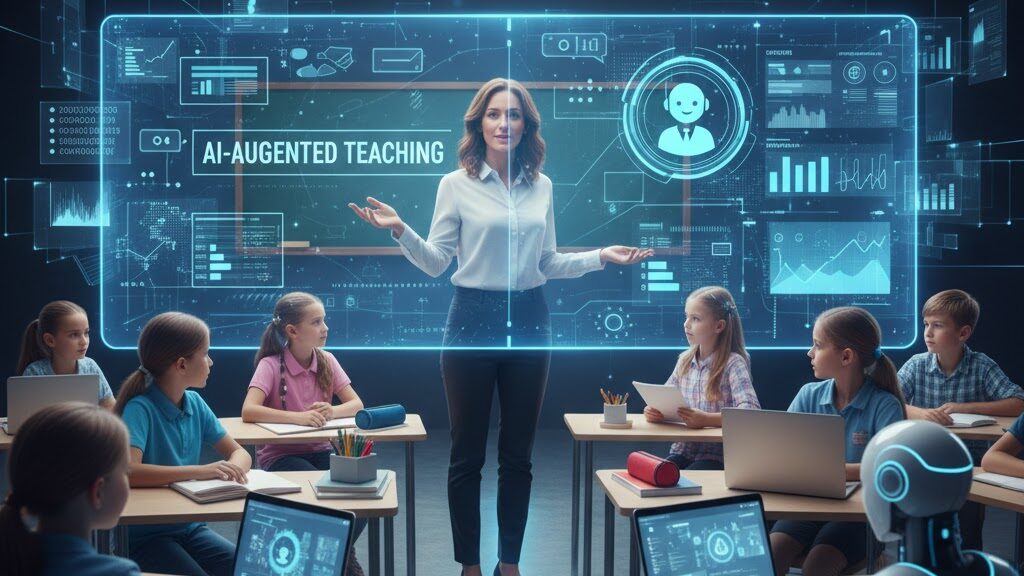
A female teacher stands confidently at the front of a modern classroom, gesturing towards a large, glowing holographic screen behind her that displays "AI-AUGMENTED TEACHING" along with various educational data, student profiles, and analytical charts. Rows of elementary school students are seated at desks, each engaged with a laptop. In the foreground to the right, a sleek, white humanoid robot is also seated at a desk, looking towards the teacher, symbolizing AI as a supportive tool rather than a replacement. The classroom is neat and well-lit. Image (and typos) generated by Nano Banana.
While the fear of AI replacing educators is prevalent, the reality is more nuanced: AI is set to empower teachers. This image illustrates how educators who embrace and integrate AI tools will fundamentally transform teaching methodologies, enhancing learning experiences rather than being superseded by technology. Image (and typos) generated by Nano Banana.

Source

Education Week

Summary

Ingrid Guerra-López argues that artificial intelligence will not replace teachers but will transform how they teach, provided educators engage with the technology thoughtfully and ethically. While AI can automate lesson planning, grading, and data organisation, Guerra-López emphasises that these efficiencies should enhance—not replace—teachers’ human judgment, empathy, and creativity. Drawing on research from RAND and the National Center for Education Statistics, she notes that teachers spend nearly ten hours a week on planning and administrative work—time AI could help recover for more meaningful teaching. However, without proper preparation and professional development, AI risks becoming another underused classroom innovation. Guerra-López calls for investment in AI literacy within teacher training and ongoing professional learning communities to ensure technology integration supports instructional quality and student engagement.

Key Points

  • AI can streamline routine teaching tasks, freeing time for deeper instructional work.
  • Educators remain essential for providing human connection, judgment, and mentorship.
  • Teacher-preparation programmes must include AI training and reflective practice.
  • Schools should create professional learning networks to support responsible AI use.
  • The goal is not to outsource thinking to AI but to use it as a scaffold for learning.
  • Failing to adapt risks both inefficiency and missed opportunities for innovation.

Keywords

URL

https://www.edweek.org/technology/opinion-ai-wont-replace-teachers-but-teachers-who-use-ai-will-change-teaching/2025/10

Summary generated by ChatGPT 5


AI in School Affects Pupils’ Ability to Create Original Work, Report Finds


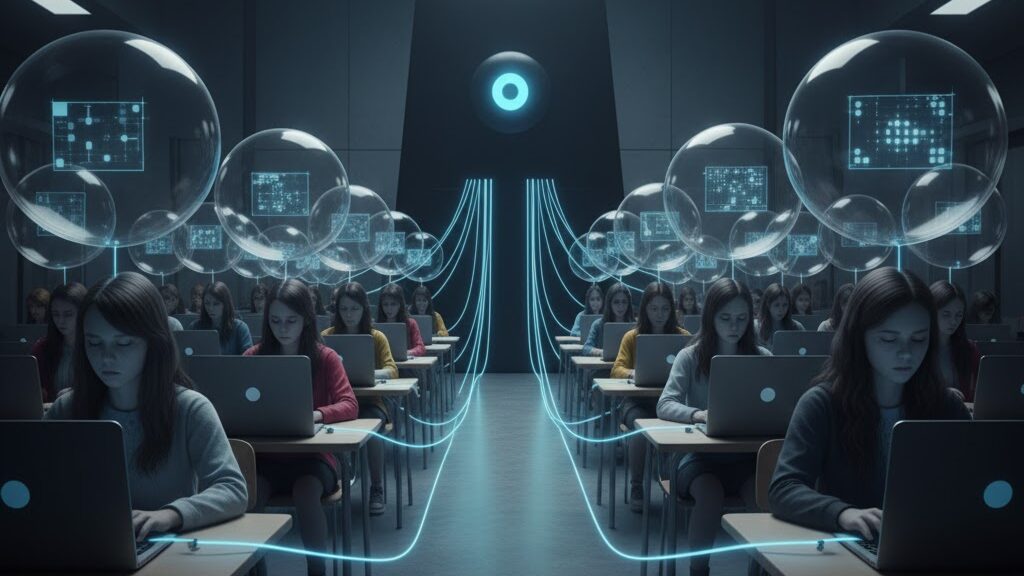
A dimly lit, futuristic classroom with rows of young students, predominantly girls, seated at individual desks, each intensely focused on an open laptop. Above each student's head, a clear, transparent bubble contains glowing digital circuitry and data, symbolizing ideas or creativity. These bubbles are connected by glowing blue lines that lead back to a large, imposing, glowing blue eye or orb on a dark monolith at the front of the classroom, suggesting a central AI influence. The students appear subdued and uniform. Image (and typos) generated by Nano Banana.
A concerning new report indicates that the increasing integration of AI in schools may be diminishing students’ capacity for original thought and creative work. This image visualizes the potential impact, raising questions about how technology might inadvertently hinder the development of essential human skills. Image (and typos) generated by Nano Banana.

Source

The Stage

Summary

A new Oxford University Press report warns that secondary school students in the UK fear artificial intelligence is limiting their creativity and originality. The study found that 80 per cent of pupils aged 13 to 18 use AI regularly for schoolwork, and while 90 per cent said it has helped them develop at least one skill, many expressed concern that it encourages imitation rather than innovation. Sixty per cent reported that AI makes them more likely to copy existing content, while 12 per cent said it hinders creative thinking and writing. Over half also feared AI tools reinforce biased or inaccurate stereotypes. The Writers’ Guild of Great Britain has called on schools and government to protect young people’s creative development and critical independence in the classroom.

Key Points

  • 80 per cent of pupils regularly use AI for schoolwork; only 2 per cent have never used it.
  • 60 per cent say AI encourages imitation and reduces originality.
  • 12 per cent believe AI negatively affects their creative thinking and writing.
  • 51 per cent worry AI tools reinforce bias and untrue stereotypes.
  • The Writers’ Guild urges policies to safeguard creativity and human-centred learning.

Keywords

URL

https://www.thestage.co.uk/news/ai-in-school-affects-pupils-ability-to-create-original-work-report

Summary generated by ChatGPT 5


AI and the Future of Universities


Source

Higher Education Policy Institute (HEPI), October 2025

Summary

This collection of essays explores how artificial intelligence—particularly generative AI (GenAI)—is reshaping the university sector across teaching, research, and administration. Contributors, including Dame Wendy Hall, Vinton Cerf, Rose Luckin, and others, argue that AI represents a profound structural shift rather than a passing technological wave. The report emphasises that universities must respond strategically, ethically, and holistically: developing AI literacy among staff and students, redesigning assessment, and embedding responsible innovation into governance and institutional strategy.

AI is portrayed as both a disruptive and creative force. It automates administrative processes, accelerates research, and transforms strategy-making, while simultaneously challenging ideas of authorship, assessment, and academic integrity. Luckin and others call for universities to foster uniquely human capacities—critical thinking, creativity, emotional intelligence, and metacognition—so that AI augments rather than replaces human intellect. Across the essays, there is strong consensus that AI literacy, ethical governance, and institutional agility are vital if universities are to remain credible and relevant in the AI era.

Key Points

  • AI literacy is now essential for all staff and students.
  • GenAI challenges traditional assessment and integrity systems.
  • Universities must act quickly but ethically in AI integration.
  • Professional services can achieve major efficiency gains through AI.
  • AI enables real-time strategy analysis and forecasting.
  • AI literacy must extend to leadership and governance structures.
  • Human intelligence—creativity, criticality, empathy—remains central.
  • Ethical frameworks and transparency are essential for trust.
  • Data maturity and infrastructure underpin successful adoption.
  • Collaboration across disciplines and sectors will shape sustainable change.

Conclusion

The report concludes that AI will redefine the university’s purpose, requiring institutions to shift from reactive adaptation to active leadership in shaping the AI future. The challenge is not simply to use AI but to ensure it strengthens human intelligence, academic integrity, and social purpose in higher education.

Keywords

URL

https://www.hepi.ac.uk/reports/right-here-right-now-new-report-on-how-ai-is-transforming-higher-education/

Summary generated by ChatGPT 5


‘Urgent Need’ for More AI Literacy in Higher Education, Report Says


An aerial, wide shot of a large, circular university lecture hall filled with many students seated at desks, all looking towards a prominent stage and screen at the front. A powerful spotlight shines onto the empty stage. Above the students and emanating from the screen, a dense network of glowing digital lines, icons, and data points fills the air, representing AI and digital information. Below the central spotlight, floating holographic icons labeled "AI KNOWLEDGE" and "DIGITAL SKILLS" are prominently displayed, emphasizing the core concepts. Image (and typos) generated by Nano Banana.
A recent report highlights the critical need for increased AI literacy across higher education institutions. As technology rapidly advances, universities face an urgent challenge to equip students with the essential knowledge and digital skills required for an AI-driven future. Image (and typos) generated by Nano Banana.

Source

Research Professional News

Summary

A new report from the Higher Education Policy Institute warns that British universities must urgently improve AI literacy among both staff and students to stay relevant and equitable in an era of rapid digital transformation. Co-authored by Professor Wendy Hall and Giles Carden of the University of Southampton, the report argues that universities can no longer afford to simply “acknowledge AI’s presence” and must adopt structured strategies for skills development, teaching innovation, and research support. It highlights growing digital divides across gender, income, and subject disciplines. Contributions include a chapter written by ChatGPT itself, advocating AI training within doctoral and staff development programmes, and cautioning against uneven capability across institutions. The report also predicts that AI adoption could lead to job reductions in professional services as universities seek financial efficiencies.

Key Points

  • The Higher Education Policy Institute calls for systemic AI literacy across the UK university sector.
  • Experts stress active engagement and structured upskilling, not passive awareness.
  • Digital divides linked to gender, wealth, and discipline risk deepening inequality.
  • ChatGPT’s own chapter recommends integrating AI training into research and doctoral curricula.
  • Financial pressures may drive automation and staff cuts in professional services.

Keywords

URL

https://www.researchprofessionalnews.com/rr-news-uk-universities-2025-10-urgent-need-for-more-ai-literacy-in-higher-education-report-says/

Summary generated by ChatGPT 5